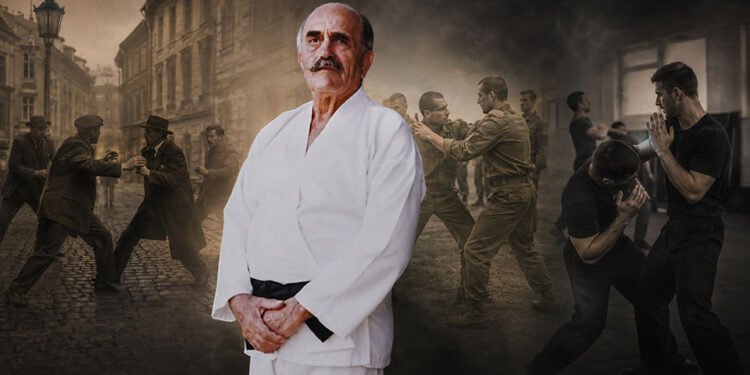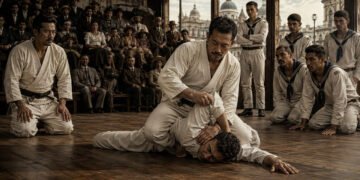
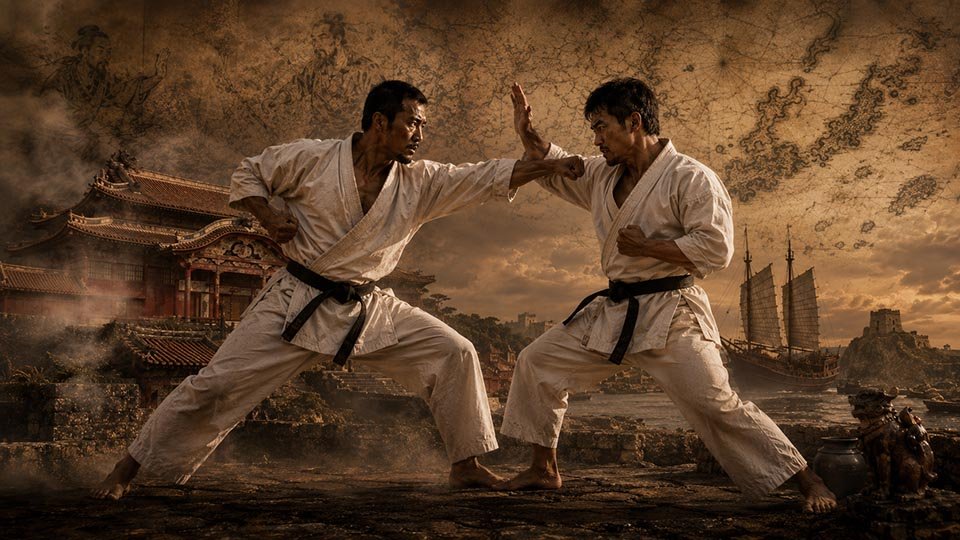
Karate came from Okinawa, but geography alone does not explain its origin. The martial art emerged from Ryukyuan fighting practices shaped by political change, maritime trade and sustained contact with Chinese martial traditions.
Ask where karate came from and the shortest answer is Okinawa.
The more accurate answer begins before Okinawa was a Japanese prefecture, before Shotokan or Goju-ryu existed, and long before white uniforms and colored belts became part of training.
Karate developed in the Ryukyu Kingdom, the independent island state that occupied much of what is now Okinawa Prefecture. Its earliest roots are connected to an indigenous fighting practice called Ti or Te, meaning “hand.” That method evolved inside a society whose ships, officials and merchants maintained extensive contact with China and other parts of Asia.
There was no single founder. No surviving record identifies one day when karate was invented. Even the official Okinawa account of karate’s origins states that its exact beginning was not recorded, while placing Ti at the center of its early development.
Karate was built gradually.
Understanding where it came from therefore requires looking beyond Japan and into the political world of Ryukyu.
Karate Came From the Ryukyu Kingdom
Between 1429 and 1879, Okinawa stood at the center of the Ryukyu Kingdom, a state with its royal court at Shuri.
Its geography mattered.
Ryukyu sat between China, the Japanese archipelago and Southeast Asia. Naha developed as a major port, while Shuri became the political center of the kingdom. Goods passed through these islands, but so did languages, administrative practices, religious ideas, technology and physical skills.
Okinawa Prefecture’s account of Ryukyuan history and culture describes the kingdom as a transit trading state connected to Japan, China and Southeast Asia. Naha Port became particularly important after the political center shifted to Shuri.
This matters because karate did not develop in an isolated island society.
Its early environment was international.
The official Okinawa karate portal describes the older Ryukyuan art of Te as something systematized through cultural exchange with neighboring countries.
That relationship between local practice and outside influence sits at the heart of karate’s origin.
Before Karate, There Was Ti
Modern practitioners may think immediately of punches, blocks, kicks and kata when they hear the word karate.
Early Ryukyuan practice was not organized through the same standardized framework.
The older term was Ti, also rendered Te in Japanese transliteration. Both refer to “hand.”
According to Okinawa’s official historical presentation, Ti was already present during the Ryukyu Kingdom era and flourished particularly under King Shō Shin, who ruled from 1477 to 1526. Members of the ruling classes from different parts of the islands lived around Shuri, helping concentrate martial knowledge in the royal capital.
The practice described in early karate histories was broader than the long-range punching and kicking commonly associated with some modern competition formats.
It included percussive strikes alongside seizing, joint manipulation and close-range control. Terms such as torite or tuite became associated with gripping and manipulating an opponent rather than simply exchanging blows.
That does not mean one standardized system called Ti existed throughout the kingdom.
Quite the opposite.
Instruction moved through teachers, families and social networks. Different practitioners developed their own methods, while geography produced recognizable variations.
Karate’s earliest form was therefore less like a modern international style and more like a collection of connected Ryukyuan fighting traditions.
The Peasant-Rebellion Story Is Too Simple
One of the most repeated karate origin stories begins with Okinawan farmers.
In this version, rulers confiscated weapons, leaving ordinary people defenseless. Peasants then secretly created karate to resist sword-carrying samurai and converted agricultural tools into kobudō weapons.
The political restrictions were real enough to become part of Okinawan martial memory. What is difficult to sustain is the idea that they explain karate by themselves.
Okinawa’s official account places Ti among members of the ruling classes, while the island’s karate heritage portal describes Shuri’s Suidii tradition as being transmitted among Ryukyuan Samurē, the kingdom’s warrior class.
That makes a purely peasant origin difficult to reconcile with the social setting in which much of the early practice was preserved.
The distinction matters.
It does not require pretending that ordinary Okinawans never fought, trained or handled weapons. It means the development of a sophisticated martial tradition cannot be reduced to a single story of farmers improvising against Japanese swordsmen.
Karate emerged within a much larger political and cultural system.
China Changed the Equation
The Chinese connection predates modern karate by centuries.
In 1372, Satto, ruler of Chūzan, established tributary relations with Ming China. The relationship opened sustained diplomatic and commercial movement between the Ryukyu Islands and the Chinese mainland.
A particularly important community emerged near Naha.
Around the late 14th century, Chinese families from Fujian settled in Kumemura, close to the kingdom’s major port. Okinawa Prefecture records the community traditionally known as the 36 Min families, whose members became involved in diplomacy and exerted influence across Ryukyuan politics, economics and culture.
It would be too simple to say those families “brought karate” to Okinawa.
Karate did not exist yet in the form now recognized under that name.
What Kumemura demonstrates is something more important: sustained Chinese presence was embedded in Ryukyuan society.
Officials traveled. Students studied abroad. Diplomatic missions crossed the sea. Chinese investiture delegations stayed in the kingdom. Technical knowledge had repeated opportunities to move in both directions.
Martial practice was part of that wider exchange.
Fujian Became a Critical Martial Connection
Southern China, particularly Fujian Province, occupies an important place in the development of Okinawan fighting systems.
Ryukyuan travelers went to Fuzhou, while Chinese visitors arrived in Okinawa. Over time, methods associated with southern Chinese boxing entered local martial networks.
The influences described in karate history include systems connected with Fujian White Crane, Five Ancestors Boxing, Luohan methods and other southern traditions. Their precise contribution to every kata or lineage is not always traceable, and later oral histories sometimes make cleaner connections than surviving evidence permits.
What can be established more securely is the broader pattern: Ryukyuan Te did not develop without Chinese contact.
Okinawa’s own karate heritage presentation explicitly treats Te as a Ryukyuan martial art that was systematized through interaction with neighboring cultures. The same account identifies Kanbun Uechi’s later training in Fuzhou as the foundation of what became Uechi-ryu.
The relationship was not one-way copying.
Local practitioners absorbed foreign methods into an existing Okinawan environment.
That distinction helps explain why karate is neither simply Chinese boxing under a Japanese name nor an entirely isolated Okinawan invention.
It is a Ryukyuan synthesis.
The Bubishi Shows How Deep the Chinese Connection Ran
One artifact makes that relationship particularly visible: the Bubishi.
Hand-copied versions of the martial and medical text circulated among prominent Okinawan practitioners before karate was organized into modern schools.
Its material included fighting principles, anatomical targets, traditional treatments and concepts associated with southern Chinese martial practice, particularly Fujian traditions.
The Bubishi was not a universal syllabus followed by every Okinawan instructor.
Its importance lies elsewhere.
It demonstrates that some of the people involved in karate’s development were engaging with a body of technical knowledge that extended far beyond striking combinations. Fighting methods sat beside ideas about anatomy, health, strategy and physical cultivation.
Chinese influence was therefore not limited to one imported kick or a borrowed kata.
It reached into the intellectual framework surrounding martial training.
Political Unification Changed the Martial Landscape
In 1429, Shō Hashi unified the competing Okinawan principalities of Chūzan, Hokuzan and Nanzan.
Shuri became the kingdom’s political center.
Okinawa Prefecture records how that consolidation shifted the royal capital and helped establish Naha as the kingdom’s principal commercial gateway.
Later, during the reign of Shō Shin, regional elites were drawn toward the capital as royal authority became increasingly centralized.
That movement had consequences for martial transmission.
People who previously belonged to separate local political centers were now operating within the same royal environment. Ti could circulate through administrative, security and aristocratic networks concentrated around Shuri.
This helps explain why the capital became one of the principal centers of Okinawan martial development.
Yet Shuri did not produce the only version.
Naha and Tomari developed their own traditions.
Then Came the Satsuma Invasion
Another major political break arrived in 1609.
Forces from the Japanese Satsuma Domain, controlled by the Shimazu clan, invaded the Ryukyu Kingdom. The kingdom survived as a political entity, but Satsuma imposed external control while Ryukyu continued its relationship with China.
The invasion is central to many karate histories because restrictions were placed on the carrying of weapons.
The official Okinawa history of karate connects this period with the continued development of Ti toward forms recognizable as karate.
But weapons restrictions should not be treated as a magical starting point.
Unarmed methods existed before 1609. Chinese contact had already been underway for generations. Elite martial networks were already present.
Satsuma rule changed the conditions under which those practices continued.
It did not create them from nothing.
That difference separates political context from origin mythology.
Shuri, Naha and Tomari Produced Different Traditions
By the 18th and 19th centuries, Okinawan martial practice had developed recognizable regional branches.
The best-known were centered in Shuri, Naha and Tomari.
English-language histories usually call them Shuri-te, Naha-te and Tomari-te. Okinawa’s contemporary heritage institutions also preserve the Okinawan readings Suidii, Naafa-dii and Tumai-dii.
These were not “styles” in the modern sense of organizations with logos, headquarters, grading requirements and standardized international curricula.
They were lineages associated with different communities.
Shuri-te
Shuri was the royal capital.
Its martial tradition was connected with royal retainers and the kingdom’s warrior class. Later figures associated with this branch included Sakugawa Kanga, Matsumura Sōkon and Ankō Itosu.
The technical profile became known for direct movement, mobility and decisive striking.
Modern Shorin-ryu traditions grew substantially from this lineage, while Shuri-te also fed into the development of Shotokan and Shito-ryu.
Naha-te
Naha operated in a different environment.
As the kingdom’s commercial port, it maintained especially close contact with overseas visitors and Chinese culture.
Naha-te became associated with rooted movement, circular defensive mechanics, close-range engagement and structured breathing. Higaonna Kanryō, whose martial development included training in Fuzhou, became one of its central figures.
His student Chōjun Miyagi later organized the lineage that became Goju-ryu.
Tomari-te
Tomari was another maritime community.
Its traditions are linked with teachers including Matsumora Kōsaku and Oyadomari Kōkan. Later descriptions associate Tomari-te with evasive angling, changes of position and close-range controlling methods.
A contemporary Okinawan karate history still separates Shuri-te, Naha-te and Tomari-te by their historical centers, while Okinawa’s official karate institutions group the traditions into the same broader heritage.
Their existence tells us something essential about karate’s origin.
There was never just one original karate.
From Te to Tōde
As Chinese methods became increasingly integrated into Okinawan practice, another term gained importance: Tōde.
The first character, 唐, referred to Tang China and carried a wider association with things Chinese. Tōde can therefore be rendered as “China Hand” or “Tang Hand.”
That name makes the cultural relationship difficult to miss.
It also shows why the history of karate cannot be explained solely through Japanese Budō.
The modern characters 空手, meaning “Empty Hand,” belong to a later stage of development. Their adoption became part of karate’s modernization and integration into mainland Japan during the 20th century.
By then, the underlying Okinawan traditions had already existed for generations.
The art did not originate when the name changed.
The name changed because the art had entered another political and cultural environment.
Modern Karate Came Later
The karate recognized today — formal styles, school curricula, karategi, colored belts, dan rankings and international organizations — is largely a product of later modernization.
Ankō Itosu helped move karate into Okinawan education around the beginning of the 20th century.
Gichin Funakoshi brought the discipline to a wider mainland Japanese audience, most notably through his 1922 Tokyo demonstration.
Other teachers, including Chōjun Miyagi and Kenwa Mabuni, developed systems that became major modern lineages.
Okinawa’s official karate portal traces exactly this progression: Te developed during the Ryukyu Kingdom era, entered school education through Itosu and his students, and then spread more widely in mainland Japan through figures such as Funakoshi, Mabuni and Miyagi.
That chapter explains how karate became modern.
It does not explain where karate originally came from.
For that, the story has to return to Ryukyu.
So, Where Did Karate Come From?
Karate came from Okinawa, but it originated in an Okinawa that belonged to the Ryukyu Kingdom rather than the modern Japanese prefecture most people know today.
Its foundation was Ti, an indigenous Ryukyuan fighting tradition.
Its development was shaped by the kingdom’s political elite, particularly around Shuri.
Its technical vocabulary changed through sustained contact with China, especially Fujian.
Its regional branches developed around Shuri, Naha and Tomari.
Political centralization, weapons regulation and Satsuma domination altered the conditions surrounding training, but none provides a credible single-point explanation for karate’s birth.
Later teachers would reform it.
Japan would institutionalize it.
International organizations would turn parts of it into sport.
Different masters would build Shotokan, Goju-ryu, Shito-ryu, Wado-ryu, Uechi-ryu and other systems from overlapping inheritances.
Those developments came after the foundation had already been laid.
Karate’s origin is therefore not a story about one founder discovering an empty-hand fighting system.
It is the history of a small maritime kingdom where local combative practice met foreign influence, political change and generations of individual transmission.
Karate came from Ryukyu.
Okinawa gave it its body.
Asia helped shape what that body could do.