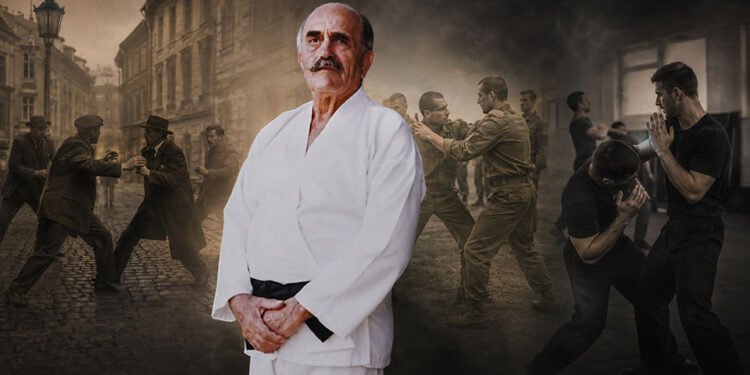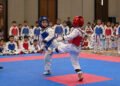
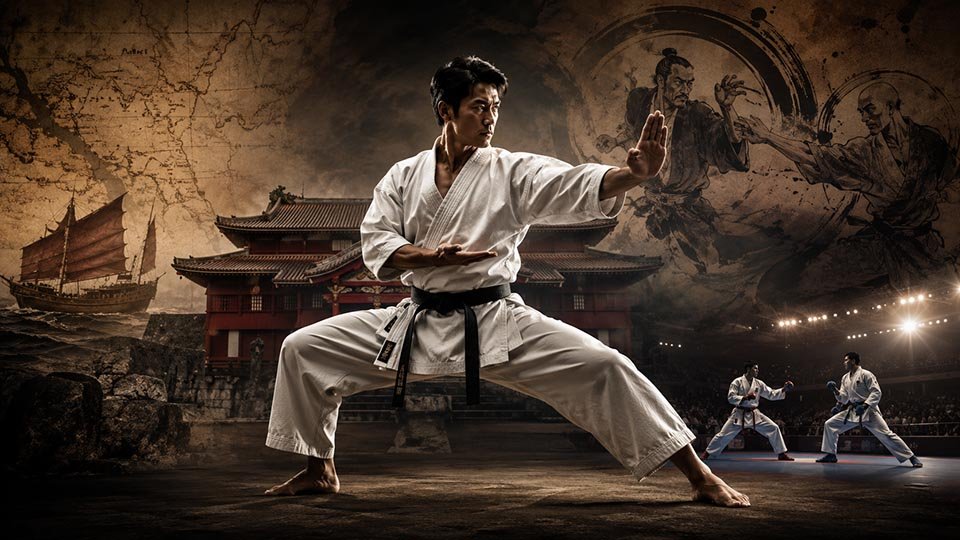
Karate did not begin as a Japanese school system, Olympic discipline or collection of fixed styles. Its history runs through the Ryukyu Kingdom, Chinese martial exchange, Okinawan fighting traditions, Japanese modernization and competing ideas about what Karate should become.
Karate has no single founder and no documented moment of invention.
Its history begins instead in the Ryukyu Islands, where an indigenous fighting practice developed inside a maritime kingdom positioned between larger Asian powers. What eventually became karate absorbed techniques, training methods and ideas from outside Okinawa, changed as the Ryukyuan political order disappeared, entered public education, moved to mainland Japan and then fractured into distinct styles and competitive systems.
That history matters because modern karate can look radically different depending on where it is practiced. A Goju-ryu practitioner working through Sanchin, a Shotokan competitor fighting at long range, a Kyokushin athlete trading full-contact body punches and low kicks, and a WKF karateka chasing a three-point head kick can all claim karate as their discipline.
The differences are not accidents. They are products of karate’s repeated reconstruction.
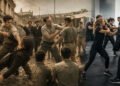
The official Okinawa tourism history of karate describes the art as closely connected to ti, an older Okinawan method of self-defense whose precise beginnings were never recorded. Rather than emerging fully formed, karate developed over centuries as Okinawa absorbed martial influences through trade and political contact.
Before Karate, There Was Ti
For much of its history, Okinawa was not simply a remote Japanese island.
From 1429 until its formal incorporation into the Japanese state in 1879, the Ryukyu Kingdom occupied a strategic position in the East China Sea. Its ships and diplomatic missions connected the islands with China, Japan, Korea and Southeast Asia. That commercial network moved ceramics, textiles and luxury goods, but it also moved people, knowledge and physical practices.
Within that environment existed an Okinawan fighting method commonly identified as Ti or Te, meaning “hand.”
The tradition was associated particularly with members of the Ryukyuan ruling and warrior classes rather than an organized mass movement among agricultural peasants. Official Okinawan historical material describes Ti as being practiced among the kingdom’s warrior class and later concentrated around Shuri, where members of the governing elite lived.
This distinction challenges one of karate’s most persistent origin stories: that unarmed farmers invented the art because Japanese rulers confiscated their weapons.
Weapons restrictions belong to the political history of Ryukyu, including policies under the kingdom and restrictions following the 1609 Satsuma invasion. Yet turning those measures into a simple chain — peasants lose weapons, peasants invent karate — removes the social networks through which sophisticated martial knowledge was actually transmitted.
Karate grew through elite practice, local experimentation and foreign exchange. Disarmament may have shaped the environment, but it does not adequately explain the art by itself. The surviving history does not support a single act of invention by an oppressed peasant population.
China Was Part of the Equation
Ryukyu’s relationship with China gave Okinawan fighting methods access to another technical world.
Formal tributary relations with Ming China began in the 14th century. Diplomatic delegations traveled between the two states, while Chinese specialists established communities in Okinawa. Fujian, particularly the port city of Fuzhou, became important to later karate history because several Okinawan practitioners studied Chinese fighting methods there.
The result was not the wholesale importation of one Chinese martial art.
Okinawan practitioners encountered systems now associated with southern Chinese boxing, including White Crane and other Fujian traditions. Techniques and training concepts were absorbed into existing local practices, adapted and transmitted through individual teachers.
The eventual term Tōde — often rendered as “China Hand” or “Tang Hand” — reflected that connection.
One surviving symbol of this exchange is the Bubishi, a martial and medical text circulated among Okinawan practitioners. Versions associated with karate contain fighting principles, anatomical targets, therapeutic material and concepts linked to Fujian boxing. Rather than functioning as a standardized karate textbook, the work shows how closely some Okinawan martial circles remained connected to Chinese technical thought.
The development of karate is therefore better understood as synthesis than inheritance: Ryukyuan methods changed through repeated contact with outside systems while retaining their own local structures. That broader process is also reflected in Okinawa’s official account, which places Chinese and wider Asian exchange within Ti’s gradual evolution.
Shuri, Naha and Tomari Did Not Produce the Same Karate
By the 18th and 19th centuries, recognizable differences had emerged around three Okinawan centers: Shuri, Naha and Tomari.
Those geographical labels later became known as Shuri-te, Naha-te and Tomari-te. They should not be treated as neatly standardized modern styles. Each represented networks of teachers whose practices shared tendencies while continuing to change through personal transmission.
Shuri-te
Shuri was the royal capital.
Its martial tradition became associated with figures such as Sakugawa Kanga, Matsumura Sōkon and later Ankō Itosu. Shuri-te generally favored mobility, relatively upright movement, rapid entry and direct striking.
Matsumura occupied an especially important place because of his connection to the Ryukyuan royal establishment. Through later generations, the Shuri lineage would feed directly into systems that became Shorin-ryu, Shotokan, Shito-ryu and other branches.
Naha-te
Naha was Okinawa’s commercial port and maintained particularly strong connections with Chinese trade.
Its fighting tradition became associated with closer-range engagement, circular defensive actions, rooted positioning, body conditioning and controlled breathing. Higaonna Kanryō, who trained in Fuzhou, became one of its central figures.
His student Chōjun Miyagi later organized these methods into Goju-ryu, the “hard-soft style.”
Sanchin became one of the lineage’s defining kata: a form built around posture, breathing, structural tension and short-range mechanics.
Tomari-te
Tomari was a port community between the political center of Shuri and commercial Naha.
Teachers including Matsumora Kōsaku preserved methods commonly associated with evasive movement, angular repositioning and a mixture of striking with controlling actions.
Its historical boundaries are less clean than the labels sometimes suggest. Techniques, kata and teachers crossed municipal lines. Modern Okinawan karate histories nevertheless retain Shuri-te, Naha-te and Tomari-te as useful ways of understanding the different streams from which later systems developed.
A separate route emerged through Kanbun Uechi, whose period of training in Fujian led to the tradition eventually known as Uechi-ryu. Its open-hand striking, body conditioning and Sanchin practice preserve another visible Chinese connection within Okinawan karate.
Karate and Kobudō Were Not Separate Worlds
Empty-hand practice developed alongside weapons traditions now grouped under Ryukyu Kobudō.
The connection matters because modern presentations can make karate and kobudō appear to be unrelated disciplines: one empty-handed, the other built around weapons. Historically, practitioners often moved between both.
The arsenal included the bō, sai, tonfa, nunchaku, kama, eku and other implements. Some had relationships with tools or local occupations; others had clearer military, policing or imported martial functions.
The six-foot bō provided long-range leverage and rotational striking. Sai could trap or redirect an opposing weapon. Tonfa protected the forearm while creating a powerful rotating striking surface. The eku adapted the shape of an Okinawan oar.
Official Okinawan cultural material still presents kobudō as part of the broader martial tradition surrounding karate rather than as an unrelated historical curiosity.
By the 20th century, preservation became increasingly deliberate. Figures such as Yabiku Mōden, Taira Shinken and the Matayoshi family worked to collect and organize weapons traditions that might otherwise have been fragmented by modernization and war.
The relationship between both practices also reveals something larger: early Okinawan martial training was not necessarily organized around the sharply separated “styles” familiar to contemporary practitioners.
That classification came later.
Ankō Itosu Changed Who Karate Was For
One of karate’s most consequential transformations occurred without a professional fight, tournament or duel.
It happened in schools.
Ankō Itosu, born in Shuri in 1831, helped move karate from comparatively restricted instruction into Okinawan public education. His influence changed not only where the discipline was taught but what kind of practice it could become.
A fighting method passed through small teacher-student networks could include material unsuitable for a large class of children. School karate required repetition, order, physical conditioning and a curriculum that instructors could teach to groups.
Itosu helped create that system.
He is strongly associated with the five Pinan kata, structured as progressive forms for students. His approach converted elements of older practice into a format that could be taught systematically rather than preserved solely through individualized instruction.
Okinawan historical accounts credit Itosu with a central role in karate’s modernization and acceptance in physical education.
In 1908, he set out his thinking in the Tōde Jūkūn, commonly known as the Ten Precepts of Karate. The text linked training with physical development, disciplined practice and the potential preparation of young men for military service. A surviving English translation of Itosu’s Ten Precepts also explicitly acknowledges that methods transmitted from China contributed to karate’s development in Okinawa.
That educational shift came with a trade-off.
The more karate became suitable for schools, the further it moved from an exclusively practical close-quarters fighting curriculum. Dangerous applications could be de-emphasized while kata, conditioning, stance work and basic strikes became easier to standardize.
This was not the disappearance of old karate.
It was the creation of a form capable of surviving modern institutions.
Gichin Funakoshi Took Karate Into Japan
Itosu helped build the educational bridge. Gichin Funakoshi carried karate across it.
Funakoshi had studied under Itosu and Ankō Asato in Okinawa. In 1922 he traveled to Tokyo for a public demonstration and subsequently remained on the mainland, teaching the Okinawan art to a new population.
The Japan Karate Association’s biography of Funakoshi records his activity in Tokyo during that period and his 1922 publication Ryukyu Kempo Karate, one of the works that helped introduce karate-jutsu to a Japanese readership.
Moving karate into mainland Japan meant entering a martial culture already being reorganized through modern Budō.
Judo offered the clearest institutional model.
Uniforms, formal ranks and structured progression suited universities and national organizations far better than the personal licensing relationships characteristic of older instruction. Karate consequently adopted the white training uniform and the kyū/dan ranking structure familiar from judo.
The conceptual language shifted as well.
Karate-jutsu emphasized technique. Karate-dō presented training as a “Way”: a discipline connected not only with fighting competence but with character, conduct and lifelong practice.
The transformation made karate easier to recognize within Japan’s established martial institutions.
It also moved the art another step from its Ryukyuan social setting.
When “China Hand” Became “Empty Hand”
Even the name changed.
Earlier usage could write karate using the characters 唐手, commonly understood as “Tang Hand” or “Chinese Hand.” During karate’s integration into mainland Japanese culture, 空手 — “Empty Hand” — became the dominant written form.
The pronunciation remained karate.
The meaning did not.
That linguistic change reduced the explicit Chinese association while fitting the discipline more comfortably into Japanese Budō culture. Funakoshi strongly promoted the new characters on the mainland, while Okinawan masters discussed terminology amid karate’s wider standardization during the 1930s.
The change was more than branding.
Karate’s identity had followed its geography.
Ti belonged to the Ryukyuan setting. Tōde acknowledged Chinese influence. Karate-dō, written as Empty Hand, could now be presented as a modern Japanese Budō.
Each name recorded a different stage in the art’s political and institutional life.
Modern Styles Were Built, Not Discovered
The styles familiar today largely took shape through this period of reorganization.
They share ancestry but developed different answers to distance, posture, power generation, training and competition.
Shotokan, associated with Gichin Funakoshi and later heavily shaped technically by his son Yoshitaka, developed long stances, direct linear attacks and an increasingly dynamic kicking repertoire.
Goju-ryu, founded by Chōjun Miyagi, preserved Naha-te’s close-range mechanics, circular actions and breathing work. Its name — “hard-soft” — reflected the attempt to integrate tension and yielding rather than treat them as opposing systems.
Shito-ryu emerged through Kenwa Mabuni, who had studied the Shuri-te lineage of Itosu and the Naha-te tradition of Higaonna. Its extensive kata curriculum preserved material across both lines. Okinawan historical profiles document Mabuni’s training under the two teachers.
Wado-ryu followed another route. Hironori Ōtsuka combined karate learned through Funakoshi’s circle with his background in Shindō Yōshin-ryū jujutsu. Body shifting, throws, joint manipulation and avoidance became important parts of its technical identity.
In Okinawa, Uechi-ryu maintained a separate line associated with Kanbun Uechi’s Chinese training.
None represented karate frozen at an ancient point in time.
Each was an editorial decision made with the body: which kata to retain, which mechanics to emphasize, how practitioners should move, what distance mattered and what the discipline was meant to achieve.
Kyokushin Asked a Different Question
As karate became increasingly standardized, another disagreement emerged.
How hard should karate competition allow people to hit one another?
Masutatsu Oyama answered by building Kyokushin around severe conditioning and full-contact knockdown fighting.
The rules permitted fighters to strike the body and legs with substantial force and kick to the head, while bare-knuckle punches to an opponent’s face were prohibited. Victory could come by knocking an opponent down rather than accumulating controlled touches.
That format created a different competitive body.
Low kicks mattered. Conditioning became tactical. Remaining functional under impact could decide a bout.
Kyokushin also produced descendants and influenced later Japanese striking formats. Ashihara, Enshin and Seidokaikan emerged from the wider knockdown karate environment, while that culture fed into the development of Japanese kickboxing competition.
The divergence established a division that remains visible: karate as controlled point competition and karate as continuous or knockdown fighting.
Neither can tell karate’s entire history alone.
War Helped Push Karate Beyond Japan
World War II devastated Okinawa, but the post-war period created new routes for karate’s international expansion.
American military personnel stationed in Japan and Okinawa trained with local instructors, then carried those systems home. Okinawan and Japanese teachers also traveled abroad, while emigrant communities and national martial arts organizations established permanent dojo networks.
Karate no longer depended on one island or one country for transmission.
That expansion created another consequence: styles became international institutions.
Organizations certified instructors, standardized kata, established grading systems and defined legitimate lineage. A practice that had once moved largely through personal relationships now required constitutions, national branches, examinations and international events.
Karate had become both martial art and bureaucracy.
Sport Karate Needed Common Rules
International competition could not function if every school brought its own interpretation of acceptable contact, scoring and technique.
The effort to create shared rules accelerated during the post-war decades.
In 1970, the World Union of Karate-Do Organizations, or WUKO, was established in Tokyo. The same year brought the first WUKO World Championships, with 33 countries represented. WUKO later became the World Karate Federation, which the International Olympic Committee recognized in 1999 as the international governing body for sport karate. The WKF’s institutional history documents that progression from WUKO to the modern federation.
Two disciplines became central.
Kata turned prescribed forms into judged athletic performance.
Kumite converted free fighting into regulated point competition with defined targets, scoring actions and contact limits.
That structure solved one problem: karate practitioners from different countries could compete under the same framework.
It created another.
A technique could be mechanically effective yet illegal if delivered without sufficient control.
The difference between being capable of impact and being permitted to produce it became central to sport karate.
The Olympic Final That Exposed the Contradiction
Karate finally entered the Olympic Games at Tokyo 2020, staged in 2021 after the pandemic delay.
The competition included kata and kumite, with 80 athletes divided equally between men and women. The Olympic program represented the largest institutional stage karate had reached since leaving Okinawa.
Then the final men’s kumite bout produced an image that exposed the central tension in point karate.
On August 7, 2021, Saudi Arabia’s Tareg Hamedi faced Iran’s Sajad Ganjzadeh in the +75 kg final.
Hamedi led 4–1.
He then landed a high kick that rendered Ganjzadeh unconscious.
In most knockout striking sports, that sequence would settle the contest in Hamedi’s favor. Under the karate rules being used in Tokyo, excessive contact could instead constitute a serious violation.
Officials disqualified Hamedi.
Ganjzadeh received the gold medal.
The Olympic profile of Sajad Ganjzadeh records the Iranian’s victory after he was knocked out in the final, while contemporary reporting confirmed Hamedi had been ahead before the disqualification.
The result was legally consistent with the competition framework. It was also difficult to explain using the intuitive logic of a fighting contest: the athlete left unconscious had won.
That contradiction did not prove point karate was illegitimate.
It showed exactly what sportification had done.
Karate competition was no longer asking only whether a technique could stop another person. It was measuring whether that technique could be delivered with timing, precision and prescribed control.
The distinction had taken a martial method into the Olympics.
It also produced one of the most disputed moments of karate’s Olympic appearance.
Full-Contact Karate Found New Arenas
Point competition never became the only destination.
Knockdown organizations continued operating internationally, while professional formats attempted to make karate compatible with modern combat-sports broadcasting.
Karate Combat represents one such model.
Its rules allow continuous full-contact striking inside the promotion’s angled fighting area, known as the Pit. Fighters use small gloves rather than traditional point-sparring protection, while the rules accommodate takedowns and limited striking after an opponent reaches the floor. The promotion’s official rules set out equipment and contest requirements for its professional format.
That development does not restore a supposedly pure version of ancient karate.
It is another adaptation.
The same is true when karate enters mixed martial arts.
Distance management, rapid entries, side-on stances, reverse punches and kicking attacks associated with several karate traditions have been incorporated by fighters working under MMA rules. Once transplanted, those movements change again because takedowns, cage pressure, boxing combinations and ground fighting alter the tactical environment.
Karate has survived partly because it has rarely remained still.
Karate’s History Is a History of Reconstruction
The easiest version of karate history moves in a straight line.
An ancient Okinawan art is created. Masters preserve it. Japan receives it. The world adopts it.
The historical record is less convenient.
Karate emerged from a Ryukyuan environment already connected to other Asian societies. Indigenous Ti interacted with Chinese martial methods. Different Okinawan communities developed distinct practices. Itosu changed instruction so karate could enter schools. Funakoshi and other teachers moved it into mainland Japanese Budō. Modern founders organized lineages into recognizable styles. International federations rewrote fighting into common sport rules. Knockdown practitioners rejected some of those limitations. Professional leagues revised the formula again.
At every stage, somebody decided what should be preserved and what should change.
That is why arguments over “traditional” karate can become misleading when tradition is treated as a fixed historical object.
There was no single karate waiting unchanged in Okinawa to be distributed around the planet.
There were practices, teachers, kata, fighting principles, social institutions and competing interpretations. Their descendants now exist in school gyms, Okinawan dojo, university clubs, knockdown tournaments, international championships, MMA cages and professional striking arenas.
Karate’s journey from Ryukyuan Ti to global martial art was not a process of simple preservation.
It was a succession of adaptations.
That may be the most durable tradition karate has.