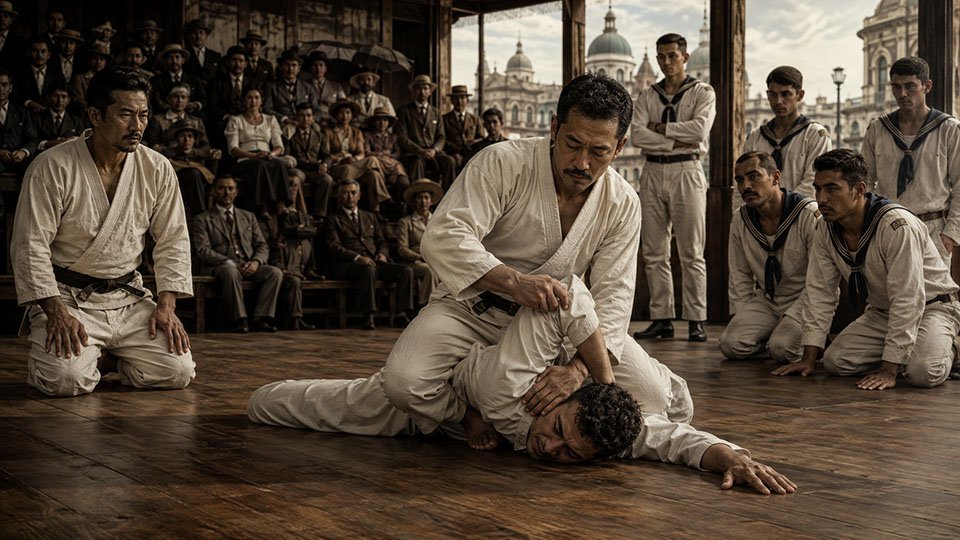
Japanese jiu-jitsu was already being demonstrated, taught and tested in Brazil years before the Gracie family became central to its history. From Manaus and Rio de Janeiro to Belém and São Paulo, Japanese fighters built the early networks, challenge culture and training environments that later shaped Brazilian Jiu-Jitsu.
Brazilian Jiu-Jitsu history is often compressed into a familiar sequence: Mitsuyo Maeda arrived in Brazil, taught Carlos Gracie, and the Gracie family transformed his knowledge into a new fighting system.
That sequence contains important people, but it begins too late.
Japanese jiu-jitsu had already appeared before Brazilian audiences years before Maeda established himself in the country. Japanese practitioners taught sailors, fought capoeiristas, staged public challenges and demonstrated grappling in theaters. By the time Carlos Gracie entered the story, Brazil had already experienced more than a decade of contact with Japanese martial arts.
The early history was not built by one traveler. It was a transnational movement carried by fighters who crossed continents and made their living through instruction, exhibitions and contests.
Jiu-Jitsu Arrived With a Japanese Martial Diaspora
At the beginning of the twentieth century, Japanese martial arts were moving far beyond Japan.
Judo had been organized by Jigoro Kano through the Kodokan, while various forms of jujutsu continued to circulate under different schools and names. Abroad, the distinction between judo and jiu-jitsu was not always clear. Japanese practitioners frequently advertised themselves using whichever terminology foreign audiences understood.
Their international visibility also increased after Japan defeated Russia in the Russo-Japanese War of 1904–1905. Japan’s military success attracted attention to the country’s institutions, education and physical culture, giving martial demonstrations additional commercial value overseas.
The people carrying those systems into Brazil were not members of a coordinated mission to create what would later become Brazilian Jiu-Jitsu. Some were professional performers. Others taught military personnel. Several moved from city to city accepting challenges.
Together, however, they created the environment from which Brazilian grappling developed.
Manaus Saw Japanese Jiu-Jitsu in 1906
One of the earliest documented episodes occurred in Manaus.
In November 1906, Japanese practitioners Akishima Sadashi and Suiotos Ki arrived in the Amazonian capital while traveling through the Americas. They advertised challenges through the local press and appeared at the Coliseu Metálico Brasileiro, an entertainment venue in Praça da Saudade.
Accounts place a major public challenge session on November 18. Sadashi and Ki faced a succession of local opponents, reportedly defeating more than a dozen challengers within short time limits.
Those appearances did not immediately create a permanent Brazilian school or identifiable lineage. Their significance lies elsewhere.
They show that Jiu-Jitsu in Brazil before Gracie was already being presented through the challenge-match format that later became central to the public identity of Brazilian grappling.
The audience was not simply watching a technical demonstration. Spectators were being invited to see whether the foreign method worked against resistance.
That question—does it work against someone using another fighting style?—would remain embedded in Brazilian combat culture for decades.
The Brazilian Navy Brought Another Japanese Instructor Into the Story
A more institutional encounter followed in 1908.
The Brazilian Navy training ship Benjamin Constant returned from an international voyage carrying Japanese instructors Sada Miyako and M. Kakihara, whose name appears in varying forms in later accounts.
Period reporting cited in academic scholarship described both men as Japanese jiu-jitsu instructors brought aboard to train Brazilian sailors. The Navy subsequently established instruction in the Japanese fighting method, providing an early example of state-backed martial training well before the creation of the famous commercial academies associated with Brazilian Jiu-Jitsu.
The episode also corrects a persistent assumption that Japanese grappling entered Brazil primarily through civilian teaching.
Military adoption came early.
Miyako did not remain confined to naval instruction. He also performed publicly in Rio de Janeiro, where theater advertisements offered financial rewards to challengers capable of lasting several minutes against the Japanese practitioners.
That progression—from demonstration to open challenge—would become a recurring pattern.
Sada Miyako Meets Capoeira
The most important contest from Miyako’s Brazilian period came in 1909.
His opponent was Francisco da Silva Ciríaco, a capoeirista from Rio de Janeiro.
Ciríaco defeated the Japanese fighter with a rabo de arraia, a spinning capoeira kick. The result became more than a sporting curiosity because both martial traditions carried wider cultural meanings.
Japanese jiu-jitsu had acquired an image of modernity and foreign technical sophistication. Capoeira, by contrast, emerged from an Afro-Brazilian history and had been criminalized under Brazil’s Penal Code during that period.
The confrontation therefore gave newspapers an opportunity to frame a contest between imported martial modernity and a fighting practice deeply rooted in Brazilian society.
Historical scholarship using contemporary newspaper material confirms both Miyako’s naval instruction and the subsequent Ciríaco encounter.
The importance of that fight extends beyond who won.
Decades before Brazilian Jiu-Jitsu became identified with cross-style competition, Japanese grappling was already being tested against a Brazilian striking and kicking tradition in front of paying spectators.
Later Vale Tudo did not emerge from an empty competitive landscape.
Brazilian Students Were Already Learning Before Maeda Settled
Japanese instructors also left behind Brazilian practitioners.
One early figure was Mario Aleixo, who became active as a teacher in Rio de Janeiro. Accounts connect Aleixo with the earlier Japanese instruction circulating through the city, including Miyako’s presence, while translated martial manuals also contributed to his technical education.
His case illustrates how martial knowledge could move without a single formal lineage.
Instruction came from visiting teachers. Printed material circulated techniques. Public exhibitions showed how methods were applied. Brazilian practitioners then taught what they had absorbed.
That environment makes it difficult to assign a clean starting date to a specifically Brazilian form of jiu-jitsu.
There was no single moment when Japanese knowledge became Brazilian.
The change happened gradually as techniques entered local institutions, fighting circuits and teaching networks.
Maeda Was Crucial, but He Was Not the First
Mitsuyo Maeda, better known in Brazil as Conde Koma, remains the most consequential Japanese figure in the development that eventually produced Brazilian Jiu-Jitsu.
Yet identifying his importance does not require presenting him as the first.
Maeda had left Japan years earlier and traveled through North America, Europe, Central America and South America. Along the way, he fought competitors from different grappling backgrounds and learned how to present Japanese techniques to audiences unfamiliar with Kodokan terminology.
By 1914, he was not a young instructor beginning his career. He was an experienced international professional.
His Brazilian troupe included Satake alongside other Japanese fighters such as Jikichi Okura, Sadakazu Shimizu and Laku. Contemporary advertisements promoted individual members through championship claims tied to cities and countries where they had previously performed.
The language belonged to professional entertainment, but the activity carried technical consequences.
Each appearance placed Japanese grappling alongside boxing, wrestling and other combat systems.
The Maeda Troupe Crossed Brazil
Maeda’s arrival did not immediately lead to a permanent academy.
The Japanese group traveled.
Research using period newspapers records performances across several Brazilian cities after the troupe entered the country in 1914. A September 1914 notice in Correio Paulistano advertised the arrival of the Japanese jiu-jitsu fighters, while Rio newspapers later promoted Maeda, Satake, Shimizu, Okura and Laku during their appearances there.
The troupe’s itinerary eventually carried it north.
Belém became particularly important. The city was a commercial center enriched by the Amazon rubber economy and possessed theaters capable of supporting touring entertainment.
There, jiu-jitsu appeared alongside other stage attractions rather than inside a modern martial arts facility.
That setting can seem strange from a contemporary perspective, but combat sports and popular entertainment were closely connected. Boxers, wrestlers and martial performers earned money by filling theaters, challenging local athletes and presenting supposedly unfamiliar fighting methods.
Jiu-jitsu gained visibility because people paid to watch it being tested.
Satake Builds a Base in Manaus
The history becomes more institutional in 1915 and 1916.
After traveling with Maeda, Soshihiro Satake remained in Manaus and began teaching there. Historical accounts place his program at the Atlético Clube Rio Negro, creating one of Brazil’s earliest permanent Japanese-led judo and jiu-jitsu schools.
Research into the origins of Brazilian judo records that Maeda ultimately established himself in Belém while Satake remained in Manaus following their period of touring together.
The distinction matters.
Maeda became the name most strongly attached to Brazilian Jiu-Jitsu’s origin story, but Satake built his own teaching structure in the Amazon at approximately the same time.
Brazilian grappling was therefore developing through more than one Japanese instructor and more than one city.
Belém was important.
So was Manaus.
Rio de Janeiro would later become dominant, but it did not own the beginning.
Maeda Establishes Himself in Belém
Maeda’s long-term Brazilian base became Belém do Pará.
The city gave him something different from an itinerant performance schedule: a permanent social network.
He continued fighting, taught students and became connected with members of the local elite. His integration into Belém also extended beyond martial arts; he eventually settled permanently in Brazil.
The most significant part of his martial legacy was the circle that trained around him.
Among those figures was Jacyntho Ferro, a Brazilian practitioner whose role complicates the simplified version of BJJ history.
Ferro became one of Maeda’s most important local assistants. Historical accounts identify him among five Brazilian students formally recognized by Maeda in 1920. By the following year, newspaper material connected younger practitioners—including Carlos Gracie and Donato Pires dos Reis—to Ferro’s instruction.
The implications are substantial.
Carlos Gracie could still have learned from Maeda while also receiving substantial instruction from Ferro. Those possibilities are not contradictory.
What changes is the structure.
Instead of imagining a master handing a complete system directly to one chosen student, the evidence points toward an academy environment where senior pupils helped train newer members.
Jacyntho Ferro Makes the Lineage Less Linear
Ferro’s place in the story illustrates one of the central problems in martial arts historiography.
Later lineages often become cleaner than the historical environments that produced them.
A useful lineage is easy to remember:
Kano → Maeda → Carlos Gracie.
But martial instruction rarely operates so neatly.
Teachers have assistants. Students train together. Visiting practitioners exchange methods. Competitors learn from opponents. Techniques circulate through demonstrations and printed material.
Maeda himself was a product of that broader world.
Brazilian Jiu-Jitsu would later develop through similar cross-pollination.
Recognizing Ferro does not diminish Maeda or the Gracies. It provides a more accurate picture of how knowledge moved through Belém.
Geo Omori Adds Another Japanese Line
The Japanese contribution continued into the 1920s.
Geo Omori, a Kodokan-trained practitioner born in Japan, became another influential grappler in Brazil. He competed professionally and eventually opened a jiu-jitsu academy in São Paulo in 1928.
Omori later fought Carlos Gracie, but his importance does not depend on those contests.
His existence further demonstrates that Brazilian grappling did not descend through one Japanese source.
Maeda operated in Belém.
Satake built a teaching base in Manaus.
Omori established himself in São Paulo.
Miyako had already taught in Rio.
Other Japanese practitioners—including the Ono brothers, Takeo Yano and Chugo Sato—would also contribute to Brazil’s broader judo and grappling landscape.
The country was receiving multiple martial lineages at once.
Public Challenges Were Part of the Transmission
Technique was only one element carried by these Japanese fighters.
They also brought a method of proving it.
Public challenges transformed instruction into spectacle. A fighter could advertise a martial system, invite opponents from other backgrounds and allow the audience to judge what happened.
Brazil adapted readily to that model because combat entertainment was already present through boxing, capoeira encounters, wrestling and circus attractions.
The Japanese practitioners entered an existing marketplace.
Once there, their methods were subjected to local pressure.
Miyako lost to Ciríaco.
Maeda fought wrestlers and boxers.
Other members of his troupe took challenges.
Omori entered contests in São Paulo.
Results mattered because reputation determined commercial opportunity.
This environment helped create a Brazilian grappling culture in which effectiveness against another system carried unusual weight.
The later Gracie Challenge did not invent that principle. It inherited and expanded it.
Judo and Jiu-Jitsu Were Not Cleanly Separated
Modern readers can also misinterpret early accounts by treating the words judo and jiu-jitsu as if they had the same boundaries they hold today.
They did not.
Kodokan practitioners abroad were frequently advertised as jiu-jitsu fighters. Promotional language, translations and public familiarity influenced terminology.
Maeda and Satake came from the Kodokan tradition, yet Brazilian notices regularly marketed their demonstrations as jiu-jitsu. Academic studies of Brazilian judo likewise describe early practitioners using terms such as Kano jiu-jitsu, jiu-jitsu and judo within an evolving linguistic environment.
That ambiguity matters when reconstructing Brazilian Jiu-Jitsu’s origins.
It is misleading to imagine one fully developed art called judo arriving alongside another fully distinct system called Brazilian Jiu-Jitsu.
The technical separation developed over time.
What Brazil initially received was Japanese grappling transmitted through Kodokan practitioners, jujutsu teachers, professional fighters and instructors whose terminology changed according to context.
The Gracies Entered an Existing Martial Landscape
When Carlos Gracie began training in Belém around 1917, Japanese grappling was no longer unknown in Brazil.
At least a decade of activity preceded him.
Manaus had witnessed Japanese public challenges.
The Brazilian Navy had incorporated jiu-jitsu instruction.
Rio audiences had watched Miyako fight Ciríaco.
Brazilian practitioners had begun teaching.
Maeda’s troupe had traveled through several cities.
Satake had established instruction in Manaus.
Belém had developed a training network around Maeda and Ferro.
That does not make the later Gracie contribution smaller.
Carlos, Hélio, George, Carlson and subsequent generations built one of the most influential martial systems of the twentieth century. They developed academies, promoted challenge fights, refined competitive methods and eventually helped take Brazilian Jiu-Jitsu outside Brazil.
But they did not begin with an empty mat.
The Forgotten Beginning Changes the BJJ Story
The history of Jiu-Jitsu in Brazil before Gracie is not a search for someone who deserves to replace Maeda or the Gracie family as the single founder.
That would reproduce the same problem.
There was no single founder of the Brazilian grappling environment.
Akishima Sadashi and Suiotos Ki demonstrated the art in Manaus.
Sada Miyako and Kakihara trained Brazilian sailors.
Ciríaco forced Japanese jiu-jitsu to confront capoeira in public.
Maeda turned years of international fighting into a lasting Brazilian teaching network.
Satake created an institutional base in the Amazon.
Jacyntho Ferro carried instruction from teacher to student.
Geo Omori developed another Japanese-led branch in São Paulo.
Their contributions differed in scale, documentation and long-term influence. Together, however, they establish something fundamental.
Brazilian Jiu-Jitsu did not originate through a single encounter between one Japanese master and one Brazilian family.
It emerged from movement.
People crossed oceans. Fighting systems met in theaters and military schools. Techniques passed between instructors and students. Public challenges exposed what worked, what failed and what required adjustment.
The Gracies eventually became the most recognizable name in that history.
They were not its first chapter.