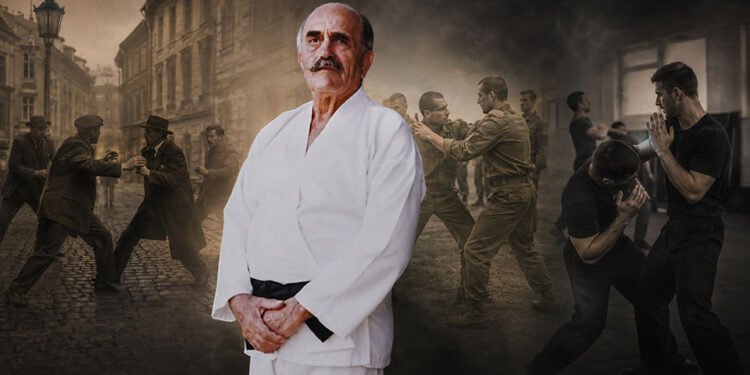
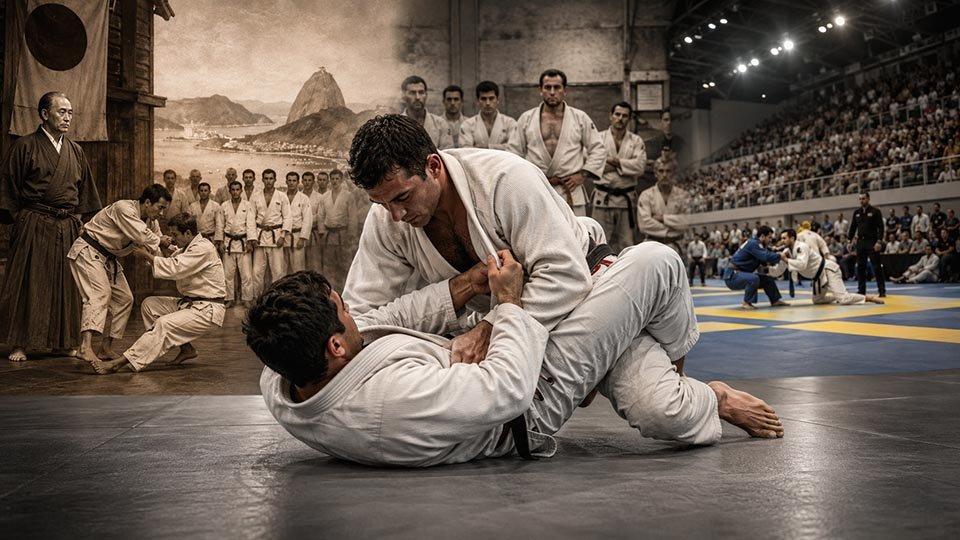
Brazilian Jiu-Jitsu grew from Japanese grappling traditions introduced to Brazil in the early twentieth century, then changed through challenge fights, competing lineages and constant technical adaptation. From Maeda, the Gracies and Oswaldo Fadda to UFC, ADCC and modern No-Gi competition, its history is a story of pressure, revision and reinvention.
Brazilian Jiu-Jitsu did not begin with a single teacher, one academy or an isolated technical breakthrough. It emerged from Japanese martial artists moving through Brazil, local challenge fighting, military instruction, competing schools and decades of adaptation before becoming the international grappling system known as BJJ.
The familiar account places Mitsuyo Maeda, Carlos Gracie and Hélio Gracie at the center of that transformation. Their importance is substantial. The historical record, however, is wider: Japanese practitioners were demonstrating and teaching jiu-jitsu in Brazil before Maeda arrived, Jacyntho Ferro appears to have played a significant role in Carlos Gracie’s training, non-Gracie lineages developed alongside the family’s academies, and later generations repeatedly incorporated methods from wrestling, judo, sambo and other grappling systems.
What became Brazilian Jiu-Jitsu was not preserved in one form. It changed through competition.
Japanese Jiu-Jitsu Reached Brazil Before the Gracies
The Brazilian encounter with Japanese grappling predates the most widely repeated BJJ origin story.

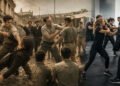
In November 1906, Japanese practitioners Akishima Sadashi and Suiotos Ki staged public jiu-jitsu demonstrations and challenge matches in Manaus. Accounts identify their appearance at the Coliseu Metálico Brasileiro in Praça da Saudade as the earliest recorded public demonstration of Japanese jiu-jitsu in the country. A broader timeline of Brazil’s formative grappling period places those exhibitions years before Mitsuyo Maeda established himself there.
Another Japanese instructor arrived in Rio de Janeiro in 1908 aboard the Brazilian Navy vessel Benjamin Constant. Saku Miura, who performed under the name Sada Miyako, taught members of the Brazilian military and later offered public demonstrations and challenge bouts. His 1909 contest against capoeira fighter Francisco da Silva Ciríaco ended when Ciríaco knocked him out with a rabo de arraia, an early example of Japanese grappling meeting an established Brazilian fighting tradition. The surviving record around Miyako contains conflicting accounts about how he joined the naval voyage, but his presence as an instructor in Brazil is documented. His Brazilian period is reconstructed here from contemporary records.
These episodes matter because they change the starting point.
Japanese grappling was already circulating through demonstrations, military programs, translated manuals and public fighting before the names later associated with BJJ had consolidated an identifiable Brazilian system.
Maeda and Satake Arrive
The decisive expansion came after Mitsuyo Maeda and Soshihiro Satake reached Brazil in 1914.
Both men came through the Kodokan tradition and had spent years traveling internationally. Their work did not resemble the modern academy model alone. They performed demonstrations, accepted challenges and competed against practitioners from other fighting backgrounds while moving through Brazilian cities.
Satake eventually based himself in Manaus. In early 1916, he established a judo/jiu-jitsu program at the Atlético Clube Rio Negro, one of the earliest permanent Brazilian schools led by a Japanese master. Historical accounts of Satake’s work also record his use of leg locks in challenge bouts, a useful correction to the idea that lower-body submissions appeared only much later in grappling history.
Maeda concentrated his activity in Belém do Pará. He taught, fought and developed a circle of Brazilian students and assistants there.
That Belém network eventually produced one of the most important disputes in BJJ historiography: who actually taught Carlos Gracie?
Carlos Gracie, Mitsuyo Maeda and the Jacyntho Ferro Question
The conventional Gracie account presents Carlos Gracie as a direct student of Maeda. That relationship became the foundation of a simple lineage:
Jigoro Kano → Mitsuyo Maeda → Carlos Gracie → Gracie Jiu-Jitsu.
The surviving record makes the transmission less linear.
Carlos entered Maeda’s training environment around 1917. Yet archival material gives particular importance to Jacyntho Ferro, one of Maeda’s senior Brazilian students.
In June 1920, Maeda formally recognized five Brazilian pupils with what contemporary reporting described as “first rank.” Ferro was among them. The precise meaning of the Portuguese terminology used for that rank remains debated, but the record establishes his standing inside Maeda’s group.
More significant is a 1921 newspaper reference identifying Donato Pires dos Reis and a Gracie student—interpreted by historians as Carlos despite a likely name error in the report—as pupils of Ferro.
The safest historical conclusion is therefore not that Carlos never trained with Maeda. The available material cannot establish that. Rather, the evidence surrounding Jacyntho Ferro indicates that Ferro was probably responsible for a substantial portion of Carlos’s regular instruction inside Maeda’s academy.
That distinction matters.
It replaces the idea of knowledge moving privately from one Japanese master to one Brazilian student with a more conventional academy structure: Maeda at the head, senior practitioners beneath him, and newer pupils learning through those instructors.
The Academy That Became the Gracie Academy
Brazilian Jiu-Jitsu began taking institutional form after the Belém generation moved into teaching.
One important figure was Donato Pires dos Reis, another practitioner connected to Ferro’s circle. In 1928, Pires received a contract to teach the Minas Gerais state police and brought Carlos Gracie into the program as an assistant. Two years later, he relocated to Rio de Janeiro.
In September 1930, Pires opened a jiu-jitsu academy on Rua Marquês de Abrantes with Carlos and George Gracie serving as instructors. Contemporary newspaper material identifies Pires as the director. He left the operation several months later, after which Carlos and George assumed control. By 1932, the school was being advertised as Academia Gracie. The institutional sequence is documented through period newspaper notices.
That chronology complicates another familiar assumption: the commercial Gracie academy did not appear in isolation. It emerged from an existing network of Brazilian practitioners who had trained in the Japanese-led schools of the previous decade.
The Gracies would nevertheless become the most effective family in turning that knowledge into an enduring fighting system, teaching business and public identity.
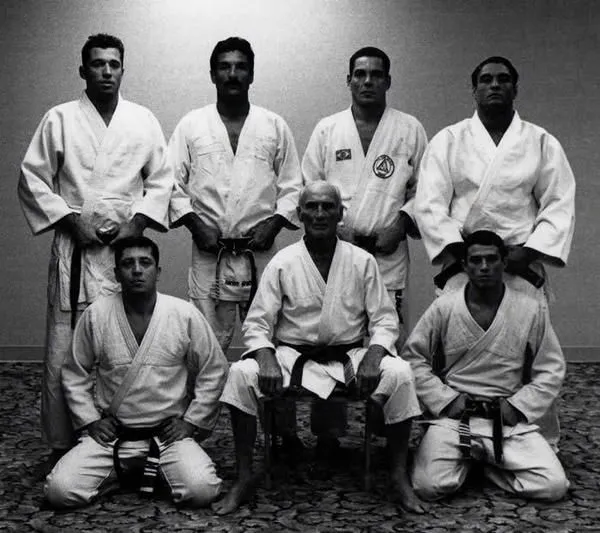
Holker Sracy, Helio Gracie , Hoiller Gracie
Challenge Fighting Becomes the Testing Ground
BJJ’s development cannot be separated from challenge matches.
During the 1930s, practitioners repeatedly tested grappling against boxing, wrestling, capoeira and rival forms of jiu-jitsu. These contests helped create the culture later associated with Vale Tudo—fights in which restrictions were limited enough to expose technical weaknesses that might remain hidden inside a single ruleset.
George Gracie became one of the family’s most active competitors. In December 1931, he defeated Mario Aleixo, an early Brazilian jiu-jitsu instructor whose knowledge had developed partly through manuals rather than sustained training under the Japanese teachers. The bout represented more than an individual result: academy-based grappling was establishing competitive legitimacy.
Hélio Gracie soon became the better-known public figure.
His approach emphasized ground control, guard work and submission mechanics suited to prolonged encounters. Later Gracie narratives often presented this as an almost independent reinvention of jiu-jitsu produced by Hélio’s physical limitations. A more defensible interpretation is that he became an important technical developer inside a system already rooted in Kodokan grappling, Brazilian competition and continual adaptation.
His 1951 match with Japanese judoka Masahiko Kimura remains one of the defining encounters of that period. Kimura defeated Hélio with gyaku ude-garami, the shoulder lock subsequently known throughout BJJ simply as the Kimura.
The result did not invalidate Brazilian Jiu-Jitsu. It demonstrated that the art was still operating inside a much larger international grappling environment.
Luta Livre Creates a Brazilian Rival
The most persistent domestic challenge came from Luta Livre, a No-Gi submission style with strong catch-wrestling influence.
In 1940, Euclydes Hatem—known as Mestre Tatu—defeated George Gracie. The contest helped establish Luta Livre as a credible alternative to the gi-based jiu-jitsu schools.
What followed was not merely technical disagreement. Over subsequent decades, the rivalry developed class, geographical and cultural dimensions in Rio de Janeiro. Different academies competed for fighters, legitimacy and public recognition.
The confrontation reached national television in 1991.
A challenge event was arranged between leading Jiu-Jitsu and Luta Livre representatives. Five matchups were discussed, but only three ultimately took place. Wallid Ismail defeated Eugenio Tadeu in a controversial finish after both men went outside the ring; Murilo Bustamante beat Marcelo Mendes; Fábio Gurgel defeated Denilson Maia.
Jiu-Jitsu finished the night 3–0.
A later Globo reconstruction of the 1991 event, drawing on participants and footage, describes the contest as a major moment in bringing Vale Tudo to a Brazilian prime-time television audience.
The result strengthened BJJ’s position domestically just before another event transformed its international reach.
Brazilian Jiu-Jitsu Was Never Only a Gracie Lineage
The Gracie family became BJJ’s dominant public identity, but it was never the only Brazilian branch.
Oswaldo Fadda built the strongest enduring alternative. Working largely outside Rio’s wealthier central districts, he developed instruction among military personnel and communities in the city’s suburbs. His students became particularly associated with lower-body attacks at a time when leg locks carried less prestige in some other academies.
Fadda’s lineage is traditionally traced through Luiz França.
That connection requires care.
Widely circulated lineage accounts state that França trained with Soshihiro Satake in Manaus, Mitsuyo Maeda in Belém and Geo Omori in São Paulo before teaching Fadda. BJJ Heroes identifies França as the founder of the leading non-Gracie lineage.
Archival evidence for França’s claimed training under all three Japanese masters, however, is thinner than the records surrounding figures such as Ferro or Pires. A detailed review of the Luiz França lineage notes that much of the biography survives through later oral accounts rather than contemporary documentation.
What is much clearer is Fadda’s impact.
He established a durable alternative to Gracie control, trained generations of practitioners and helped create a lineage that eventually fed major modern teams. Oswaldo Fadda’s documented influence remains visible in competitive BJJ through descendants connected with organizations such as Nova União and GF Team.
BJJ was therefore distributed through overlapping networks rather than owned historically by one transmission line.
Rolls Gracie Changes the Technical Culture
By the 1970s, another transformation was underway.
Rolls Gracie, the son of Carlos who was largely raised by Hélio, rejected technical isolation. He trained outside the family’s established curriculum and pursued wrestling, judo and sambo alongside jiu-jitsu.
His work with American wrestler Bob Anderson strengthened the use of takedowns and wrestling transitions. Rolls also competed in freestyle wrestling and sambo, treating other grappling systems as resources rather than threats to lineage purity.
His biographical record documents that cross-training philosophy and his involvement in multiple grappling disciplines.
The significance went beyond individual techniques.
Rolls helped normalize the proposition that Brazilian Jiu-Jitsu could remain recognizably BJJ while absorbing anything that improved its performance.
That principle became central to the art’s later evolution.
The Guard Becomes an Offensive Laboratory
Competition during the 1980s and 1990s transformed positions once treated mainly as defensive structures.
At Carlson Gracie’s academy, Ricardo De La Riva faced powerful standing guard passers. His response was to develop an outside hook around the opponent’s lead leg, disrupting balance while creating angles for sweeps and attacks.
Training partners initially called the position Guarda Pudim—“Pudding Guard”—because of the instability it created in the person standing above it.
After De La Riva used the system successfully against Royler Gracie at the Copa Cantão in the mid-1980s, the position became associated with his name. The technical history of the De La Riva guard also notes earlier precedents in Japanese grappling, illustrating again how BJJ innovation frequently involved adaptation rather than creation from nothing.
A similar transformation occurred with half guard.
For years, holding one of the passer’s legs from bottom was usually interpreted as an incomplete defensive recovery. Roberto “Gordo” Correa changed that perception after a serious knee injury in 1989 restricted his ability to use conventional guard positions.
Instead of merely surviving from half guard, Correa began developing attacks around the underhook, off-balancing, sweeps and back exposure.
The history of half guard traces its existence to earlier judo while crediting Gordo with turning it into a systematic offensive platform inside modern BJJ.
This pattern would repeat for decades: an existing position encounters competitive pressure, one practitioner develops it further, and the wider sport absorbs the solution.
Competition Turns BJJ Into a Codified Sport
Challenge fighting proved effectiveness, but standardized tournaments required another kind of structure.
Brazilian Jiu-Jitsu gradually developed rules that rewarded positional progression. Takedowns and sweeps moved the fight toward top control. Guard passes cleared the opponent’s primary defensive structure. Mount and back control represented more advanced positional dominance.
The modern International Brazilian Jiu-Jitsu Federation formalized this hierarchy through a point system. Under the current IBJJF rule framework, scoring positions require stabilization, while advantages can distinguish near-completed scoring actions or meaningful submission attempts.
Codification changed strategy.
A competitor no longer needed a submission to demonstrate superiority. Position itself acquired measurable value.
That development separated sport BJJ from the open-ended challenge fights that had driven much of its earlier identity.
Yvone Duarte Opens Competition to Women
For most of BJJ’s early institutional history, women had little access to formal competition.
Yvone Magalhães Duarte forced that structure to change.
Duarte began training in 1978, eventually joining Osvaldo Alves’ academy. With no regular women’s competitive division available, she pressed officials in Rio de Janeiro to create one.
The first female category opened in 1985. Duarte won it.
Five years later, Osvaldo Alves awarded her a black belt, making her the first documented woman to receive that rank in Brazilian Jiu-Jitsu. She later established her own team, contributed to the development of the sport in Brasília and, in 2021, was recognized at seventh-degree coral belt level.
Her career record places her not at the margin of BJJ history but inside its institutional expansion: competition became more complete because women fought for access to it.
UFC 1 Turns a Brazilian System Into a Global Reference
Brazilian Jiu-Jitsu’s international breakthrough came on November 12, 1993, at McNichols Arena in Denver.
The first Ultimate Fighting Championship placed representatives of different combat backgrounds into an elimination tournament with comparatively few restrictions.
The Gracie representative was Royce Gracie.
He submitted boxer Art Jimmerson, defeated Ken Shamrock and finished savate fighter Gerard Gordeau to win the tournament. The official UFC 1 record lists all three victories as first-round submissions.
Royce was not the largest athlete on the card, nor did his approach depend on producing the most visible damage. He closed distance, took opponents into unfamiliar positions and finished fights once their striking advantages had been reduced.
The result gave audiences outside Brazil a practical demonstration of a problem many martial arts schools had not adequately addressed: what happens when a fight reaches the ground?
UFC’s own retrospective on the inaugural tournament describes Royce’s three submissions as the performance that introduced BJJ to a much wider audience.
Demand for instruction spread.
More important, mixed martial arts began changing in response. Fighters who did not necessarily want to become BJJ specialists still needed to understand takedown defense, positional escapes, guard, submissions and ground control.
Brazilian Jiu-Jitsu moved from being one style in an experimental tournament to becoming part of MMA’s technical baseline.
ADCC Builds a Separate No-Gi World
The next major step did not occur inside MMA.
In 1998, the Abu Dhabi Combat Club staged its first Submission Fighting World Championship. Sheikh Tahnoon bin Zayed Al Nahyan had trained in several grappling disciplines and wanted a competitive framework capable of bringing jiu-jitsu athletes, wrestlers, judoka and sambo practitioners together without strikes or reliance on the gi.
ADCC’s own history of the organization describes that multi-discipline objective.
The inaugural tournament took place in Abu Dhabi in March 1998. Its official results show Renzo Gracie winning the -77kg division, with Brazilian athletes taking several other categories.
ADCC helped no-gi grappling develop an identity distinct from conventional gi competition.
Wrestling became increasingly important. Leg attacks carried fewer restrictions. Grip strategies changed without jackets and sleeves. Competitors could build careers around submission grappling without moving fully into MMA.
BJJ was no longer evolving inside one competitive ecosystem.
The Leg-Lock Revolution Changes No-Gi Again
During the 2010s, lower-body attacks moved from specialist knowledge toward the center of elite no-gi strategy.
John Danaher’s group at Renzo Gracie Academy in New York developed a systematic approach to ashi garami, positional control of the legs and heel-hook finishing mechanics. Competitors associated with that environment—including Gordon Ryan, Garry Tonon and Eddie Cummings—used those systems across submission-only events and ADCC-level competition.
The broader effect reached organizations that had traditionally restricted the techniques.
Beginning January 1, 2021, the IBJJF permitted heel hooks and knee reaping for adult brown- and black-belt no-gi divisions, a change confirmed in the federation’s official rules update.
A technique once treated as unacceptable in much of sport BJJ had become important enough that the rules changed around it.
The sequence was familiar: competitive innovation appeared outside established boundaries, athletes proved its effectiveness, and governing structures adapted.
Professional Grappling Changes the Economic Question
Modern submission grappling has also begun testing the business structure surrounding competition.
In 2024, the inaugural Craig Jones Invitational ran during the same Las Vegas weekend as ADCC. Its two men’s brackets offered $1 million to each winner, while tournament entrants were guaranteed at least $10,001 simply for competing.
The significance extended beyond another ruleset.
CJI made athlete compensation part of the event’s public argument.
For decades, technical prestige had been the primary currency of elite grappling. The emergence of competing professional events introduced another question: how much of the commercial value created by high-level athletes should return to those athletes?
BJJ’s evolution had reached economics.
The same martial art that once grew through circus exhibitions and challenge fights was now negotiating streaming audiences, event ownership, prize structures, sponsorship and professional labor.
Brazilian Jiu-Jitsu Has No Single Point of Invention
The history of Brazilian Jiu-Jitsu is easier to market as a straight line than to document as one.
Japanese instructors brought different grappling traditions into Brazil. Brazilian students learned through several academies. The Gracie family built the most influential institutional and promotional system, but parallel branches survived. Vale Tudo exposed strengths and weaknesses. Luta Livre created competitive pressure. Rolls Gracie expanded cross-training. De La Riva and Gordo changed positional strategy. Women such as Yvone Duarte challenged institutional exclusion. UFC 1 globalized the art. ADCC accelerated no-gi specialization. Modern leg-lock systems forced rules to change. Professional grappling then began challenging how competitors themselves are paid.
Each phase altered what practitioners understood Brazilian Jiu-Jitsu to be.
That is why BJJ cannot be reduced to the claim that leverage allows a smaller person to defeat a larger opponent. Leverage matters, but so do adaptation, positional control, competitive experimentation and the willingness to import effective ideas.
Its defining characteristic may be less a particular technique than a process.
Put the system under pressure.
Find what fails.
Change it.
Test it again.