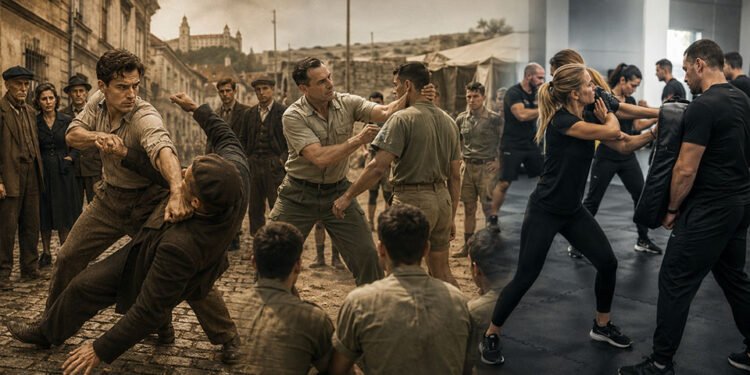
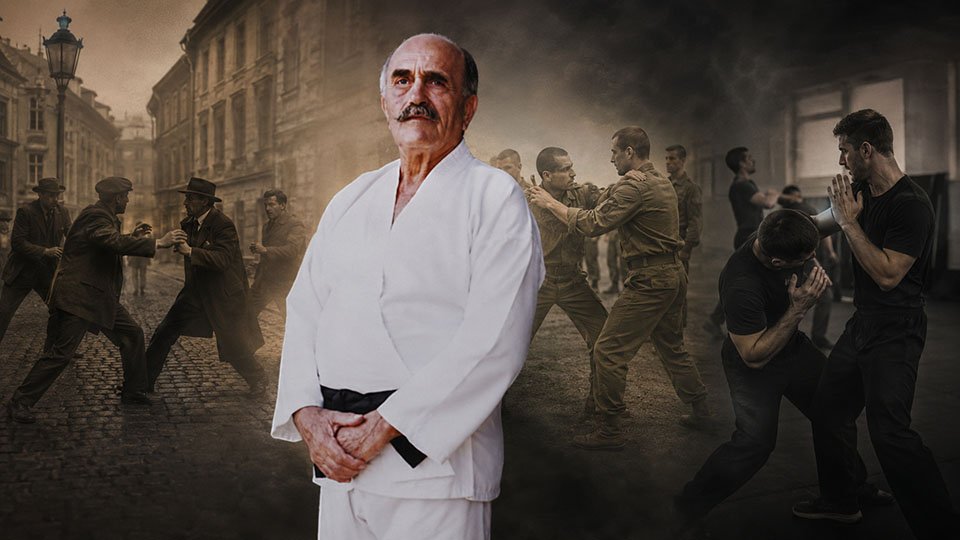
Imi Lichtenfeld began as a boxer and wrestler in Bratislava before antisemitic street violence forced him to rethink what fighting meant outside a regulated contest. That experience later shaped his work with the Haganah, the IDF and civilian students, turning him into the central architect of modern Krav Maga.
Imrich “Imi” Lichtenfeld spent his early life learning how to box, wrestle and move like an athlete. The circumstances that made him historically significant began when those sporting skills were tested against something competition was never designed to reproduce: organized antisemitic street violence in 1930s Bratislava.
Over the decades that followed, Lichtenfeld moved through refugee flight, wartime military service, Haganah training, the newly formed Israel Defense Forces and civilian instruction. His role became inseparable from Krav Maga, but the fuller story is more complicated than a founder myth built around one man and one moment.
The Policeman’s Son Who Became an Athlete
Imi Lichtenfeld was born on May 26, 1910, in Budapest, then part of the Austro-Hungarian Empire, and grew up in Bratislava. His father, Samuel Lichtenfeld, gave him an unusually direct introduction to both physical training and real-world violence.
Samuel had worked as a circus performer before joining the Bratislava police force, where he became a senior inspector. He also ran a gymnasium and taught self-defense. The International Krav Maga Federation biography of Imi Lichtenfeld describes the elder Lichtenfeld as both a former circus acrobat and a police chief inspector, while identifying swimming, gymnastics, wrestling and boxing among the activities his son pursued.


That combination mattered.
Imi did not grow up learning fighting exclusively through a competitive framework. His father’s profession exposed him to another problem: physical force sometimes had to control a violent person rather than win a contest.
At the same time, the younger Lichtenfeld was a serious athlete.
The KAMI biographical account of Lichtenfeld records that he won a Slovak youth wrestling championship in 1928, followed by a national wrestling title the next year. It also credits him with a Slovak boxing championship and an international gymnastics title in 1929.
Those achievements are important because later versions of his story can make Krav Maga seem detached from sport.
It was not.
Boxing taught distance, timing and striking. Wrestling developed balance, control and physical pressure. Gymnastics contributed coordination and body awareness. Lichtenfeld’s later methods emerged partly from those disciplines, even as experience forced him to reconsider their limits.
The distinction would define much of his career.
Bratislava Forced a Different Kind of Education
By the mid-1930s, antisemitism was becoming increasingly violent across Central Europe. Bratislava’s Jewish community faced attacks from fascist groups, and Lichtenfeld became involved in organized neighborhood defense.
He led a group that included wrestlers and boxers attempting to prevent antisemitic gangs from entering Jewish areas of the city. The IDF’s account of Krav Maga’s development identifies those confrontations as the period in which he began recognizing the gap between competitive fighting and uncontrolled violence.
The difference was structural.
A boxer knows what kinds of attacks are permitted. A wrestler knows where the contest takes place. Both understand when the match starts, how victory is determined and that another athlete is operating under the same rules.
None of those guarantees exists during an assault.
More than one attacker may be involved. A weapon can appear. The surface may be concrete rather than canvas or mat. The confrontation can begin without warning and continue after someone falls.
For Lichtenfeld, street violence did not prove that boxing or wrestling were useless. It demonstrated that techniques designed for competition had to be reconsidered when the objective changed from defeating an opponent to surviving an attack.
That distinction became one of the foundations of his later teaching.
The IKMF biography states that repeated street encounters convinced him sport had limited correspondence with actual combat. His response was to move toward techniques intended for immediate defensive use rather than competition.
The lesson was not abstract.
He had learned it while defending a community under political pressure.
The Fighter Becomes a Refugee
By 1940, the political situation had deteriorated beyond neighborhood defense.
Lichtenfeld left Bratislava aboard the Pentcho, an overloaded river steamer carrying Jewish refugees away from Nazi-controlled Europe.
The voyage was hazardous from the beginning. The Italian Navy’s historical account of the Pentcho records 509 Jewish refugees aboard the vessel when Italian forces encountered it in the Aegean in October 1940. After months of difficult travel, mechanical failures eventually left the ship stranded near the uninhabited island of Kamila Nisi.
IKMF’s biography places Lichtenfeld aboard the Pentcho and records that he eventually reached Palestine in 1942.
That period divided his life sharply.
Bratislava had made him a fighter involved in community defense. The escape from Europe displaced him from the city, sporting culture and social environment that had formed him.
What came next placed his physical experience inside organized military structures.
From Haganah Training to Israeli Close Combat
After reaching Mandatory Palestine, Lichtenfeld entered the world of Jewish paramilitary training.
By 1944, he was instructing personnel in physical fitness, swimming, wrestling, knife use and defenses against bladed attacks. His students included members of the Haganah and Palmach, as well as Pal-Yam personnel and police officers, according to the IKMF chronology of his career.
This phase is often compressed into a simple sequence: Bratislava street fighting became Krav Maga, which was then brought to Israel.
The historical picture is less linear.
Jewish defense organizations in Mandatory Palestine already had systems of physical and close-combat training. One of the important terms was Kapap, derived from krav panim el panim, or “face-to-face combat.”
Kapap incorporated methods from several fighting traditions and developed through the work of multiple instructors.
That distinction matters when assessing Lichtenfeld’s place in Krav Maga history.
Historian Guy Mor’s academic study, “History and Singularity of Krav-Maga”, challenges the idea that the discipline appeared independently through one founder. Mor traces Israeli hand-to-hand combat traditions further back and places Krav Maga within a longer process of Jewish physical-defense development.
Lichtenfeld remains central to that history.
But his importance lies partly in what he did with an existing combat environment: refining, teaching, simplifying and later civilianizing an evolving body of methods.
That is more substantial than a creation myth because it shows his actual role as an instructor and system builder.
The IDF Gave Lichtenfeld a Different Problem to Solve
Israel declared independence in May 1948, and the Israel Defense Forces were established from the country’s pre-state military organizations.
Lichtenfeld entered the new military structure as Chief Instructor for Physical Fitness and Krav Maga at the IDF School of Combat Fitness. The appointment is recorded by both the IDF and IKMF.
Military instruction changed his task.
He was no longer primarily dealing with skilled wrestlers or boxers. A national army had recruits with different physiques, backgrounds, levels of coordination and previous experience.
A close-combat method intended for widespread military use therefore had to be teachable.
Complexity became a liability when a soldier had limited training time.
KAMI’s institutional history describes Lichtenfeld revising techniques after finding that some throws and jujutsu-based movements were too difficult for every soldier to perform reliably after short instruction. His answer was to simplify the mechanics.
That teaching problem became fundamental to Krav Maga.
The objective was not to create the most sophisticated movement available. It was to find an action that could be understood, retained and performed by a broad population.
The idea is often associated with one of Lichtenfeld’s recurring principles: the shortest, fastest or simplest route should be preferred when it solves the problem.
Krav Maga’s identity was therefore shaped as much by pedagogy as by combat.
A technique that only an exceptional athlete could execute had limited value inside a system meant for mass instruction.
Krav Maga Did Not Replace Kapap Overnight
Popular histories sometimes describe 1948 as the moment Kapap disappeared and Krav Maga immediately became the IDF’s unified system.
The transition appears to have been more gradual.
Mor’s historical work notes that Kapap, Sport Magen and Krav Maga appeared in early IDF material and could be used for related hand-to-hand training. According to his analysis, Krav Maga became the accepted military term toward the end of the 1950s rather than through a single formal switch at statehood.
This chronology changes how Lichtenfeld’s contribution should be understood.
He did not simply arrive with a finished product carrying the name Krav Maga.
Instead, he worked inside a developing Israeli close-combat system and became one of its defining instructors. Over approximately two decades in military service, his methods were refined around the requirements of soldiers rather than competitors.
Weapon threats were part of that environment.
The curriculum addressed knives, firearms and military equipment alongside striking, grappling and releases from holds. The IDF still describes contemporary Krav Maga as a self-defense method built for realistic threats, with its central purpose defined as protection and escape rather than fighting for its own sake.
The system would later change again when Lichtenfeld began teaching people who were not soldiers.
1964 Changed Imi Lichtenfeld’s Legacy
Lichtenfeld retired from military service in 1964.
That decision arguably created the version of his legacy most people encounter today.
Military Krav Maga could have remained primarily a professional training method confined to Israeli defense and security institutions. Instead, he began adapting it for civilian life.
He established training centers in Netanya and Tel Aviv. Students no longer consisted only of soldiers operating within military rules and missions. The audience now included ordinary men and women who might need to protect themselves in an assault.
The purpose had to shift accordingly.
A soldier and a civilian do not possess the same authority. Their equipment differs. Their reasons for using force are not identical. Neither are their legal responsibilities.
Civilian Krav Maga therefore had to move beyond a simple transfer of military techniques into a commercial training hall.
According to the IKMF account of Lichtenfeld’s civilian work, he modified the method so it could be practiced by people across different ages and physical capabilities, with survival and minimizing harm at the center of the approach.
The transformation also required structure.
Civilian students train for months or years. They need progression systems, instructors, standards and methods for determining advancement.
Those demands brought Krav Maga closer institutionally to the martial arts world from which Lichtenfeld had partly emerged.
Eli Avikzar and the Importance of a Student
A founder’s influence is often easiest to measure through the people entrusted to continue the work.
For Lichtenfeld, Eli Avikzar became one of the most consequential.
Avikzar began training with him in Netanya in November 1964. The KAMI biography of Eli Avikzar describes him as Lichtenfeld’s principal student and records that early civilian Krav Maga had neither a dedicated uniform nor its own established grading structure. Practitioners trained in military clothing.
Judo entered the program soon afterward.
In 1965, Lichtenfeld added judo training, while Avikzar continued broadening his technical education. He later studied karate, jujutsu and aikido alongside his Krav Maga work.
The relationship between the two men illustrates another defining characteristic of Lichtenfeld’s approach: technical adaptation did not stop once a method had acquired a name.
Useful mechanics could be examined and incorporated.
KAMI records that Lichtenfeld awarded Avikzar the first Krav Maga black belt on May 1, 1971.
The date represents more than an individual promotion.
A military method was becoming a civilian discipline with identifiable ranks and a transferable teaching structure.
By 1974, Avikzar had taken responsibility for the Netanya training center. Two years later, he became head of the IDF’s Krav Maga section, continuing the exchange between civilian development and military instruction.
Lichtenfeld had begun producing successors rather than simply students.
The Founder Who Allowed the System to Change
One feature of Lichtenfeld’s career becomes visible repeatedly: he did not treat Krav Maga as technically frozen.
His own background mixed wrestling, boxing and gymnastics. Military instruction incorporated other forms of close combat. Civilian teaching absorbed judo-related progression and additional technical material. Students tested, modified and reorganized what they had learned.
That flexibility was not without consequences.
As Krav Maga expanded, different senior practitioners developed separate interpretations and institutions.
Lichtenfeld and senior students established the Israeli Krav Maga Association in 1978. Avikzar later left and founded KAMI — the Israeli Krav Magen Association — in 1989 with Lichtenfeld’s approval, according to KAMI.
Other international organizations followed different lines.
The International Krav Maga Federation developed as Krav Maga expanded beyond Israel. In the United States, Darren Levine became another important student connected directly to Lichtenfeld. Krav Maga Worldwide’s institutional history records Levine’s first period of training with Lichtenfeld in Israel in 1981 and the later development of Krav Maga Worldwide in North America.
The multiplication of organizations eventually produced disagreements over curriculum, lineage, ranks and authority.
Yet fragmentation was also evidence of scale.
A training method once associated with one Israeli instructor had become large enough for competing institutions to claim different ways of preserving or developing it.
What Lichtenfeld Actually Changed
It is tempting to reduce Imi Lichtenfeld’s contribution to a list of techniques.
That misses the larger point.
His most durable influence was the set of problems around which he organized training.
First, techniques had to be teachable.
A movement of theoretical value was less useful if ordinary recruits could not retain it within limited training time.
Second, the objective determined the method.
A street assault was not a boxing match. Military close combat was not identical to civilian protection. Training had to respond to the environment rather than force every environment into the same rules.
Third, physical attributes could not be the only answer.
A self-defense system intended for a broad population could not assume superior size, strength or athletic experience.
Fourth, prevention and survival mattered more than proving fighting ability.
The IDF’s current description of the method identifies protecting oneself and escaping danger as its primary objective. Awareness and avoidance also appear in contemporary civilian interpretations.
These principles help explain why Krav Maga looks different depending on where it is taught.
The military practitioner, police officer and civilian may share concepts without sharing an identical curriculum.
Lichtenfeld’s central idea was not that one fixed collection of movements could solve every confrontation.
It was that training should be built around the reality of the problem.
“Don’t Get Hurt”
Among the principles repeatedly associated with Lichtenfeld is a deceptively simple instruction: don’t get hurt.
KAMI preserves that idea alongside another associated with his teaching — choosing the simplest and shortest effective route.
Taken literally, “don’t get hurt” is impossible to guarantee in an actual assault.
As a teaching principle, however, it reveals something about how Lichtenfeld separated self-defense from fighting culture.
The goal was not to exchange damage.
It was not to demonstrate toughness.
Nor was it to remain in a confrontation longer than necessary to establish superiority.
The priority was preservation.
That distinction remains useful because modern marketing can sometimes reduce Krav Maga to aggressive striking, weapon disarms or scenarios designed to look dangerous.
Lichtenfeld’s broader civilian philosophy was less theatrical.
Avoid unnecessary injury. Use what is required. Simplify the response. Survive the encounter.
Those principles place responsibility ahead of spectacle.
Fighter, Instructor, System Builder
Calling Imi Lichtenfeld a fighter is accurate, but incomplete.
His athletic career gave him a technical foundation. Bratislava tested that foundation under uncontrolled conditions. Military service turned practical experience into an instructional problem. The IDF gave him a large and diverse population to teach. Civilian life forced another redesign, followed by the creation of ranks, instructors and institutions capable of carrying the method beyond him.
That progression explains why “instructor” may describe his historical importance better than any fighting title.
His influence came from deciding what other people should learn, how quickly they needed to learn it and what could be discarded when complexity interfered with function.
The system did not remain entirely his.
Avikzar and other students modified it. Organizations divided. Curricula evolved. Military and civilian branches moved in different directions.
Yet the teaching logic attached to Lichtenfeld survived those changes.
The Founder Title Needs Historical Context
There is little dispute that Imi Lichtenfeld is recognized internationally as the founder of modern Krav Maga.
The IDF, IKMF, KAMI and major international organizations all place him at the center of the system’s modern development.
The historical qualification concerns what “founder” means.
Research by Guy Mor places Krav Maga within a longer continuum of Jewish hand-to-hand combat extending before Lichtenfeld’s arrival in Mandatory Palestine. Kapap, Sport Magen and other methods formed part of an evolving close-combat culture before Krav Maga became the dominant terminology.
Recognizing that lineage does not reduce Lichtenfeld’s contribution.
It defines it more precisely.
He was not the first Jewish instructor to teach close combat. He did not invent boxing, wrestling, judo or the broader idea of self-defense.
What he did was become a central architect of the system that emerged from those influences, military requirements and his own experience.
He then carried that system into civilian life and trained the generation that internationalized it.
That is the stronger historical case for calling him Krav Maga’s founder.
A Legacy That Outgrew Its Founder
Imi Lichtenfeld died on January 9, 1998.
By then, Krav Maga no longer belonged to a single gym, military school or country.
Different organizations were teaching civilians, soldiers, police officers and security personnel. Students of his students had established programs far beyond Israel. Ranking systems had developed. Instructor qualifications became formalized. Competing lineages began arguing over what constituted authentic Krav Maga.
Lichtenfeld did not live to control everything attached to the name.
Perhaps no founder could have.
The more important legacy is visible in the questions that still shape serious Krav Maga training.
Can a technique be performed under pressure?
Can an ordinary person learn it?
Does it address the threat rather than demonstrate technical complexity?
Can the practitioner disengage?
Does the response reduce danger rather than extend confrontation?
Those questions connect the athlete in Bratislava to the instructor who later spent decades simplifying close combat for soldiers and civilians.
Imi Lichtenfeld began as a boxer and wrestler confronting violence outside the rules that had trained him. He ended his life associated with an international self-defense system built around the consequences of that distinction.
The fighter supplied the experience.
The instructor turned it into something that other people could learn.
That was the work that made him the founder behind Krav Maga.