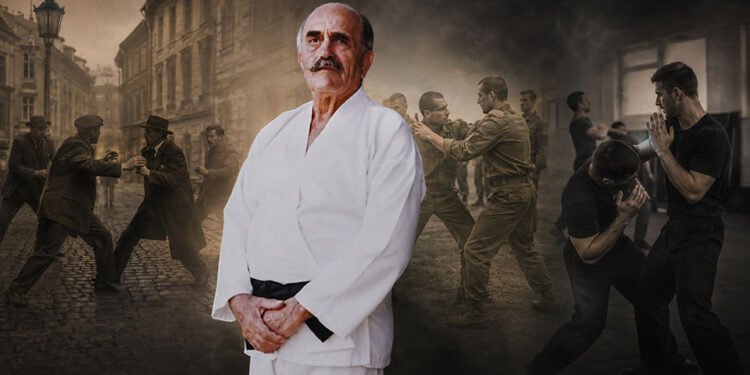
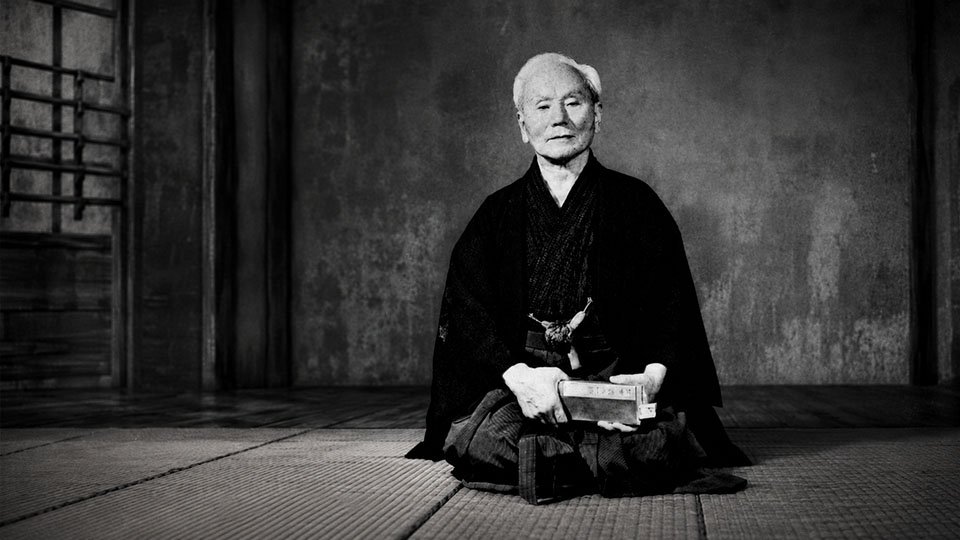
Gichin Funakoshi did not create karate, but he changed the conditions under which it could survive and spread. Born in Shuri in 1868, he carried an Okinawan fighting tradition into mainland Japan, adapted it for schools and universities, helped reshape its identity as karate-dō, and became the central figure behind the lineage that would later be known as Shotokan.
Gichin Funakoshi occupies an unusual place in martial arts history. He is routinely described as the “Father of Modern Karate,” including by the Japan Karate Association and Shotokan Karate of America, yet that description can be misleading if taken to mean he created karate itself. He did not. The fighting methods that shaped his practice already existed in Okinawa, carried through teachers, local traditions and exchanges that predated him.
What Funakoshi accomplished was different. He became one of the principal figures who moved karate from Okinawa into the institutions of mainland Japan. Along the way, he helped change its terminology, teaching structure, public identity and purpose. His students then pushed that transformation further, sometimes in directions he did not entirely embrace.
His life therefore tells two stories at once: the biography of a teacher born in the Ryūkyū world of the nineteenth century, and the larger transition through which karate became a modern Japanese budō practiced far beyond Okinawa.
Born Between Ryūkyū and Modern Japan
Funakoshi was born on November 10, 1868, in Yamakawa, Shuri, according to the Japan Karate Association’s biographical record. Shuri was the former political center of the Ryūkyū Kingdom and home to the royal court at Shuri Castle. His family belonged to the Ryūkyūan gentry associated with service to the old ruling order.
The timing mattered. Funakoshi entered the world as Japan began the Meiji Restoration, while the political system around him was being dismantled. In 1879, when he was still a child, the Ryūkyū Kingdom was absorbed into the Japanese state and Okinawa Prefecture was established. The official Shurijo Castle history records the removal of the Ryūkyū king from the castle that year and the kingdom’s conversion into Okinawa Prefecture.
Funakoshi therefore grew up inside a cultural transition rather than within a stable Japanese martial establishment. The customs, education and fighting traditions of old Okinawa were being forced to coexist with institutions built by the modernizing Japanese state.
His early career reflected that tension. He received a classical education and eventually entered teaching, working in Okinawa’s school system for decades. That profession would later become central to his martial legacy. Funakoshi was not simply a technician who happened to instruct others; he approached karate as an educator accustomed to organizing material, correcting students and turning knowledge into a repeatable curriculum.
The Teachers Behind Funakoshi
Funakoshi began karate training around the age of 11. Two names dominate accounts of his martial formation: Ankō Asato, also rendered Azato, and Ankō Itosu.
The JKA identifies Asato as his first major teacher and states that he also studied karate-jutsu under Itosu. Shotokan Karate of America likewise places both men at the center of his development.
Training in this period bore little resemblance to the standardized classes that later became familiar in university clubs and modern dojo. Funakoshi’s early instruction emphasized prolonged study of kata. According to the biographical chronology of his youth, he made repeated nighttime visits to Asato’s residence and worked forms under close supervision rather than moving rapidly through a large syllabus.
Itosu gave Funakoshi another model: karate as education.
By the beginning of the twentieth century, Itosu had become closely associated with efforts to introduce karate into Okinawan schools. That shift moved the art away from instruction conducted primarily through small circles of personal transmission and toward organized physical education. Funakoshi would eventually take the same logic much farther.
The influence of his teachers was therefore not merely technical. Asato represented direct, exacting personal instruction. Itosu demonstrated that an Okinawan martial practice could be reorganized for larger groups, public institutions and character development.
Those two ideas would remain visible throughout Funakoshi’s career.
Before Tokyo, He Was a Teacher
Funakoshi spent more than three decades in education before karate made him a national martial figure.
That detail helps explain why his later impact exceeded his individual fighting ability. Modern martial arts require more than techniques. They need teaching sequences, terminology, grading structures, written material, training spaces and people capable of reproducing a curriculum after the founder leaves the room.
Funakoshi understood that problem.
By the 1910s, he had also become involved in organized efforts to promote Okinawan martial practice. Demonstrations gradually brought karate into public view, ending an era in which instruction had often remained private or localized.
In 1916, he demonstrated karate at the Butokuden in Kyoto, according to Shotokan Karate of America. A more politically significant appearance followed on March 6, 1921, when Crown Prince Hirohito visited Okinawa and Funakoshi was asked to take part in a karate demonstration.
Neither event alone made karate a mainland institution. Together, however, they placed Funakoshi in the position to make the journey that changed his life.
The 1922 Journey That Became Permanent
In 1922, Funakoshi traveled to Tokyo for a physical education exhibition organized under Japan’s Ministry of Education. He was in his fifties and had spent most of his adult life as an Okinawan schoolteacher.
He did not return to live in Okinawa.
The JKA records the 1922 exhibition as the moment Funakoshi introduced Okinawan karate-jutsu at the ministry-sponsored event. The demonstration brought him into contact with Jigoro Kano, founder of Kodokan Judo and one of the most influential architects of modern Japanese budō. Kano subsequently invited Funakoshi and Shinken Gima to demonstrate kata at the Kodokan.
That relationship mattered because Kano had already solved many of the institutional problems facing a traditional fighting system entering modern society.
Judo possessed a central organization, standardized instruction, formal ranks, recognizable training clothing, educational legitimacy and access to Japan’s schools. Karate had techniques and lineages, but mainland expansion required an infrastructure.
Funakoshi began building one.
After deciding to stay in Tokyo, he taught at Meiseijuku, a dormitory for Okinawan students. In the same year, he published Ryukyu Kempo Karate, which the JKA describes as the first formal Japanese exposition of karate-jutsu.
A local martial practice was acquiring classrooms, readers and an audience far from the island where Funakoshi had learned it.
The Universities Changed Karate
One of Funakoshi’s most consequential decisions was to enter Japan’s university system.
In 1924, Keio University established its Karate Kenkyukai with Funakoshi as shihan, according to the Keio Karate Club’s own historical chronology. Other university programs followed, creating a network through which young practitioners could train, graduate and carry karate into new institutions and communities.
The university environment changed what karate required.
Private instruction between a master and a handful of students could tolerate variation. A club filled with young men training on schedules demanded something more systematic. Techniques needed names. Beginners needed progression. Kata had to be taught consistently. Rank provided a visible measure of advancement.
The JKA credits Funakoshi with issuing an early dan ranking certification in 1924, another indication of karate’s movement toward the institutional structures already associated with Japanese budō.
This may be the most important part of Funakoshi’s legacy to understand. He did not simply transport Okinawan techniques north across the sea.
He helped make them teachable at scale.
From “China Hand” to “Empty Hand”
The transformation was also linguistic.
Karate had historically been written using characters that could be read as “China hand” or “Tang hand.” Funakoshi eventually promoted the use of a different character for kara—空, meaning empty—and the formulation karate-dō, “the way of the empty hand.”
The JKA biography of Funakoshi places the formal shift to karate-dō in 1929 and connects his interpretation of emptiness with Buddhist thought.
The change did more than supply a different translation.
“Empty hand” described an unarmed martial discipline, but dō also situated karate within a broader Japanese idea of martial practice as a way of personal cultivation. Training could now be presented not merely as learning how to strike, block or defend oneself, but as a method for shaping conduct.
Funakoshi also changed a number of Okinawan and Chinese-derived kata names into Japanese forms that mainland students could more readily use. Pinan became Heian. Naihanchi became Tekki. Kūsankū became Kankū. Wanshū became Empi. Chintō became Gankaku.
Such changes remain debated because standardization always involves selection. Something becomes easier to transmit, while other meanings, pronunciations or local associations can recede.
For Funakoshi, however, karate had to survive beyond the circumstances in which he learned it.
Shotokan Was a Dojo Before It Was a Style
The name most closely associated with Funakoshi was not originally his declaration of a separate karate style.
Shōtō was his literary pen name. The term means “pine waves,” referring to the sound of wind moving through pine trees. Kan means a hall or building.
The JKA says Funakoshi established the Shotokan dojo in 1939, after years of teaching in borrowed or institutional spaces. Shotokan therefore meant, in practical terms, the Hall of Shōtō.
Funakoshi himself resisted the fragmentation of karate into competing schools. Yet history moved differently. As his students developed distinctive technical methods and organizations, the word attached to the dojo became the label for one of karate’s major traditions.
That distinction matters when discussing him as the “founder of Shotokan.”
He supplied its educational framework, philosophy and central lineage. The recognizable technical system later called Shotokan was also shaped substantially by the generation training under him.
No figure demonstrates that more clearly than his son.
Yoshitaka Funakoshi Changed the Mechanics
Gichin Funakoshi’s third son, Yoshitaka “Gigō” Funakoshi, became one of the central technical forces in the development of prewar Shotokan.
The elder Funakoshi’s karate retained important characteristics associated with Okinawan practice: natural posture, kata study, self-defense and character cultivation. Yoshitaka pushed training toward longer ranges, deeper stances, stronger hip engagement and a wider kicking repertoire.
Accounts of Gigō’s technical influence credit him with helping develop or popularize kicks including mawashi-geri, yoko-geri variations and ushiro-geri, while also advancing the deeper posture that became recognizable in later Shotokan practice.
He also contributed to the development of structured kumite.
This creates an important distinction between Funakoshi’s karate and everything later taught under the Shotokan name. Modern Shotokan cannot be understood as the untouched technical creation of one man. It emerged through a generational process involving Gichin, Yoshitaka and senior students who continued to revise instruction.
The father’s influence was strongest in direction and purpose.
The son’s was particularly important in mechanics and training method.
Karate Was Supposed to Change the Person
Technique alone cannot explain why Funakoshi’s influence survived.
His strongest statements concern behavior.
The Japan Karate Association’s philosophy directly attributes the Twenty Precepts of Karate to Funakoshi. They move repeatedly between fighting principles and ordinary life: begin and end with respect; understand yourself before others; do not think only of winning; adjust to the opponent; continue training throughout life.
The most famous is:
Karate ni sente nashi.
There is no first attack in karate.
The maxim does not erase karate’s capacity for force. It frames that capacity within restraint. Skill does not create an obligation to initiate violence; greater ability brings a greater requirement for judgment.
Another precept states that karate should not be confined to the dojo. A further one compares genuine training to hot water: stop applying heat and it cools.
Taken together, they reveal how Funakoshi wanted practice understood. Repetition of kata, posture and technique was not separate from conduct outside training. The body was one part of a broader educational process.
A related distinction is worth making. The five Dōjō Kun are deeply embedded in Shotokan culture, but the JKA’s own account says senior instructors at the association developed the Dōjō Kun, while it directly attributes the Twenty Precepts to Funakoshi. Treating both texts as if they were written identically by him obscures that institutional history.
War Destroyed the First Shotokan
The Second World War broke the physical infrastructure Funakoshi and his students had built.
The original Shotokan dojo was destroyed during the Tokyo air raids. The JKA describes the loss as a point at which karate’s expansion was interrupted.
The same period brought a personal blow. Yoshitaka died in 1945, removing the son who had played a major role in the technical modernization of Shotokan.
Postwar karate therefore had to be rebuilt by surviving students.
Former university practitioners revived clubs, re-established networks and began creating organizations capable of taking instruction beyond Japan. By 1949, the Japan Karate Association had emerged with Funakoshi recognized as its Supreme Master. The JKA’s institutional history subsequently records the creation of its specialist instructor program in the 1950s and the development of a competitive structure after his death.
Here, another tension appeared.
The international system developing around Funakoshi’s karate increasingly included tournament competition, standardized scoring and professional instructor training. Some of his followers accepted that direction. Others believed competition risked moving karate away from his emphasis on restraint, natural movement and personal cultivation.
The division would help produce different interpretations of the Shotokan inheritance, including the paths associated with the JKA and Shōtōkai.
Funakoshi’s legacy had become large enough to be contested.
The Author Behind the Instructor
Funakoshi’s influence did not travel only through students.
He wrote.
His 1922 Ryukyu Kempo Karate helped introduce karate to readers in mainland Japan. Later instructional works documented techniques and kata, while his writings on principles gave students a framework that could survive beyond direct contact with the teacher. The English-language editions of Karate-Do Kyohan and his autobiography, Karate-Do: My Way of Life, remain widely circulated works associated with his teaching.
That written record matters because martial systems transmitted only through personal instruction are vulnerable to fragmentation.
Books cannot preserve a living practice by themselves, but they can fix terminology, document priorities and allow later generations to examine what a teacher chose to emphasize at a particular moment.
For Funakoshi, publication became another form of instruction.
The Final Years
Postwar karate expanded rapidly, but Funakoshi no longer controlled every direction taken in his name.
Younger instructors handled the operational work of organizations such as the JKA. New technical standards appeared. Tournament structures followed. Students who shared the same teacher developed different interpretations of what should be preserved.
Funakoshi remained the senior figure above that expanding network.
On April 10, 1957, Japan’s Ministry of Education granted official recognition to the JKA as a legal entity. Funakoshi died 16 days later, on April 26, 1957.
A memorial to him was later established at Engaku-ji in Kamakura. The JKA continues to identify the temple as the site of his memorial monument.
The words associated most strongly with the monument return to the same principle that ran through his teaching:
Karate ni sente nashi.
There is no first attack in karate.
Why Gichin Funakoshi Is Called the Father of Modern Karate
Calling Gichin Funakoshi the father of modern karate is defensible only if the phrase is understood precisely.
He was not the originator of karate.
Asato and Itosu taught him. Their own knowledge belonged to older Okinawan lines of transmission. Other masters—including Chōjun Miyagi, Kenwa Mabuni, Chōki Motobu and numerous figures before them—also shaped the development of karate through traditions that did not descend from Funakoshi.
His achievement was to become a bridge.
He carried karate from Okinawa into mainland Japanese education. He entered the university system. He published instructional material. He adopted organizational tools suited to mass teaching. He helped reshape terminology from karate-jutsu toward karate-dō. His name became attached to Shotokan, even though he resisted the idea that karate should be divided into rigid schools. His students then built institutions that carried those ideas internationally.
That is a more consequential legacy than simply attaching one man’s name to a collection of techniques.
Modern Shotokan contains movements Funakoshi did not personally originate. Competitive karate developed beyond the model he preferred. Organizations claiming his inheritance later disagreed over what his principles required.
Yet the structure beneath those disagreements still points back to him: karate as something that could be taught systematically, written about, practiced in universities, organized institutionally and pursued as more than preparation for physical confrontation.
Gichin Funakoshi began as a teacher in a society losing the political world into which he had been born.
He became the educator who helped karate survive that transition.
The techniques traveled farther because the system around them changed.
That is where his place in modern karate history rests.