
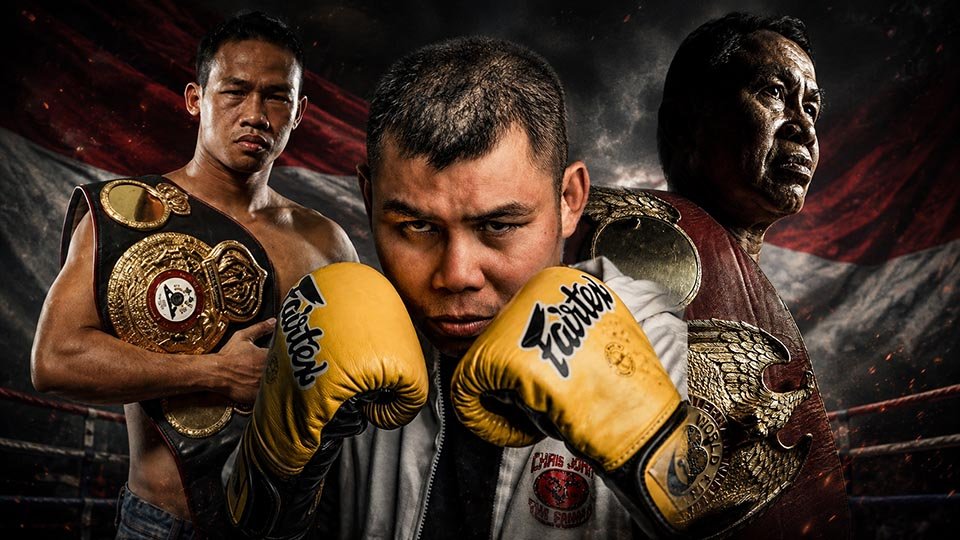
Ellyas Pical became Indonesia’s first professional boxing world champion. Chris John turned championship longevity into a decade-long career. Daud Yordan survived a different landscape altogether, crossing divisions and sanctioning systems as the domestic fight economy became less centralized. Their records tell three stories. Their careers also show how Indonesian boxing changed around them.
On April 17, 2011, two generations of Indonesian boxing met inside the same ring.
Chris John entered the Jakarta International Expo as the established WBA featherweight champion. Across from him stood Daud Yordan, seven years younger and already trying to build an international career of his own.
John won by unanimous decision, with scores of 117-111 and 116-112 twice. The World Boxing Association described the contest as one of the biggest fights staged on Indonesian soil.
The bout did more than establish which boxer was better that night.


It placed two different versions of Indonesian professional boxing beside each other. Behind both stood an earlier figure whose career had changed what Indonesians thought was possible in the first place.
Ellyas Pical.
Ellyas Pical: When a World Champion Became a National Event
On May 3, 1985, Pical stopped South Korea’s Chun Ju-do in the eighth round in Jakarta to win the IBF super flyweight title.
The victory made him Indonesia’s first professional boxing world champion. BoxRec’s record of the fight confirms the date, opponent and eighth-round stoppage.
Pical came from Saparua in Maluku, far from the commercial center of Indonesian sport. His southpaw left hand became the defining weapon of his career, eventually earning the nickname “The Exocet.”
His championship years were not a single uninterrupted reign. Pical lost the IBF belt to Cesar Polanco in 1986, regained it later that year, then claimed the championship for a third time against Chang Tae-il in 1987. BoxRec lists three separate IBF super flyweight reigns between 1985 and 1989.
What surrounded him was equally distinctive.
Pical rose when television attention was concentrated rather than fragmented across hundreds of channels and platforms. TVRI, Indonesia’s first television broadcaster, occupied a dominant position in the national media environment during the 1980s; private network RCTI did not arrive until 1989.
That gave a successful boxer access to something difficult to reproduce today: concentrated national attention.
Pical did not need a personal content operation, daily social posts or a streaming strategy. A major bout carried by national television could place the same athlete before viewers across the country at once.
His era made the champion larger than the boxing market supporting him.
Chris John: The Indonesian Champion Went International
By the time Chris John developed into a world-level featherweight, the structure had changed.
Private television had expanded. Indonesian audiences had more choices. Professional boxing was no longer operating inside the same concentrated media environment that surrounded Pical.
John’s career responded by becoming more international.
The Márquez fight remains the clearest measure of his level.
On March 4, 2006, John defeated the Mexican by unanimous decision in Indonesia. The WBA’s career record for Márquez lists John as the winner of their featherweight title bout.
John then kept winning.
That longevity separated him from every Indonesian champion before him.
Pical had proved an Indonesian could reach a world title. John demonstrated that one could remain around championship level for years, defend across different countries and operate within an international management and promotional network.
His boxing reflected that structure as well.
John was often associated with distance control and movement, but reducing him to a cautious out-boxer misses part of his adaptability. Against Yordan in 2011, the WBA reported that the champion spent much of the contest fighting at close range rather than simply circling outside. He still won clearly.
The career was built around adjustment.
So was the era.
Daud Yordan: A Career Built Without One Stable Center
Yordan’s path looked different from both men before him.
Born in Ketapang, West Kalimantan, he developed outside Jakarta’s traditional sporting center and carried his professional career through several weight divisions.
The route was less about defending one major sanctioning body’s championship for a decade. It required taking opportunities across different organizations, markets and countries.
A year later, after losing that belt to Simpiwe Vetyeka, he moved to lightweight and defeated Daniel Brizuela in Australia to claim another IBO championship.
The pattern continued beyond those titles.
Those belts do not all carry the same standing within global boxing.
That distinction matters.
Pical’s defining championship belonged to the IBF. John’s long reign came through the WBA. Yordan’s major achievements were spread across the IBO, WBO regional structure, IBA and other sanctioning routes.
His résumé therefore reflects the increasingly decentralized environment in which an Indonesian professional could build a career.
There was no single championship path to follow.
One Fight Connected the Second and Third Eras
That makes the 2011 meeting between John and Yordan more revealing with distance.
John was already the established champion. Yordan represented the next internationally ambitious Indonesian boxer.
They did not fight after the older man had retired.
The transition happened directly.
John controlled the contest and retained the WBA championship. Yordan absorbed the defeat, moved on and eventually built a career across heavier divisions.
Two years later, their paths crossed indirectly through the same opponent.
Vetyeka stopped Yordan in Jakarta in April 2013. That December, the South African ended John’s reign in Perth when the Indonesian champion did not come out for the seventh round. The WBA recorded it as John’s first professional defeat and the conclusion of his championship run.
Indonesian boxing had reached a handover point.
What followed was not another decade-long reign.
Three Champions, Three Different Systems
Pical, John and Yordan are often placed together because they won significant international titles.
The comparison becomes more useful when the differences are preserved.
Pical belonged to the age of concentrated national attention. His 1985 championship gave Indonesian professional boxing its first world-title breakthrough at a time when television could turn one sporting figure into a shared national reference.
John operated through international integration. Australian training, overseas contests and a long relationship with the WBA allowed him to sustain a championship career far beyond one successful night.
Yordan entered a more fragmented market. His longevity depended on mobility: multiple divisions, several sanctioning organizations and fights spread across Indonesia, Singapore, Australia, Russia and Britain.
None followed the same blueprint.
That is the central point.
Indonesia did not produce three champions through one stable machine. It produced three fighters who learned to operate inside the conditions available to them.
The Next Era Cannot Depend on Another Exception
His longevity extends the line from Pical’s breakthrough in 1985 across four decades of Indonesian professional boxing.
Yet those decades do not reveal a smooth progression from pioneer to mature industry.
They show adaptation.
Pical found a nation watching through one dominant screen. John built a championship operation that crossed borders. Yordan remained relevant by moving through divisions, organizations and international opportunities after the domestic environment had become less predictable.
Each solved the problem presented by his time.
The harder task belongs to Indonesian boxing itself.
Its next significant champion should not need to reconstruct an entire career system around himself.
Pical proved the first world title was possible. John established how long an Indonesian could stay there. Yordan showed how far a fighter could continue when the structure around him changed.
The fourth era will be defined by whether the system finally becomes more durable than the champion.