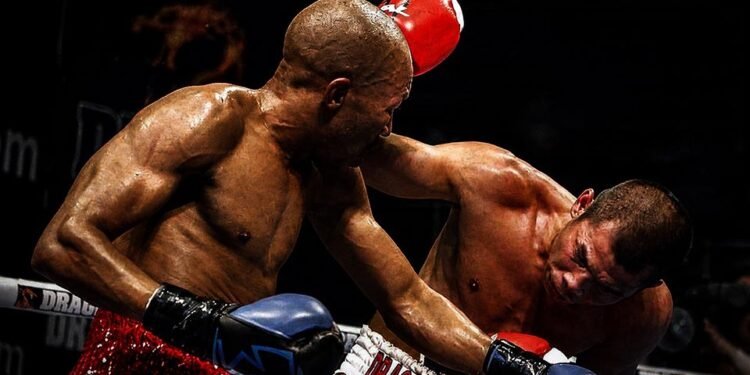
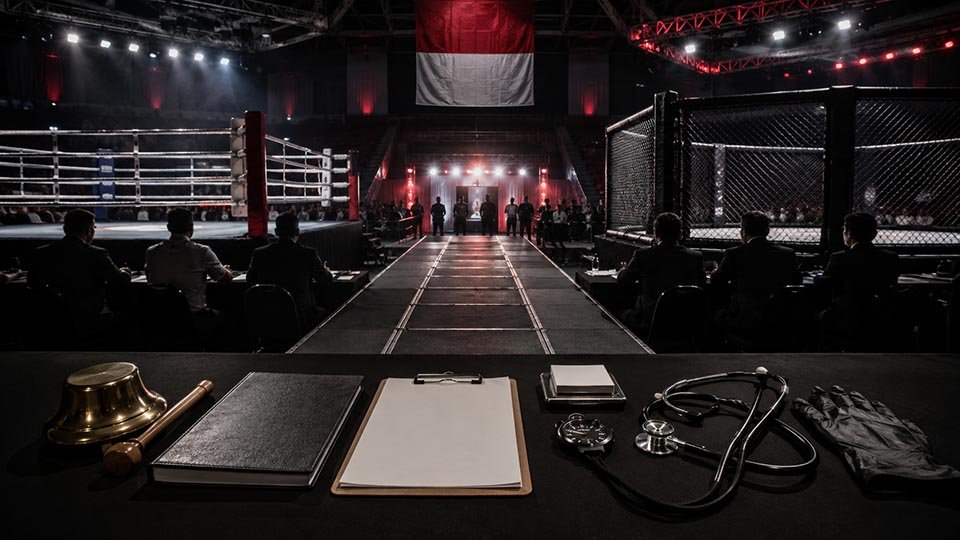
Indonesia has no single commission that sanctions every combat-sports event. Professional MMA, amateur MMA, boxing and hybrid cards can operate under different technical authorities, while police permission remains a separate legal requirement. That means a fight can be approved on several levels before the opening bell—and “sanctioned” only makes sense once the responsible organization is identified.
A fight card in Indonesia can have a promoter, a venue and a broadcast deal without answering the most important regulatory question: under whose rules will the bouts actually take place? The answer depends on the discipline. MMA, boxing and hybrid combat events operate through different sanctioning structures, while police permission remains a separate legal layer.
There is no Indonesian equivalent of one national athletic commission that approves every professional fight.
That distinction became more important after the government dissolved the Badan Olahraga Profesional Indonesia, or BOPI, through Presidential Regulation No. 112 of 2020. The decree abolished BOPI alongside nine other non-structural bodies rather than replacing it with another dedicated professional-sports regulator.
Indonesia’s broader sports framework now sits under Law No. 11 of 2022 on Sports, which remains in force. Kemenpora handles government policy and oversight, but it does not appoint one commission to sanction every boxing, MMA, kickboxing or crossover contest.


Sporting authority is distributed.
So when somebody asks who sanctioned a fight in Indonesia, the first question should be:
What kind of fight was it?
Sanctioning Is Not the Same as Promoting
A promoter creates the event.
A sanctioning organization determines the sporting framework under which the contest operates.
That can include rules, weight classes, referee and judge appointments, athlete eligibility, rankings, championships and technical supervision. Medical requirements may also sit within that structure.
The difference matters because the company selling tickets or streaming access should not be treated automatically as the authority defining whether a bout meets recognized competitive standards.
A promotion can produce the show.
It still needs a ruleset and officials.
In Indonesia, the organization providing those elements changes according to the discipline and the institutional route chosen for the card.
Professional MMA Has KOBI
For professional MMA, the most established domestic organization is the Komite Olahraga Beladiri Indonesia, or KOBI.
KOBI’s current website identifies it as an Indonesian professional MMA organization and describes its functions as including an official sanctioning, supervisory and advisory role for the sport. The organization was founded on November 17, 2015. (KOBI)
Its institutional history is closely connected with the development of One Pride MMA.
That does not mean every bout containing MMA techniques anywhere in Indonesia automatically falls under KOBI. It means KOBI provides an established professional framework through which MMA contests can be sanctioned and supervised.
The amateur side now follows another route.
Amateur MMA Runs Through IBCA
Indonesia’s internationally recognized amateur MMA federation is Indonesia Beladiri Campuran Amatir, or IBCA.
The division was formalized through an agreement between KOBI and IBCA on November 30, 2023. Under that arrangement, IBCA took responsibility for amateur talent development while KOBI remained active on the professional side.
In April 2025, the International Mixed Martial Arts Federation formally recognized IBCA as its Indonesian member federation. IMMAF described KOBI as continuing within the professional MMA space.
For a fighter, the distinction is substantial.
An IBCA amateur competition belongs to a developmental federation structure. A professional contest sanctioned through KOBI operates under a different competitive and commercial environment.
Those are related parts of Indonesian MMA.
They are not interchangeable.
Boxing Is Much Less Centralized
Professional boxing presents a different problem because Indonesia has several active organizations rather than one exclusive national commission.
When the Dewan Tinju Indonesia, or DTI, was established in December 2022, its leadership identified existing organizations including KTI, ATI, KTPI, FTI and FTPI and said it intended to work alongside them. (detikSport)
The significance is straightforward.
A professional boxing promoter does not face one universally exclusive Indonesian commission.
Different cards may operate with different bodies.
Each commission can bring its own officials, administrative procedures and championship structures.
This is why asking whether an Indonesian boxing event is “sanctioned” is incomplete.
The useful question is sanctioned by whom?
Hybrid Cards Can Use Another Sanctioning Route
The picture becomes wider when one event combines kickboxing, boxing-style contests, MMA or crossover rules.
ISKA Indonesia, for example, describes itself as a sanctioning and regulatory body for combat sports in Indonesia and publishes structures covering professional K-1 rules, Muay Thai, MMA, boxing and other disciplines.
Its current event pages also show involvement with modern hybrid fight products. The organization’s 2025 archive includes BYON Madness and other multi-ruleset events, while earlier records identify ISKA-sanctioned kickboxing competition on BYON cards.
That does not make ISKA the sole Indonesian authority for those sports.
Instead, it demonstrates how contemporary cards can operate through an international/private sanctioning framework outside the older federation model.
The event’s poster may say boxing, MMA or kickboxing.
Its technical authority depends on the organization whose rules and officials are actually being used.
A Sanction Does Not Replace a Police Permit
This is where another distinction becomes essential.
Sporting sanctioning and legal permission to hold a public event are separate matters.
A commission or federation may approve the competitive structure, but public events can still require permission through the Indonesian National Police.
Police therefore do not decide whether a fighter wins an ISKA title or qualifies for a KOBI ranking.
The sanctioning organization does not replace the police authority responsible for public order either.
Both can be necessary for different reasons.
The Referee Is Only the Visible End of the System
Most spectators encounter regulation through three people inside the arena: the referee and two or more judges.
Their presence hides a larger process.
Before the opening bell, somebody must decide which rules apply. Fighter eligibility has to be established. Weight needs verification. Officials require appointment. Championship status, where applicable, must have an institutional basis.
Medical supervision becomes even more consequential because combat sports carry risks that do not end when an athlete leaves one promotion.
The problem becomes harder when several organizations can sanction similar contests.
A medical suspension is useful only if the next promoter and commission know it exists.
The Promoter Cannot Be the Only Answer
Modern combat promotions increasingly control almost everything the viewer sees.
They choose the venue, package the athletes, sell sponsorship, negotiate streaming, produce promotional content and determine the commercial shape of the evening.
Technical authority is different.
A credible event should allow a reader, fighter or manager to identify the organization responsible for:
the rules being used, athlete eligibility, officials, medical requirements and championship recognition.
If those answers are unclear, the sanction itself deserves scrutiny.
This matters particularly with crossover events, where familiar words such as “boxing” or “MMA” can describe contests that use modified rules rather than the standards associated with conventional professional competition.
A fight can look legitimate on camera before its regulatory structure has been explained.
So Who Sanctions a Fight in Indonesia?
There is no universal answer.
For professional MMA, KOBI provides an established domestic sanctioning structure.
For amateur MMA, IBCA holds the recognized IMMAF federation role.
In professional boxing, several commissions operate, including KTI, ATI, KTPI, FTPI and DTI, so the applicable authority depends on the card.
For kickboxing and hybrid combat events, organizations such as ISKA Indonesia can provide their own sanctioning framework.
Kemenpora remains part of the wider government sports architecture, while Polri handles public-event permission rather than the sporting result itself.
That division explains why the word “sanctioned” should never end the conversation.
For Indonesian combat sports, it should begin one:
Which organization sanctioned the contest, under what rules, and who was responsible for the fighter once the bell rang?