
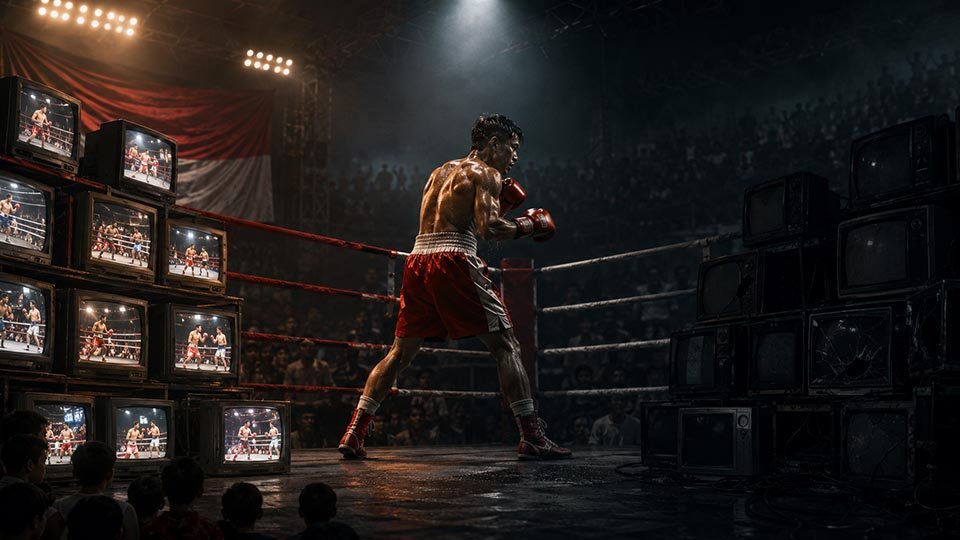
Indonesian boxing once had something its current revival still struggles to reproduce: regular access to a national audience. Television did more than show fights. It made fighters recognizable, gave promoters distribution and helped turn professional boxing into a recurring public event.
There was a period when an Indonesian boxer did not need a viral clip to become familiar.
He needed television.
By 2007, RCTI and Indosiar were broadcasting live professional boxing cards weekly. Fighters entered homes far beyond the arenas where they competed. Promoters gained national exposure, while viewers could follow athletes across multiple bouts instead of discovering them only when a world title appeared.
That frequency mattered.


Boxing was not simply available. It was visible often enough for careers to develop in public.
When regular terrestrial coverage later became scarce, the sport lost more than airtime. One of the systems connecting fighters, audiences and promoters had weakened.
Television Turned a Fighter Into a Public Asset
Professional boxing requires two forms of value.
A boxer needs competitive ability, but somebody also has to care about watching him.
Regular broadcasting connected those qualities.
A prospect appearing repeatedly could build recognition while accumulating rounds. Viewers learned the name, style and progression. By the time a larger fight arrived, the audience already understood who was competing.
That public familiarity gave promoters something to market beyond a record.
The relationship could also affect how events were staged. In 2010, promoter Zaenal Thayeb said Chris John’s proposed defense against Fernando David Saucedo was being scheduled around RCTI’s broadcast availability. The fight was not planned in isolation and handed to television afterward. Broadcast considerations were part of the event itself.
That is what media infrastructure looks like inside a sport.
Chris John Was Built in the Television Era
Chris John’s championship run became the clearest expression of Indonesian boxing’s reach.
The World Boxing Association records 18 successful title defenses during a reign that lasted roughly a decade. His 2006 victory over Juan Manuel Márquez showed that an Indonesian boxer could defeat elite international opposition without becoming disconnected from a domestic audience.
John later identified television as part of the environment that helped sustain professional boxing during his era.
In 2023, he contrasted the scarcity of contemporary events with a period when professional bouts appeared regularly on national television. His argument was not simply nostalgic. More competition meant more opportunities for boxers to gain experience and become known.
The champion sat at the top of that structure.
Television helped audiences see what was beneath him.
When Regular Coverage Faded, the Calendar Became Harder to Sustain
It would be inaccurate to blame television alone for Indonesian boxing’s decline.
Promoter economics, fragmented governance and weak succession planning were already serious problems.
Broadcasting nevertheless connected several parts of the business to the public.
A televised card gave fighters exposure and offered promoters a platform around which commercial partnerships could be built. Repeated events created opportunities for younger professionals to accumulate meaningful rounds.
As that regularity disappeared, the weakness became increasingly visible.
By 2019, promoter Armin Tan was describing the shortage of competitions as an obstacle to producing stronger Indonesian professionals. Chris John made the same connection between activity and development.
A thinner calendar creates consequences inside the ring.
Prospects fight less often. Matchmakers have fewer opportunities to build opposition gradually. Coaches wait longer to see whether training adjustments survive under pressure.
The media problem becomes a fighter-development problem.
Indonesia Tried to Rebuild the Connection
There were attempts to restore television’s role.
In 2016, Chris John Indonesia partnered with Kompas TV on a program designed to identify promising boxers and place selected athletes in televised competition. ANTARA reported that the project would screen prospects before giving them television exposure.
Later that year, the Indonesia Boxing Championship was structured around weekly Kompas TV broadcasts, with successful fighters potentially progressing toward Asian and international opportunities.
The logic was familiar.
Find talent.
Give it fights.
Make those fighters visible.
Build careers from repeated exposure rather than waiting for a champion to emerge anonymously.
John returned to the same point in 2019, arguing that media coverage helped audiences recognize promising boxers while regular competition supplied the experience needed for advancement.
Those projects showed that Indonesian boxing understood what had been lost.
Rebuilding it consistently proved harder.
Digital Combat Learned the Lesson Faster
The audience did not disappear when television habits changed.
It moved.
MMA promotions built recurring broadcast products. Crossover boxing later used YouTube, social media, streaming and personality-driven marketing to create attention without depending entirely on terrestrial networks.
Traditional professional boxing now operates in that same market.
The opportunity is significant.
A promoter can distribute training footage before the bout, introduce prospects through interviews, stream undercards and keep athletes visible between events. Sponsors can appear across an entire content cycle rather than purchasing exposure on one fight night.
But digital access does not automatically create an industry.
Someone still has to produce the content, build an audience, measure it and persuade viewers to return.
The old television system performed much of that distribution work for boxing.
The modern promoter has to own more of it.
Indonesian Boxing Does Not Need Television Back. It Needs Television’s Function.
The mistake would be trying to recreate the media environment of Chris John’s era exactly as it existed.
That period is gone.
What Indonesian boxing needs is the function television once provided: frequency, visibility and continuity.
Young professionals need enough fights for audiences to follow their development. Promoters require distribution that gives each card value beyond the venue. Sponsors need measurable exposure. Fighters must remain visible between championship opportunities.
Whether that happens through terrestrial television, streaming, social platforms or a combination matters less than whether the system operates consistently.
Indonesian boxing once had champions appearing inside a recurring national media product.
When regular television coverage faded, the sport discovered how much of its public economy had depended on the screen.
The next revival cannot depend on convincing broadcasters to return.
It has to build an audience that stays even when they leave.