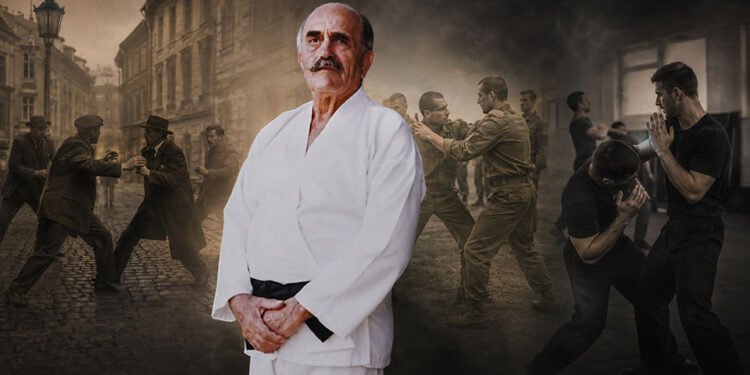
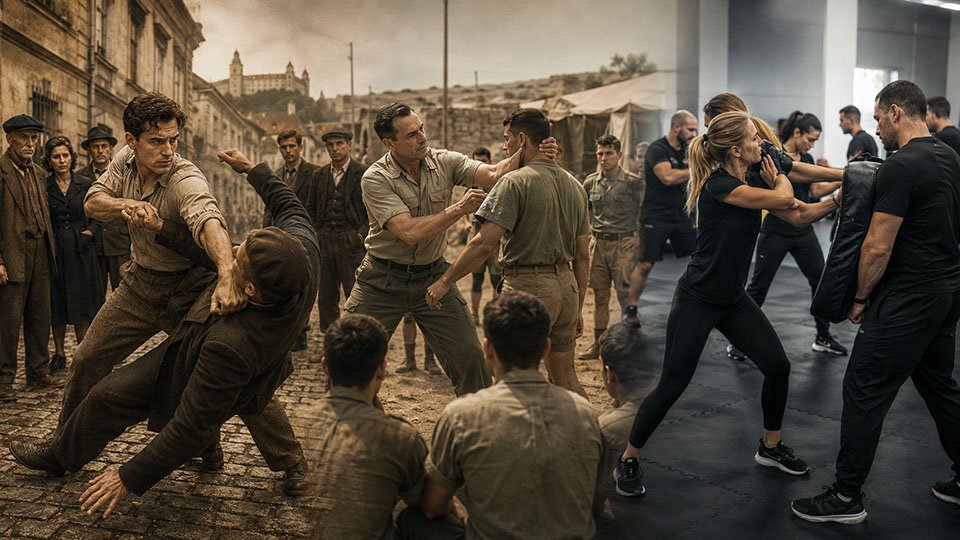
Krav Maga emerged from antisemitic street violence in 1930s Bratislava before evolving through military training in Mandatory Palestine and the early Israel Defense Forces. Its history is a story of adaptation—from improvised community defense to a structured global self-defense system built around simplicity, pressure, and survival.
Krav Maga did not begin in a dojo, military academy or competitive arena. Its formative ideas emerged from violence in 1930s Bratislava, where Imrich “Imi” Lichtenfeld drew on boxing and wrestling to help defend Jewish neighborhoods from antisemitic attacks before carrying those lessons into military instruction in Mandatory Palestine and, later, Israel.
What eventually became a worldwide self-defense system passed through several distinct environments: European combat sports, street confrontations, wartime displacement, Haganah and Palmach training, the early Israel Defense Forces, civilian schools and competing international organizations. That progression explains why Krav Maga remains difficult to place neatly inside the usual categories of martial art, combat sport or defensive tactics.
Before Krav Maga, There Was Imi Lichtenfeld
Imrich Lichtenfeld was born in Budapest on May 26, 1910, when the city was part of the Austro-Hungarian Empire, and grew up in Bratislava. His father, Samuel Lichtenfeld, combined two backgrounds that would shape his son’s development: physical training and police work.
Samuel had performed in a traveling circus before joining the Bratislava police, where he rose to senior investigative rank. He also ran a gymnasium in the city and taught self-defense alongside athletic disciplines. The International Krav Maga Federation biography of Imi Lichtenfeld identifies swimming, boxing, wrestling and gymnastics among the activities he practiced under his father’s influence.


Sport was initially central to the younger Lichtenfeld’s life. He competed in wrestling and boxing and developed as an athlete rather than as the founder of a defensive system. Those competitive skills gave him balance, conditioning, striking experience and knowledge of grappling.
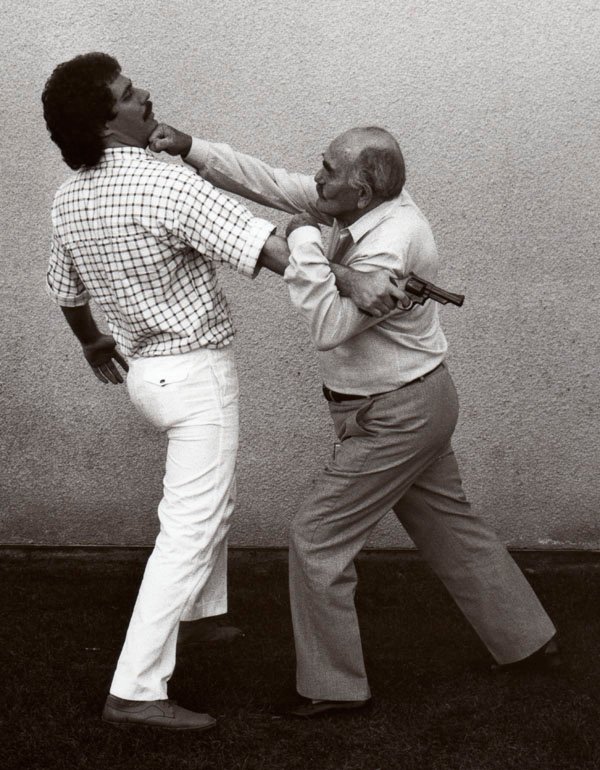
Events outside sport forced a different question: how useful were those abilities when there was no referee, agreed weight class, controlled surface or expectation of a single opponent?
By the mid-1930s, fascist and antisemitic movements were threatening Bratislava’s Jewish population. Lichtenfeld helped organize wrestlers and boxers to defend the community against violent groups attempting to enter Jewish areas. Both the IKMF account and the IDF’s history of the method identify these confrontations as a decisive period in his development.
The distinction he encountered was practical. A wrestler could not assume a confrontation would remain a wrestling exchange. A boxer could not rely on boxing rules. Surprise, weapons, uneven numbers and uncontrolled surroundings changed the problem.
The experience pushed Lichtenfeld away from treating fighting as a contest between comparable athletes. What mattered was getting through an assault rather than winning under an agreed ruleset.
That difference would follow Krav Maga throughout its development.
Bratislava Changed the Logic of Fighting
Competitive fighting rewards performance within restrictions. Those restrictions allow athletes to test skill against resistance while controlling the kinds of harm permitted inside the contest.
Street violence offers no equivalent agreement.
Lichtenfeld’s response was not to discard everything he had learned in sport. Boxing and wrestling remained part of his technical foundation. Instead, he began reconsidering which movements could survive when the circumstances changed.
Krav Maga organizations descended from his teaching repeatedly emphasize a related principle: defensive action should work with natural responses rather than depend entirely on elaborate sequences recalled under pressure. IKMF’s account of its own technical doctrine describes the use of natural instincts and relatively simple movements as a defining feature of the method.
That principle did not produce Krav Maga in complete form on a Bratislava street. Its development continued for decades. Still, this period established the problem the system would repeatedly attempt to solve: how to make fighting skills usable by people who might have limited time, uneven athletic ability and no control over when violence begins.
The Pentcho and Lichtenfeld’s Escape From Europe
Lichtenfeld left Bratislava in 1940 as Nazi domination transformed the political landscape of Central Europe.
He boarded the Pentcho, a river steamer carrying Jewish refugees toward Palestine. The voyage became another defining episode in his biography.
The episode is important to Krav Maga history for more than its dramatic circumstances. It marks the break between Lichtenfeld’s Central European life and the military environment in which his ideas would next develop.
After reaching Egypt, he served with a Czechoslovak military formation under British command before eventually reaching Mandatory Palestine.
Haganah, Palmach and the Kapap Period
Lichtenfeld entered a close-combat culture that already existed before his arrival.
This matters because simplified histories sometimes present Krav Maga as though a single individual arrived with a finished system and replaced everything that preceded it. The historical record is more layered.
The Haganah, established decades before Israeli statehood, had already developed physical training and hand-to-hand instruction. Palmach, its strike force, also trained personnel for close combat. One term used for this wider body of instruction was Kapap, an acronym derived from krav panim el panim, commonly translated as “face-to-face combat.”
Kapap included methods associated with boxing, wrestling, jujutsu, stick fighting, knives and other practical requirements. Multiple instructors contributed to its development.
Lichtenfeld became part of that environment rather than its sole creator.
The academic study “History and Singularity of Krav-Maga” places Krav Maga within a longer history of Jewish hand-to-hand combat rather than treating its origins as an isolated invention. This distinction does not diminish Lichtenfeld’s role. It clarifies it.
By 1944, according to IKMF’s biography, he was training personnel in physical conditioning, swimming, wrestling, knife use and defenses against knife attacks. His students included members of the Haganah, Palmach and Pal-Yam, as well as police personnel.
His experience in Bratislava now met a different requirement: preparing people for organized security and paramilitary activity.
Teaching also imposed another constraint. A method intended for widespread use could not assume that every recruit had spent years boxing or wrestling. Instruction had to be learned within the time available.
That demand became even more important after 1948.
How Krav Maga Entered the IDF
The creation of the State of Israel in 1948 was followed by the formation of the Israel Defense Forces.
Lichtenfeld became Chief Instructor for Physical Fitness and Krav Maga at the IDF School of Combat Fitness, according to both the IKMF founder biography and the IDF’s own account.
Military institutionalization changed the scale of the problem.
Instead of training a small group of experienced athletes, instructors had to prepare recruits with different levels of strength, coordination and previous combat experience. A conscript might arrive with years of sport behind him or virtually none.
The value of simplicity therefore became organizational rather than merely technical.
Weapons also changed the curriculum. Soldiers could encounter knives, blunt objects, rifles and close-range firearm threats, while retaining control of their own equipment presented another concern.
Krav Maga consequently evolved as part of a wider military training system, not as a ring discipline designed to determine the superior athlete.
Even the terminology developed gradually.
Historical scholarship complicates the common claim that “Kapap became Krav Maga” immediately in 1948. Research on Israeli combat systems indicates that Kapap, Sport Magen and Krav Maga appeared alongside one another in early IDF usage before Krav Maga gradually became the accepted term for military hand-to-hand combat toward the end of the 1950s.
The transition was therefore institutional and evolutionary rather than a clean overnight renaming.
Why Krav Maga Was Built Differently From a Combat Sport
Modern Krav Maga still carries the imprint of the conditions that produced it.
Its central question is not, “How does one defeat another trained athlete under a shared ruleset?”
It is closer to: “How can a person recognize danger, respond under pressure and reach safety?”
That difference changes training priorities.
The IDF’s description of Krav Maga states that protecting oneself and escaping danger are central objectives. IKMF places avoidance, prevention, escape and evasion at the beginning of its listed principles.
Those ideas are significant because public perceptions of Krav Maga often focus on its most aggressive-looking techniques. Historically, however, aggression is only part of the system’s logic. It is used as a response to danger rather than as a sporting identity.
The method also favors movements intended to remain functional under stress. Immediate counteraction, efficient motion and rapid transitions became recurring characteristics.
There are no competition points to accumulate in the original tactical framework. A practitioner is not trying to establish superiority for three or five rounds. The purpose is to deal with a threat and disengage when possible.
That is also why translating Krav Maga directly into competitive terms can be misleading.
Boxing, wrestling, judo and other disciplines influenced its development. Yet the environment for which it was structured required different decisions.
The 1964 Turning Point: From Soldiers to Civilians
Lichtenfeld retired from military service in 1964 after roughly two decades of work in the IDF.
His next challenge was substantial: transforming a military close-combat method into civilian self-defense.
A civilian does not operate under the same mission, equipment, authority or legal framework as a soldier. The desired outcome changes accordingly. Escaping safely may be more important than continuing physical engagement. Avoiding unnecessary force becomes part of the problem.
That change altered Krav Maga’s future.
Without civilianization, it might have remained primarily an Israeli military training method. Civilian schools gave it a structure capable of crossing borders.
They also changed how progression was organized.
Military instruction does not require the same long-term ranking architecture as a civilian school where students may train for years. As Krav Maga entered that environment, uniforms, grades and formal instructor pathways became more important.
Eli Avikzar and the Next Technical Generation
One of the key figures in that transition was Eli Avikzar.
Avikzar began training with Lichtenfeld in Netanya in November 1964 and became one of his closest students. The official KAMI biography of Avikzar records that early civilian Krav Maga had no dedicated training uniform or independent grading structure.
Judo soon became part of the evolving curriculum. Avikzar trained in the discipline while continuing his work with Lichtenfeld, later expanding his experience into karate, jujutsu and aikido.
In 1971, Lichtenfeld awarded Avikzar the first Krav Maga black belt, according to KAMI.
The importance of this period lies less in which martial art supplied which individual movement than in what the exchanges reveal about Krav Maga itself. It was not preserved as a closed technical museum. Techniques were tested, modified and, where considered useful, incorporated into a system already oriented toward practical application.
Avikzar eventually assumed responsibility for the Netanya center and later headed the Krav Maga section in the IDF. His career illustrates how civilian and military versions continued influencing one another rather than following entirely separate paths.
Institutional structure followed.
In 1978, Lichtenfeld and senior practitioners established the Israeli Krav Maga Association. Organizational unity, however, did not last indefinitely.
Avikzar eventually left and founded KAMI, the Israeli Krav Magen Association, in 1989.
That division foreshadowed a feature of modern Krav Maga: there would be no single organization controlling every branch of the system worldwide.
From One Method to Multiple Ranking Systems
Civilian expansion produced another change that military Krav Maga had not originally required: long-term student ranking.
Some organizations retained colored belts influenced by conventional martial arts structures. Others adopted level systems with titles rather than relying primarily on belt color.
Those differences are more than cosmetic.
They show what happens when a military training method becomes an international civilian discipline. Schools need curricula, instructor qualifications, progress markers, quality-control systems and ways to reproduce teaching across cities and countries.
Krav Maga therefore acquired some of the institutional features associated with martial arts even while many practitioners continued to insist that it should be understood primarily as self-defense rather than as a traditional martial art.
Krav Maga Moves to North America
International expansion accelerated during the 1980s.
Levine helped adapt instruction for American civilian and law-enforcement environments and eventually developed the organization that became Krav Maga Worldwide.
The process illustrates a recurring pattern.
Krav Maga did not move internationally as a perfectly uniform package. Local instructors taught within different legal systems, professional environments and organizational structures. The underlying principles traveled, but curricula continued to evolve.
That flexibility helped expansion.
It also made disputes over lineage, rank, authenticity and organizational authority increasingly common.
Richard Douieb and the European Expansion
Europe developed another major branch through Richard Douieb.
In 1987, Douieb opened a school in France at Lichtenfeld’s request, according to the European Krav Maga Federation’s institutional history. France subsequently became an important center for the method’s European development.
Douieb also worked with the GIGN, the French National Gendarmerie’s intervention unit, further connecting European Krav Maga with professional security training.
In 1997, he founded the European Krav Maga Federation, or FEKM, to structure expansion while maintaining a recognizable curriculum.
The organization retained a traditional belt framework, creating another example of how civilian Krav Maga could look structurally different from military instruction without abandoning its historical connection to Lichtenfeld.
IKMF and the Fragmentation of Global Krav Maga
A separate international structure emerged during the 1990s.
Other organizations would follow or develop along separate lines.
That fragmentation can confuse newcomers because “Krav Maga” does not identify one worldwide governing body comparable to a single sports federation. Different organizations maintain distinct curricula, ranking standards, instructor pathways and interpretations of lineage.
The variation is not incidental to Krav Maga’s history. It is a direct consequence of its internationalization.
Once Lichtenfeld’s students and their successors established independent institutions, authority became distributed across several lineages.
As a result, contemporary Krav Maga is better understood as a family of closely related systems than as one centrally regulated curriculum practiced identically everywhere.
The Meaning of “Practical” Changed With the Audience
Krav Maga’s history is often summarized with one word: practical.
Yet practicality depends on who is training.
For a soldier, the problem may involve military equipment, battlefield constraints and unit requirements.
For police, it can include arrest, restraint and legally governed use of force.
A civilian may need something different again: recognizing danger, creating distance, escaping, protecting another person or surviving an assault without turning a confrontation into a prolonged fight.
Modern organizations reflect those divisions.
IKMF, for example, maintains separate civilian, military, law-enforcement and protection programs.
This differentiation is one reason Krav Maga cannot be judged solely by asking whether a particular technique would work in an MMA bout.
That is the wrong environment.
MMA is a sport built around trained resistance under a detailed competitive ruleset. Krav Maga was structured around scenarios in which those agreements do not exist. Each must therefore be evaluated against the problem it claims to solve.
Nor does that mean every technique labeled Krav Maga is automatically effective. The global spread of the name makes instructor quality, pressure testing, training methodology and organizational standards important questions for anyone choosing where to train.
A historical lineage is not a substitute for competent instruction.
Is Krav Maga a Martial Art?
The argument over whether Krav Maga qualifies as a martial art has persisted partly because the term itself carries several meanings.
It contains techniques drawn from fighting disciplines. It has instructors, schools, ranks and long-term practitioners. Some organizations use belts. Others emphasize philosophy and personal development.
Yet its original institutional purpose differed from martial arts organized around forms, tradition or competition.
Krav Maga was developed around problems.
How does someone respond when attacked unexpectedly?
What can a recruit learn in limited time?
Which movements remain usable under pressure?
How should training change when a weapon is involved?
How does a civilian escape rather than continue fighting?
That problem-solving orientation remains closer to the identity many organizations claim today: self-defense system or close-combat method, rather than combat sport.
The classification matters less than understanding what the training is designed to accomplish.
From a Jewish Neighborhood in Bratislava to an International System
Imi Lichtenfeld died on January 9, 1998.
By then, the system associated with his name had moved far beyond the circumstances that first shaped it.
It began with a competitive athlete confronting the limits of sporting technique during antisemitic street violence. It passed through refugee flight and wartime military service, then entered the pre-state Jewish defense organizations of Mandatory Palestine. Inside the IDF, close-combat training became institutionalized and increasingly identified as Krav Maga. Civilian schools changed its purpose again, while students such as Eli Avikzar, Darren Levine, Richard Douieb, Eyal Yanilov and others carried different branches into new countries and organizations.
That history also explains why no single snapshot captures Krav Maga completely.
The Bratislava version was not the IDF curriculum of later decades. Military instruction was not identical to the civilian system developed after 1964. Today’s international schools do not all teach from the same syllabus.
What connects those stages is a recurring set of priorities: simplicity, adaptation, natural responses, rapid action under pressure and an emphasis on resolving danger rather than winning a regulated contest.
The wider historical record adds an equally important correction. Krav Maga did not emerge from one man in isolation. Lichtenfeld was its defining founder and central architect, but he worked inside a broader lineage of Jewish and Israeli close-combat practice that included Kapap and numerous instructors before, alongside and after him.
That distinction gives the history of Krav Maga more depth, not less.
Its development was not the sudden invention of a collection of techniques. It was a long response to changing environments: Bratislava streets, wartime Europe, Mandatory Palestine, military bases, civilian training halls, police programs and international schools.
The surroundings changed.
The central problem remained recognizable: how to protect a person when violence is no longer governed by the rules of sport.