Muay Thai and kickboxing share many striking tools, but their rules produce different approaches to distance, clinching, defense, pacing and scoring. Elbows, sustained clinch work and broader standing control give Muay Thai a different tactical structure, while kickboxing places greater emphasis on combinations, movement and round-by-round output.
A fighter steps into a roped ring wearing boxing gloves. Punches, round kicks and knees follow. From a distance, the contest could be Muay Thai or Kickboxing.
Move closer and the distinction becomes immediate.
An elbow that is legal in Muay Thai can be a foul in kickboxing. A clinch that allows sustained work in one contest may require an immediate release in another. Sweeps, kick catches, scoring criteria and round structure further change what a fighter can attempt—and what a judge rewards.
That is why Muay Thai vs Kickboxing cannot be reduced to the familiar explanation that one uses eight limbs while the other does not. Rules reshape distance, stance, defense, combinations, pacing and even the decisions athletes make when an opponent closes the gap.


The difference is not simply the weapons available.
It is the fight those weapons create.
First, “Kickboxing” Does Not Describe One Universal Ruleset
Any comparison requires a qualification: Kickboxing is a broad competitive category rather than one worldwide rulebook.
K-1, GLORY, ONE Championship and other sanctioning systems can differ in bout structure, clinch interpretation, judging and permitted techniques. For a concrete modern comparison, this article uses full-rules professional Muay Thai alongside the current GLORY Kickboxing rules, while referring to K-1 and ONE where their formats illustrate the same broader divide.
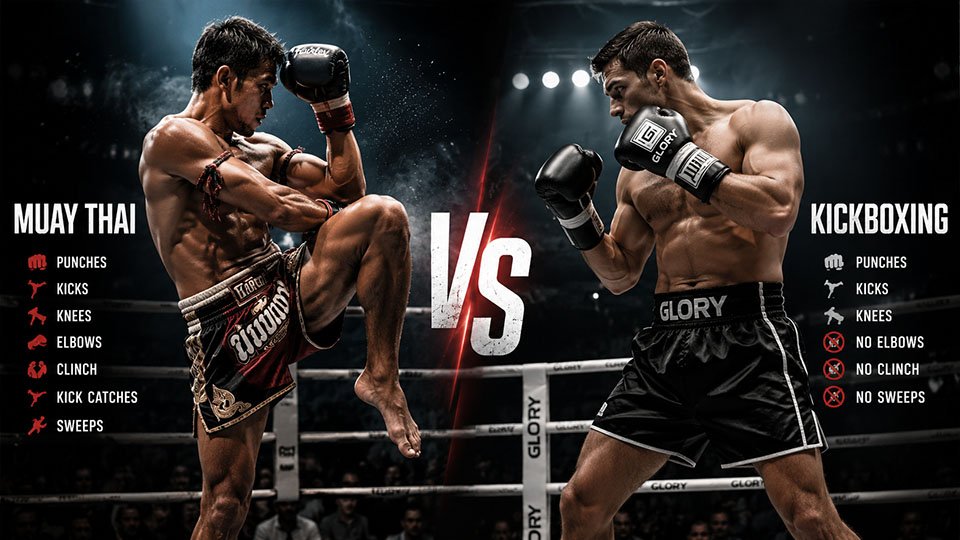
GLORY’s March 2026 regulations permit punches, kicks and knees but prohibit elbows, wrestling, judo techniques, throws, leg sweeps and prolonged holding. An athlete may clinch only to deliver an immediate legal knee before disengaging.
The current WBC MuayThai rules, by contrast, recognize fists, feet, knees and elbows as scoring weapons. Active clinch exchanges can continue while competitors are producing effective techniques, and kick catches remain legal within defined limits.
That produces the first structural difference.
| Area | Professional Muay Thai | GLORY-Style Kickboxing |
|---|---|---|
| Punches | Legal | Legal |
| Kicks | Legal | Legal |
| Knees | Legal | Legal |
| Elbows | Legal | Prohibited |
| Sustained clinch | Permitted when active | Prohibited |
| Sweeps / off-balancing | Certain Muay Thai actions permitted within rules | Throws and sweeps prohibited |
| Kick catches | Permitted within restrictions | Catch must lead immediately to a legal strike and release |
| Standard championship structure | 5 × 3 minutes under WBC MuayThai | 5 × 3 minutes for GLORY title fights |
| Standard non-title structure | Depends on sanctioning rules | Usually 3 × 3 minutes under GLORY |
The consequences extend well beyond the table.
The Clinch Changes What Happens When Distance Disappears
The clearest technical separation begins at close range.
Under Muay Thai rules, arriving chest-to-chest does not necessarily stop the action. The encounter can become another phase of the contest.
Fighters work for head position, inside control and leverage. A collar tie can disrupt posture. Biceps control can prevent clean punching. Knees become easier to generate once an opponent’s upper body is compromised. Turns and legal off-balancing actions can leave one athlete upright while the other loses position.
The WBC MuayThai scoring framework specifically addresses clinch work. Effective techniques must land with power, and the referee can allow the exchange to continue while scoring attacks are being produced. If neither competitor creates useful offense or a workable dominant position, the referee separates them.
GLORY removes most of that phase.
Its 2026 rules classify grabbing, clinching or holding as a foul except when used to launch an immediate single knee. Once that strike is delivered, the athlete must release. Throws and sweeps designed to put an opponent on the floor are also prohibited.
A fighter under pressure therefore has different options.
In Muay Thai, closing distance can interrupt a puncher’s rhythm and shift the exchange toward knees, elbows and positional control.
Under GLORY rules, the same athlete cannot remain attached to the opponent and turn the sequence into sustained clinch work. They need another solution: pivot away, frame briefly, counter, shell up or exit laterally.
The rule determines the escape route.
Elbows Change the Geometry of Punching Range
Elbows create another problem that kickboxers do not face under rules that prohibit them.
A punch needs space to travel. An elbow can operate from much shorter distance.
That makes the area between conventional boxing range and a full clinch far more dangerous in Muay Thai. The fighter entering behind hooks or uppercuts must also account for horizontal, upward and diagonal elbow attacks.
WBC MuayThai identifies elbows alongside punches, knees and kicks as legal scoring weapons. GLORY lists elbow strikes among prohibited techniques.
The difference encourages contrasting tactical behavior.
A kickboxer can remain in the pocket and build a punching sequence without having to defend an elbow coming through the middle of the guard. That does not make close-range kickboxing safe; hooks, uppercuts, knees and knockdowns remain threats. It does, however, remove one weapon from the equation.
Muay Thai preserves it.
As a result, lingering at punching distance carries another layer of risk.
Knees Exist in Both Sports, But the Clinch Determines How They are Built
Calling knees a shared weapon can obscure how differently they function.
A Muay Thai fighter can establish upper-body control first, break posture and then create the opening. The strike becomes part of a positional sequence.
Kickboxing often requires the knee to arrive without prolonged attachment.
Under GLORY’s current rules, legal knees include straight, round, jumping and leg-targeting variations, but clinch limitations apply. A competitor can grab long enough to attack immediately with one knee, then must disengage.
That restriction makes timing more important than extended control.
A kickboxer may place the knee behind a punching combination, intercept an advancing opponent or use it during a brief tie-up. The athlete cannot expect to remain in the clinch, improve position and repeatedly attack from there.
Same anatomical weapon.
Different tactical environment.
Kick Catches Expose Another Ruleset Divide
Catching a kick appears simple until the referee’s interpretation becomes part of the exchange.
WBC MuayThai permits a fighter to catch an opponent’s leg, but its regulations restrict how long the holder can advance without attacking. Moving forward more than two steps without using a strike can produce a warning.
GLORY uses a tighter model. Its regulations allow an athlete to grab the leg only to execute an immediate single legal strike, accompanied by no more than one step, before releasing it. Holding the limb without attacking is prohibited.
The distinction affects what follows a caught round kick.
A Muay Thai exchange can develop into balance disruption, repositioning or another legal attack within the governing rules.
In kickboxing, the window closes quickly.
A fighter crossing between disciplines therefore cannot rely on the same automatic response when a kick lands in their hands.
Scoring May Be the Most Important Difference Spectators Miss
Rules determine what athletes can do.
Scoring determines what they want to do.
That distinction explains why two contests containing similar techniques can develop at very different rhythms.
Modern professional Muay Thai itself does not use one identical scoring system everywhere. The common claim that every Muay Thai judge simply values kicks above punches, or that the opening rounds do not count, is too broad.
Under current WBC MuayThai regulations, judges score each round using a 10-point must system and are explicitly instructed to judge only the round in progress. The framework emphasizes damage, dominance and disruption, alongside effective aggression, ring generalship and defense. Fists, feet, knees and elbows begin as valid weapons; effectiveness determines their value.
That matters because a punch is not automatically worth less simply because it is a punch.
A body kick can outscore a straight right when its effect is greater. An accurate punch that staggers the opponent can reverse that calculation.
The weapon’s name is not the final criterion.
The result it produces is.
GLORY Uses a Different Priority Order
Current GLORY scoring rules place knockdowns first. Damage follows, then the number of clean strikes, with aggressiveness or ring domination used further down the hierarchy. The organization also uses the 10-point must system.
GLORY’s official explanation of its judging has long stressed another distinction: blocked strikes do not receive the same credit as clean connections.
That can change defensive behavior.
If a fighter knows a clean kick matters but a fully blocked attempt does not, remaining planted behind a strong guard can set up an immediate boxing response.
Muay Thai judging must be understood according to the particular sanctioning body or stadium system in use rather than imported wholesale from kickboxing.
The lesson for spectators is straightforward: do not score one sport with the assumptions of the other.
Round Structure Changes Urgency
Time changes strategy before either athlete throws a strike.
A regular GLORY single match consists of three three-minute rounds with one-minute intervals. Title contests run five rounds of three minutes.
WBC MuayThai professional championship fights consist of five three-minute rounds separated by two-minute rests.
A three-round contest gives a fighter fewer opportunities to repair an early deficit.
Dropping the opening frame can leave only six scheduled minutes to overturn the score. That encourages immediate engagement, sustained combination work and less tolerance for prolonged reconnaissance.
Five rounds create more time for adjustments.
The extra duration also changes how a corner manages information. A fighter can spend longer reading reactions, exposing defensive habits and changing targets before the final bell.
This does not mean every Muay Thai bout must begin slowly or every kickboxing match becomes a sprint.
It means the clock rewards different levels of urgency.
Why the Stances Often Look Different
No rulebook orders a Muay Thai fighter to stand upright or a kickboxer to adopt a Dutch-style shell.
Those postures developed because certain positions make more sense under particular threats.
Muay Thai requires constant awareness of low kicks, body kicks, teeps, knees, elbows and clinch entries. A relatively upright posture with less commitment on the lead leg can make checking kicks or lifting the foot for a teep easier. Square positioning also helps when defending or entering the clinch.
Kickboxing frequently rewards heavier boxing combinations and lateral exits because sustained grappling is unavailable. A more boxing-influenced stance can improve punch rotation and movement across the pocket.
These are tendencies, not uniforms.
Thai fighters can box aggressively.
Dutch kickboxers can kick from upright positions.
Individual style, coaching and opponent choice still matter.
The important point is that the rule environment changes which compromises a stance must solve.
Head Movement Carries Different Risks
A deep slip may move a kickboxer’s head away from a punch and load the hips for a counter-hook.
The same movement in Muay Thai can place the athlete on a line with a knee or bring the head close enough for clinch control.
That does not make head movement illegal or useless in Muay Thai. Skilled fighters slip punches, pull from range and change levels.
The risk calculation is different because elbows, sustained clinching and a wider knee game remain available.
GLORY removes elbows and sharply limits upper-body holding, giving boxers and Dutch-style kickboxers more freedom to work through punching exchanges before disengaging.
Defensive habits therefore cannot always cross from one ruleset unchanged.
The Thai kick and Dutch Combination Game Solve Different Problems
Technical labels can become misleading when treated as absolute categories, but one useful contrast appears in how kicks are incorporated into offense.
Traditional Thai kicking mechanics often emphasize heavy hip rotation and driving the shin through the target. The kick can operate as a major attack on its own.
Dutch-style kickboxing became strongly associated with punch-to-kick combinations: jab-cross-low kick, hook-low kick, or longer boxing sequences ending at the leg or body.
Neither system owns either method.
Muay Thai fighters combine punches with kicks. Kickboxers can throw a single heavy roundhouse.
The distinction concerns emphasis.
Kickboxing’s limited clinch and absence of elbows create more space for extended hand combinations. Muay Thai retains additional weapons at close distance, allowing a competitor to transition from kicking range into elbows or clinch work rather than extending every entry into a boxing exchange.
Crossing from Muay Thai into kickboxing Requires Subtraction
A Muay Thai fighter entering kickboxing does not simply keep the same game and remove the elbows.
Several instincts need revision.
The clinch can no longer function as a prolonged answer to pressure. Kick catches must be released quickly. Sweeps disappear. Punching combinations can become more valuable because the fighter has additional freedom to remain in the pocket.
Panpayak Jitmuangnon described that adjustment after competing under kickboxing rules in ONE, identifying distance as a central problem because close-range clinching and elbows were no longer available. He also said he needed to improve his punching combinations.
That is a tactical change rather than a cosmetic one.
The Muay Thai athlete has to remove options that previously solved specific problems.
A Kickboxer Moving into Muay Thai Has to Add Threats
The reverse transition can be more demanding.
A kickboxer entering full Muay Thai must now account for elbows when punching at close range. Remaining tied up can lead to repeated knees instead of an immediate referee break. Kick catches can develop further, while legal off-balancing actions add another defensive problem.
A deep boxing slip may suddenly intersect with a knee.
A tight shell may stop punches but leave room for clinch control.
An opponent who appears close enough to smother can still attack.
ONE Championship has repeatedly highlighted this difference when athletes cross between its striking formats. In 2025, kickboxer Masaaki Noiri described Muay Thai as giving Tawanchai access to punches, kicks, elbows and clinching across more ranges.
The adaptation is not learning another kick.
It is relearning which positions are safe.
Buakaw Showed That Elite Muay Thai Could Translate to K-1
Few careers sit more visibly at the intersection of the two sports than Buakaw Banchamek’s.
K-1 records Buakaw as the winner of the K-1 World MAX tournament in both 2004 and 2006. His success placed a Thai fighter at the center of an international kickboxing format where sustained Muay Thai clinching was restricted.
The important lesson is not the frequently repeated claim that one fighter single-handedly caused K-1 to rewrite its rules; that causal story is harder to establish from official records.
What can be established is Buakaw’s ability to succeed inside the kickboxing framework.
His kicking base remained valuable, but K-1 required him to operate without the complete clinch-and-elbow environment available in Muay Thai.
Modern K-1 still enforces that separation. In a 2024 World MAX bout, the promotion reported Lenny Blasi receiving a warning for using knees while clinching, a practical example of how an action associated with Muay Thai can become illegal under K-1 competition.
Sitthichai and Robin van Roosmalen Showed the Stylistic Collision
Sitthichai Sitsongpeenong’s GLORY career offers another example.
Before his 2015 title challenge against Robin van Roosmalen, GLORY itself described the technical divide: kickboxing restricted the clinch and removed elbows, while Thai fighters tended to rely more heavily on kicks and kick-based defense.
Van Roosmalen represented a different pressure system—heavy hands, combinations and a high work rate.
Sitthichai brought a Thai kicking base into that environment.
Their rivalry demonstrated why style cannot be separated from rules. A Muay Thai technique does not disappear when the athlete enters kickboxing, but its value must be recalculated according to what the referee allows and what judges reward.
Superbon vs Giorgio Petrosyan Showed How a Thai Weapon Can Survive the Transition
Superbon’s 2021 fight with Giorgio Petrosyan produced a cleaner example.
The contest was kickboxing, not Muay Thai. Sweeps were illegal, as ONE’s own account noted after the referee separated the fighters following an attempted sweep.
Superbon nevertheless retained one of the central weapons of his Thai striking background: the right roundhouse.
In the second round, he knocked Petrosyan out with a right high kick and became the inaugural ONE Featherweight Kickboxing World Champion. (ONE Championship)
The finish illustrates an important point about crossover fighting.
Rules can remove techniques without erasing an athlete’s original system.
The task is deciding which parts still work.
Muay Thai vs Kickboxing: Which is More Complete?
That question is less useful than it appears.
Muay Thai permits a larger standing arsenal. Elbows, extensive clinching and a wider range of off-balancing work create more legal problems for an opponent to solve.
Kickboxing deliberately narrows that arsenal.
The restriction does not make the sport technically simple. It changes where complexity develops.
With less sustained clinching and no elbows under systems such as GLORY, greater emphasis can move toward combination punching, angle changes, rapid transitions between hands and kicks, distance management and immediate offensive returns.
One ruleset expands the number of legal weapons.
The other concentrates the contest into a narrower striking framework.
Both demand specialization.
Why the Rules Matter More Than the Label
A fighter should never prepare for a match simply because the poster says “kickboxing” or “Muay Thai.”
The actual regulations matter.
How long can the clinch continue?
Are elbows permitted?
Can a kick be caught?
What can happen after the catch?
Are sweeps legal?
How long are the rounds?
How are judges instructed to separate a close frame?
Those details alter training decisions long before fight night.
They also matter to audiences.
A spectator accustomed to kickboxing may see a Muay Thai fighter controlling the clinch and wonder why the referee does not separate them. Someone raised on traditional Thai competition may watch a kickboxer throw long combinations and question why greater kicking volume is not automatically winning the scorecards.
Neither reaction makes sense without the rulebook.
Muay Thai and kickboxing share punches, kicks, knees, gloves and a ring. Their resemblance ends where regulation begins.
Muay Thai allows the fight to continue through elbows, sustained clinching and a broader standing-control game. Kickboxing formats such as GLORY remove or restrict those elements, opening more space for punching combinations, lateral movement and rapid striking exchanges. Their scoring frameworks then reinforce those choices.
That is the difference that matters.
Rules do not merely decide what is legal. They decide what kind of fighter the contest rewards.