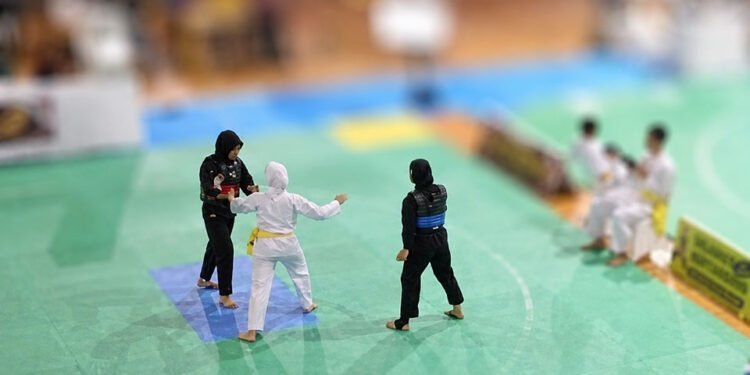
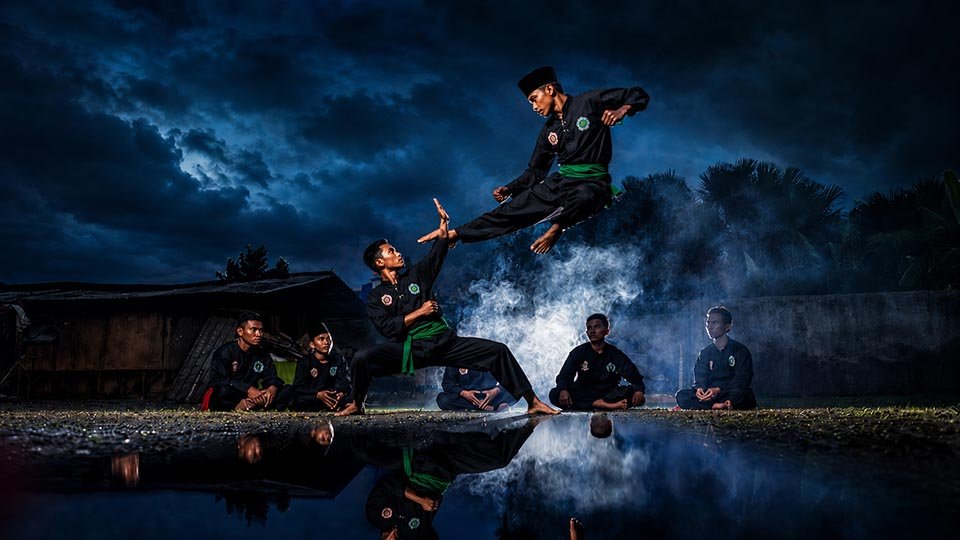
Pencak and silat are now joined in one national martial identity, but they did not begin as interchangeable terms. Pencak developed through strong usage in Java, while silat carried wider currency in Sumatra and the Malay world. Indonesia’s eventual decision to combine both words reflected more than language: it created a shared name for martial traditions shaped by different regional histories.
Ask whether pencak and silat are different martial arts and the simplest answer is no. The two words came from different regional naming traditions before being joined within Indonesia’s modern national framework. Understanding pencak vs silat therefore requires looking beyond technique. The distinction is also linguistic, geographic and institutional.
Today, Indonesia’s national federation treats Pencak Silat as one formal term. The constitution of Ikatan Pencak Silat Indonesia (IPSI) states explicitly that the expression consists of two words forming an inseparable unity. That formulation is the result of a historical process rather than proof that communities across the archipelago always used both names together.
The pairing solved a practical problem: a country with numerous martial traditions needed vocabulary broad enough to represent more than one regional way of naming them.
Pencak and Silat Did Not Begin as One Fixed Label
Long before a national federation could decide terminology, fighting systems developed through individual communities, schools and local cultures.
Related Post


One area might speak of pencak. Elsewhere, practitioners used silat, silek or another regional expression. These terms did not necessarily identify neatly separated martial systems with universally agreed technical boundaries.
UNESCO’s description of the Traditions of Pencak Silat reflects that geography. It notes that pencak is better known in Java, while silat is better known in West Sumatra, and describes the pair as referring to martial arts that share many similarities while retaining regional differences in movement, style, music and equipment.
That distinction matters.
Someone hearing pencak in Java and another hearing silat in Sumatra were not necessarily being introduced to opposite sides of the same technical equation. They were encountering vocabulary shaped by different communities.
The modern compound term came later.
Why Java Used Pencak
The word pencak had strong currency among martial communities in Java before pencak silat became the national expression.
Jean-Marc de Grave’s chapter on the standardisation of pencak silat, published by Brill in The Fighting Art of Pencak Silat and Its Music, describes the naming dispute that confronted Indonesia’s early national martial organization.
According to de Grave, many Javanese and Sundanese figures involved in the federation regarded pencak as the obvious term because it was already used in their respective regional languages. He also notes that books published before 1950 frequently used pencak rather than the combined expression.
The older spelling pentjak appears in colonial-era and early Indonesian material. Changes in Indonesian orthography later produced the modern spelling pencak.
Yet a Java-centered name created another problem.
Indonesia’s martial landscape extended far beyond Java.
Why Silat Had to Be Included
Sumatra carried its own terminology.
When representatives sought to organize Indonesian martial traditions nationally after independence, relying on pencak alone risked giving one regional vocabulary authority over others.
De Grave records that Sumatran representatives objected to the original naming approach. A compromise followed: pencak and silat were combined because both represented major terminological traditions within the archipelago.
The argument was more than linguistic housekeeping.
A national martial federation was being created during the formation of the Indonesian state. Choosing its terminology meant deciding which regional identities would fit inside the new structure.
That makes the two-word name partly a story about martial practice and partly one about national integration.
1948 Created the Institution — the Name Continued to Evolve
IPSI was founded in Surakarta on May 18, 1948, with Wongsonegoro among its founders. The organization describes its purpose as coordinating, preserving and developing pencak silat while bringing schools together within a national structure.
The terminology was not immediately frozen in its current form.
De Grave’s historical account states that the organization initially used Ikatan Pentjak Seluruh Indonesia. In 1949, following the dispute over regional naming, it became Ikatan Pentjak Silat Seluruh Indonesia. At the first congress in Yogyakarta in December 1950, the title was simplified to Ikatan Pentjak Silat Indonesia—the name represented today by the acronym IPSI.
That sequence provides a clearer answer to the pencak vs silat question than attempts to derive an absolute technical distinction between the words.
The national name was negotiated.
It joined terminology that different Indonesian communities already recognized.
Does Pencak Mean Art While Silat Means Fighting?
This is one of the most persistent explanations.
In some traditions, pencak is associated with outward form, aesthetic movement, practice or performance, while silat refers more directly to combative application. The distinction is sometimes expressed through the imagery of the visible flower and functional fruit: what can be displayed versus what can be applied.
That framework can be meaningful within particular schools or cultural settings.
It should not become a universal dictionary definition.
UNESCO does not separate the two terms into an artistic half and a fighting half. Instead, its Indonesian heritage description treats Pencak Silat as a tradition containing several overlapping dimensions: sport, mental-spiritual education, self-defence and art.
The difference is significant.
A practitioner may train aesthetically structured movement without abandoning combative purpose. Another school can preserve ritual, physical conditioning, weapons, tactical knowledge and performance within the same curriculum.
Pencak silat developed through systems where those categories often overlap rather than remain isolated.
Silek Shows What National Standardization Did Not Erase
West Sumatra offers a useful example of how regional language survives beneath the national term.
Among Minangkabau communities, silat commonly appears as silek. Research on Silek Tuo in Nagari Paninggahan, West Sumatra describes a practice connected not only to self-defence but also to ethics, religious instruction, customary knowledge and merantau, the Minangkabau tradition of leaving one’s home community to seek experience elsewhere.
The terminology remains local even though the activity can sit inside the broader Indonesian category of pencak silat.
That pattern appears elsewhere across the archipelago. National standardization created a common administrative vocabulary; it did not require every school to abandon its inherited language, movement system or cultural setting. Academic work on pencak silat standardization likewise describes formalization as a process involving federations, written systems and competitive disciplines rather than the simple replacement of local traditions.
In practical terms, Pencak Silat can function as the national umbrella while silek, penca and other expressions continue to identify particular regional environments.
Silat Is Also Bigger Than the Indonesian Compound Term
Another complication appears once the discussion moves beyond Indonesia.
Silat is used independently across parts of Southeast Asia. It cannot always be treated as shorthand for the Indonesian institutional term pencak silat.
Malaysia, for example, has a separate UNESCO inscription for Silat. UNESCO describes the Malaysian tradition as a combative art of self-defence and survival rooted in the Malay Archipelago, with physical, spiritual, artistic and customary dimensions.
Indonesia’s UNESCO entry, by contrast, is formally titled Traditions of Pencak Silat. Both were inscribed in 2019, but they represent separate nominations from different countries.
This prevents another common mistake.
Silat does not belong exclusively to one modern state, while pencak silat has acquired a particularly strong institutional identity within Indonesia.
The vocabulary crosses borders more easily than national federations do.
The Etymology Is Less Certain Than the Modern History
Attempts to explain pencak and silat often move further back, proposing origins in Sanskrit, Arabic, Tamil, Chinese or indigenous regional languages.
Those theories are difficult to establish conclusively.
The historical record is much firmer when examining how the terms were used regionally and later combined institutionally than when trying to identify one definitive linguistic ancestor for either word. The competing etymological explanations should therefore be treated as hypotheses, not settled history.
For an explainer, that distinction matters because a convincing story is not necessarily a proven one.
The documented naming debate around IPSI gives a more defensible explanation for why contemporary Indonesia uses Pencak Silat.
A National Name for Regional Diversity
Once the paired terminology was established, it became increasingly embedded in administration, education, competition and international organization.
Current IPSI statutes no longer treat pencak and silat as rival regional labels. The federation formally defines them as one inseparable expression and organizes schools under that identity.
International sport followed the same direction.
The International Pencak Silat Federation’s competition framework uses Pencak Silat as the formal sporting name. PERSILAT says its rules were developed with contributions from the founding members to create a common system for international competition.
Standardization made one name portable across borders.
It did not prove that every tradition beneath it had always called itself the same thing.
So What Is the Difference Between Pencak and Silat?
The most accurate answer depends on context.
Historically, pencak and silat reflect different regional naming traditions. Pencak became strongly associated with Java, while silat carried wider use in Sumatra and the Malay world. Local variants such as silek remain active today.
Within particular schools, practitioners may assign the terms different technical or philosophical meanings. One can emphasize aesthetic form and another practical application, but that interpretation should not be imposed universally.
Institutionally, Indonesia resolved the question by combining them.
The decision was not accidental. During the early years of the national federation, a name centered on pencak met resistance from Sumatran representatives. Joining pencak with silat created terminology capable of carrying more than one regional identity.
That history explains why separating the words too aggressively can distort what the name was designed to accomplish.
Pencak Silat is written as two words because the martial culture behind it was never built from one regional vocabulary.
The name preserves that difference while placing it inside a common system.