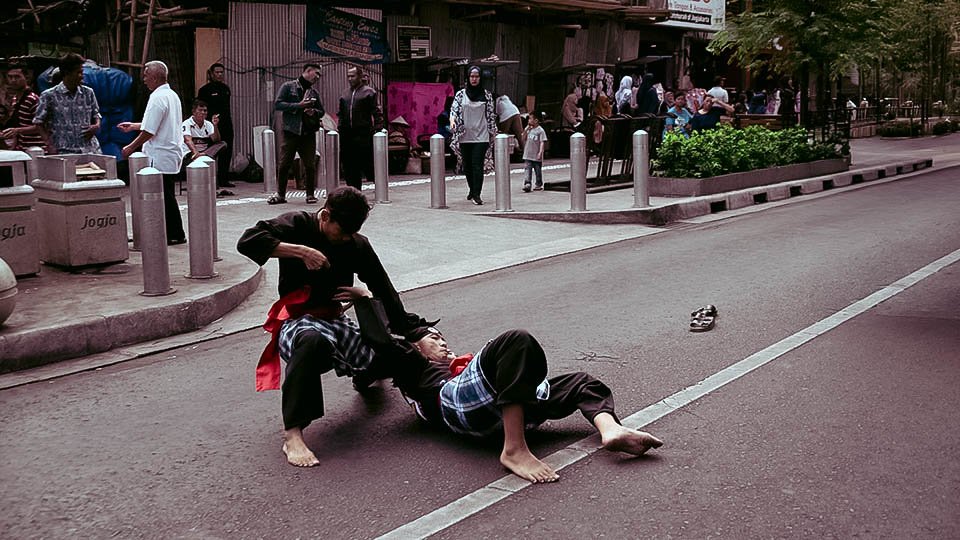
Pencak silat did not begin as one standardized martial art. It emerged from regional fighting traditions shaped by local communities, spiritual practice, social institutions and political change across the Nusantara. Over time, those systems were drawn into national structures, regulated competition and international governance—without fully losing the identities that existed before the modern sport.
Modern pencak silat can be scored in an arena, governed by an international rulebook and contested at major multi-sport events. That structure can make the art appear as though it has always existed as one coherent system.
It did not.
The history of pencak silat is better understood as a long process of consolidation. Local fighting methods, ritual practices, artistic forms, spiritual disciplines and systems of social education developed in different communities before Indonesia created a national framework around them. International governance came later still.
That distinction explains one of pencak silat’s defining characteristics. The same name can describe a competitive athlete attacking for points, a Minangkabau practitioner training silek near a surau, a Sundanese lineage preserving inherited movement, or a performer demonstrating choreographed technique with traditional weapons.
Related Post


When UNESCO inscribed the Traditions of Pencak Silat on the Representative List of the Intangible Cultural Heritage of Humanity in 2019, it did not define the tradition simply as a combat sport. UNESCO specifically identified mental-spiritual, self-defence and artistic dimensions alongside its sporting form.
That range is not a modern branding exercise. It is the result of how the practice survived, changed and acquired new institutions over generations.
The Name Came After the Traditions
Trying to give pencak silat a single birthplace creates an immediate historical problem.
The modern label covers practices that once carried different names according to region, language and community. Pencak, penca, silat, silek, maenpo and other terms did not originally describe one standardized curriculum administered from a central authority.
Even today, the vocabulary retains those regional histories.
In Minangkabau communities of West Sumatra, for example, silek remains embedded in a social world extending beyond physical technique. A 2022 study of Silek Tuo in Nagari Paninggahan records its relationship with the surau, local ethics, religious education and merantau—the Minangkabau practice of leaving one’s home region to seek experience elsewhere. Training in that setting is presented not merely as preparation for confrontation but as part of a broader education in conduct and community responsibility.
This is why searching for one inventor of pencak silat is less useful than asking how numerous martial traditions became connected under one name.
The distinction between pencak and silat has also been interpreted differently across communities. Some traditions associate one with visible movement or performance and the other with fighting application. Those definitions are culturally significant, but they should not be mistaken for an uncontested linguistic formula applying to every lineage.
The etymology of silat itself remains uncertain. Attempts to derive it definitively from Sanskrit, Arabic, Tamil, Chinese or local terms produce hypotheses rather than a settled historical answer.
The uncertainty matters. Pencak silat emerged in a maritime region shaped by migration, trade, religion, war and cultural exchange. A neat linguistic origin would simplify a history that was rarely neat.
Origin Stories Explain Identity Better Than Dates
Silat traditions carry stories about founders, animals and moments of martial discovery.
One widespread narrative from West Sumatra tells of a woman observing a confrontation between a tiger and a bird, learning from their movements and translating what she saw into defensive technique. Minangkabau accounts also connect early silek with figures such as Datuak Suri Dirajo.
Such stories should be treated for what they are: oral traditions carrying ideas about intelligence, adaptation, environment and legitimate martial knowledge.
They are not equivalent to dated institutional records.
The study of Silek Tuo in Paninggahan illustrates the problem. It records inherited accounts of early Minangkabau martial figures while acknowledging that the deeper origins of silat cannot be fixed with certainty.
That does not make the stories irrelevant. Oral history tells us how communities understand their own practice. What it cannot automatically establish is a precise chronology.
The difference becomes especially important when ancient kingdoms enter the story.
What the Temple Reliefs Actually Show
Borobudur and Prambanan are frequently invoked as evidence that pencak silat existed in Java more than a thousand years ago.
The temples do provide important evidence of martial culture.
Research discussing the physical knowledge surrounding silat points to relief carvings at the Central Javanese monuments depicting weapons, fighting positions and bodily postures associated with combat. Borobudur’s broader visual record also contains soldiers, arms and scenes from courtly life.
What those carvings cannot do by themselves is prove that the people represented there practiced a system identical to what is now called pencak silat.
That is an important boundary.
A relief can demonstrate that structured armed and unarmed fighting existed. It can reveal how bodies were positioned, what weapons were present and how warfare entered visual culture. Assigning a twentieth-century umbrella term directly to an eighth- or ninth-century practice requires another evidentiary step.
The temples therefore give the history of pencak silat a deeper martial context without providing a simple birth certificate.
The same caution applies to Srivijaya and Majapahit.
Both states possessed military cultures, fought wars and depended on armed forces. Later silat narratives frequently connect their lineages to the great kingdoms of the archipelago. Yet claims that either empire operated a standardized military doctrine recognizable as modern pencak silat are much harder to demonstrate.
The safer historical conclusion is more substantial than it may first appear: organized martial knowledge existed long before modern Indonesia, while the categories used to describe that knowledge changed over time.
Silat Was Never Only About Fighting
The fighting component is real. So is everything surrounding it.
In West Sumatra, silek became connected with religious instruction, social preparation and the movement of young men beyond their home communities. The Paninggahan study describes the surau not only as a place of worship but also as a setting associated with martial learning and the transmission of ethical values.
West Java produced another landscape.
Sundanese martial culture developed through forms including penca and maenpo. Research on penca among Sundanese communities documents how Cianjur maenpo circulated among aristocratic menak as well as pesantren environments. Martial study could be understood as physical knowledge, spiritual discipline and a means of regulating the self rather than simply a route toward becoming a feared local fighter.
Systems such as Cimande and Cikalong emerged from this wider regional environment, carrying their own technical priorities, pedagogies and community histories.
The result was diversity rather than uniformity.
Two schools could both belong to the world now identified as pencak silat while disagreeing over stance, distance, rhythm, weapons, spiritual practice, teaching progression or the proper purpose of training.
That diversity later confronted a distinctly modern question: how can hundreds of local practices become one national martial art?
Colonial Rule Changed Where Martial Authority Lived
European colonialism altered political power across the archipelago, and martial practice changed with it.
The relationship was more complicated than a simple story in which rulers suppressed silat and fighters resisted them.
Local fighting knowledge existed within overlapping worlds of aristocracy, villages, pesantren, informal authority and political coercion. Figures such as the jago and jawara could be regarded as protectors, strongmen, intermediaries or threats depending on who was describing them and under what circumstances.
That ambiguity has remained significant enough for scholars to examine pencak silat as part of Indonesian political society rather than as an isolated catalogue of techniques.
Ian Douglas Wilson’s Martial Arts and the Body Politic in Indonesia examines precisely this relationship between physical training, spiritual cultivation, nationalism and political power. His work treats martial practice as something embedded in institutions and social authority, not as a combat system operating outside history.
This perspective also helps explain why regional traditions endured.
Silat did not need one central organization to survive because its transmission was already distributed across schools, teachers, families, religious networks and local communities.
What Indonesia would eventually create was not pencak silat itself.
It created a national institution capable of speaking in its name.
1948 Changed the Structure
Indonesia had declared independence in 1945, but political independence did not automatically produce a unified national martial system.
Different schools retained their own identities. Earlier attempts at coordination had appeared before and during the independence period, including organizations in West Java and Yogyakarta.
The decisive institutional step came on May 18, 1948, when the Ikatan Pencak Silat Indonesia, or IPSI, was established in Surakarta.
IPSI’s own institutional history identifies K.R.M.T. Wongsonegoro among its founders and describes earlier efforts to bring separate schools together before the 1948 formation. Its stated role included coordinating the preservation, development and sporting achievement of pencak silat while building relationships among member schools.
That date marks a crucial turn in the history of pencak silat.
A dispersed martial landscape now had a national umbrella.
The change did not erase Cimande, Setia Hati, Minangkabau silek or other regional systems. It created an administrative level above them.
That difference became increasingly important as the Indonesian state treated physical culture as part of nation-building.
A martial tradition once transmitted principally through local authority could now be organized through committees, competition systems, national programs and common terminology.
The fighter, teacher and school remained.
The federation entered the room.
Sportification Changed What Could Be Measured
Turning a martial tradition into a sport requires choices.
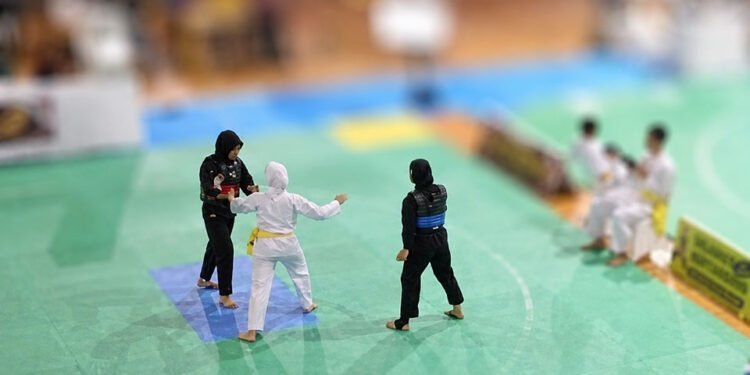
A competition needs a defined area, legal techniques, prohibited actions, scoring criteria, weight divisions, officials and a method for determining who won.
Traditional combat systems do not automatically arrive with those things.
The process therefore changes the practice it regulates.
During Indonesia’s New Order period, standardization became increasingly important. Scholarship on pencak silat has described this period as one of nationalization and “sportification,” in which the state-backed competitive format became a vehicle for presenting a common Indonesian martial identity. An interview with Ian Wilson published by Inside Indonesia discusses that transformation directly, while academic work on the standardisation of pencak silat examines the political and international consequences of creating common forms.
Something inevitably changes when technique must become judgeable.
A movement designed for self-protection may be too dangerous for competition. A local sequence may not translate into a common scoring language. A school’s internal ideas about timing or legitimate application may conflict with what a tournament can safely permit.
Sportification therefore did not simply take traditional silat and place it inside an arena.
It produced another layer of pencak silat.
Traditional systems continued to exist. Artistic forms remained. Spiritual practices survived in numerous lineages. Alongside them grew an athletic version capable of being compared across regions.
That version could travel internationally.
PERSILAT Made the System Portable
National standardization solved only part of the problem.
For athletes from different countries to compete, the rules themselves had to cross borders.
The International Pencak Silat Federation, PERSILAT, was established in Jakarta on March 11, 1980. Its institutional mandate includes international development, preservation and the standardization of competition.
That organizational step changed the scale again.
IPSI had helped turn diverse Indonesian schools into participants within a national structure. PERSILAT provided machinery for competition beyond Indonesia.
The federation’s historical timeline records international competition from the early 1980s, SEA Games inclusion in 1987 and the sport’s Asian Games debut at Jakarta-Palembang in 2018.
Rules became transportable.
Officials could be trained against common criteria. Athletes from separate national systems could meet under an agreed framework. Tournament results could be compared. International championships no longer depended on competitors sharing the same lineage.
This is the point at which pencak silat became not merely an exported martial tradition but an international competitive system.
The Asian Games Put Pencak Silat on a Continental Stage
Pencak silat had already appeared in other Asian multi-sport settings before 2018. The Olympic Council of Asia records its inclusion in the Asian Beach Games in 2008 and Asian Indoor Games in 2009.
The Jakarta-Palembang Asian Games represented another scale of visibility.
Pencak silat made its Asian Games debut there in 2018, placing an Indonesian martial tradition inside one of the continent’s largest sporting platforms. PERSILAT lists the event among the central milestones in its international history.
Yet the tournament also exposed the distinction that had followed the art throughout its development.
Competitive pencak silat was visible because it had been standardized.
Traditional pencak silat remained diverse because it had not been completely standardized.
Those two facts are not contradictions.
They are the reason the system could become global without every school becoming identical.
UNESCO Recognized Something Larger Than the Sport
One year after the Asian Games, a different institution recognized pencak silat for a different reason.
At its 2019 session, UNESCO’s Intergovernmental Committee inscribed the Traditions of Pencak Silat on the Representative List of the Intangible Cultural Heritage of Humanity.
The wording matters.
UNESCO’s decision emphasized the tradition’s role in friendship, respect, community integration, social cohesion and Indonesian identity. Its description extends beyond athletic competition to mental-spiritual development, self-defence and artistic expression.
The recognition therefore did not settle the question of whether pencak silat is a sport, an art, a defensive system or a cultural practice.
It effectively acknowledged that the answer can be all of them.
A competition federation needs uniformity.
Intangible heritage depends on transmission.
Those are different forms of continuity.
A Global System Without One Global Style
Pencak silat’s international expansion did not require the disappearance of its local identities.
That may be its most important structural achievement.
The international sport now operates through formal regulations that continue to change. PERSILAT’s competition rules describe a rule-making process involving the federation and its founding members, with revisions made as the sport develops and enters different competitive environments. The federation issued another revision effective in February 2026.
A traditional lineage works differently.
Its legitimacy may come from a teacher, community, inherited methodology, family connection, religious environment or regional history. Those forms of authority cannot be reduced to a tournament manual.
Pencak silat consequently exists on overlapping levels.
Local practice preserves the identities of individual schools and communities. At the national level, institutions such as IPSI provide a broader martial framework. International competition operates through PERSILAT, while UNESCO recognition places the tradition within a cultural heritage context.
None completely replaces the others.
That is why the history of pencak silat cannot be told accurately as a straight line from an ancient founder to a modern championship.
Its development looks more like convergence.
Regional systems generated techniques, rituals and philosophies. Communities gave those practices social meaning. Political change altered who controlled martial authority. Independence created pressure for national organization. Standardization made competition possible across schools. International governance carried the sporting form beyond Indonesia. Heritage recognition then reinforced the importance of what standardization could not fully contain.
A fighter stepping onto an international mat is participating in the newest layer of that history.
Behind the scoring system sits a much older landscape of teachers, villages, courts, pesantren, surau, weapons, movement, belief and regional identity.
Pencak silat became global not because all of those differences disappeared.
It became global because institutions found a way to build a common system above them.