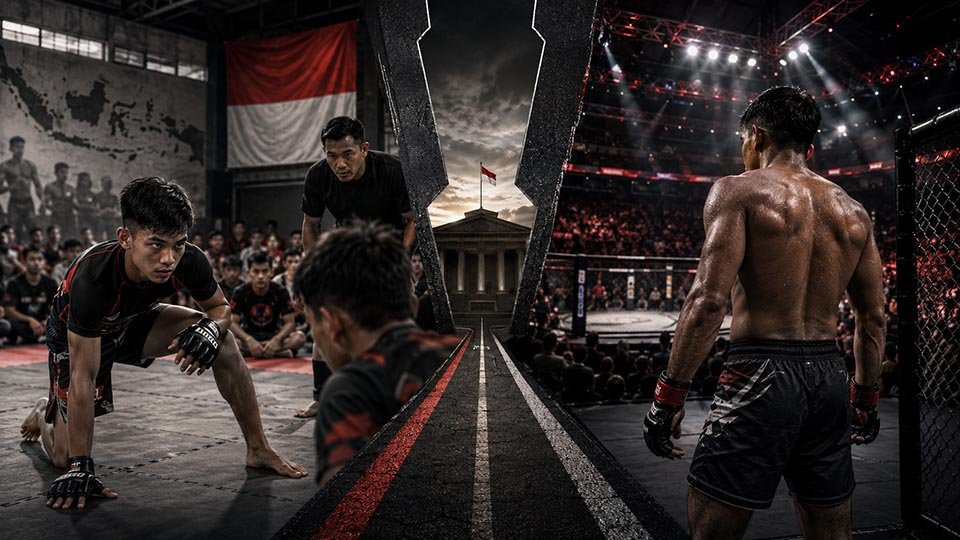
Indonesian MMA no longer sits under one institutional track. IBCA now holds the internationally recognized amateur mandate, while KOBI remains focused on professional competition. The division clarifies who develops fighters and who operates at the paid level, but the transition between those systems is still not governed by one universal pathway.
Indonesian MMA now operates through two distinct institutional tracks. IBCA holds the internationally recognized amateur mandate, while KOBI remains centered on professional competition. The division is clearer than it was several years ago, but it does not mean either organization controls every part of MMA in Indonesia.
Ask who governs Indonesian MMA and the answer depends on where the fighter stands.
At amateur level, the clearest institutional authority is Indonesia Beladiri Campuran Amatir, or IBCA. The International Mixed Martial Arts Federation currently lists IBCA as its national federation for Indonesia, giving the organization a defined route into international amateur competition.
Professional MMA follows another track.

The Komite Olahraga Beladiri Indonesia, or KOBI, describes itself as an organization for professional MMA and assigns itself functions covering development, education for fighters and officials, technical policy and professional competition. Its institutional identity has also been closely connected to One Pride MMA. KOBI’s organizational profile explicitly defines its domain as professional mixed martial arts.
That separation did not emerge overnight.
It was negotiated.
KOBI Once Covered More of the MMA Structure
KOBI was established on November 17, 2015, during the period when professional MMA was beginning to acquire a more consistent domestic platform.
Its stated mission extended beyond staging contests. The organization set out to develop professional MMA, train athletes, coaches and officials, formulate policies and build relationships with international organizations.
KOBI later became Indonesia’s member of the International Mixed Martial Arts Federation. According to IMMAF, that relationship began in 2019.
At that stage, the boundary between amateur development and the professional product was less distinct.
KOBI could participate in international federation structures while remaining deeply involved in domestic commercial MMA. That arrangement became harder to maintain as the amateur side expanded.
A dedicated developmental organization eventually took that responsibility.
The November 2023 Agreement Changed the Structure
The decisive institutional change came on November 30, 2023.
KOBI and IBCA formalized an agreement that transferred responsibility for amateur MMA development to IBCA. IMMAF later confirmed the arrangement when it recognized IBCA as Indonesia’s new MMA federation in April 2025.
The federation described the division plainly: IBCA would focus on developing amateur talent, while KOBI would continue operating in the professional MMA space.
That decision matters because amateur and professional MMA perform different jobs.
One is supposed to build competitors.
The other sells fights.
Combining both functions inside one organization can create overlapping incentives. A developmental federation needs tournaments, provincial participation, coaching systems and international amateur pathways. A professional operator works around matchmaking, commercial events, championships, broadcast products and fighter careers.
Separating those responsibilities gives each side a more defined purpose.
IBCA Now Owns the International Amateur Pathway
IBCA’s position is strongest when the question concerns amateur competition.
Its admission to IMMAF means an Indonesian athlete competing within that structure has a recognized route toward international federation championships. The current IMMAF federation directory identifies IBCA under Indonesia and lists I Made Susila Adnyana as president.
The organization also sits inside Indonesia’s domestic performance-sport environment.
In July 2023, Kemenpora reported that IBCA MMA had entered KONI Pusat, connecting the discipline with the country’s established multi-sport development structure.
That pathway subsequently became visible in competition.
IBCA MMA appeared as an exhibition discipline at the 2024 PON Aceh–North Sumatra cycle. The event involved 96 competitors from 22 provinces, according to an account published by the Indonesian Air Force.
This is the amateur side’s central function: create enough provincial competition that a fighter can develop before professional matchmaking becomes the primary concern.
KOBI Remains Anchored to Professional MMA
KOBI’s role sits on the other side of that transition.
Its own constitution-style description focuses explicitly on professional MMA, including policies, athlete and official education, technical development and the creation of recurring professional competition.
One Pride provides the most visible example of that function.
Kemenpora described One Pride MMA as a competition organized by KOBI when Sports Minister Dito Ariotedjo attended Fight Night 72 in September 2023.
IMMAF uses somewhat different terminology. When announcing IBCA’s recognition, the international federation said KOBI would continue as a private promoter within the professional MMA space.
The wording is important.
KOBI presents itself as a professional MMA organization with regulatory and developmental functions. IMMAF’s description emphasizes its professional commercial role.
Both point toward the same boundary: KOBI is no longer Indonesia’s IMMAF amateur federation.
An Amateur Fighter Does Not Automatically Become a KOBI Professional
The division can easily be misunderstood as a single conveyor belt:
IBCA amateur competition, then KOBI professional competition.
In practice, the structure is not yet that simple.
Publicly available institutional material establishes a division of responsibility between amateur and professional MMA, but it does not show a universal licensing rule requiring every Indonesian professional to complete a prescribed number of IBCA bouts before entering KOBI-linked competition.
That distinction matters.
A pathway allows athletes to progress between systems.
A mandatory licensing pipeline sets formal prerequisites before they can do so.
Indonesia clearly has the first. The case for a standardized second remains less established.
Formal transition criteria could eventually define minimum experience, medical documentation, suspension history and competitive readiness before an amateur enters full professional rules.
Without those common requirements, the two-track structure can still leave a gap precisely where the athlete changes status.
Neither Organization Replaced BOPI
KOBI and IBCA also operate inside a larger regulatory environment.
Indonesia abolished the Badan Olahraga Profesional Indonesia through Presidential Regulation No. 112 of 2020. No single combat-sports commission replaced it.
The broader national framework now includes Law No. 11 of 2022 on Sports, while individual organizations handle discipline-specific functions.
That means KOBI does not function as a replacement national ministry.
IBCA is not a state athletic commission either.
Event organizers remain subject to government requirements beyond sporting sanctioning, and public-event permissions involve authorities outside either MMA body.
“Control” therefore needs qualification.
The Real Division Is Development Versus Profession
For Indonesian MMA, the institutional map is now easier to read than it was before the 2023 agreement.
IBCA is the amateur federation recognized by IMMAF and connected to Indonesia’s domestic performance-sport structure.
KOBI operates on the professional side, with its institutional history and event activity closely tied to commercial MMA.
What remains unresolved is the bridge between them.
A functioning national MMA system needs more than separate organizations at either end of a fighter’s career. Medical records should travel with the athlete. Suspensions need recognition across competition environments. Technical readiness requires measurable standards, while the decision to turn professional should mean more than finding a promoter prepared to offer a bout.
Indonesia has now separated amateur development from the professional product.
The next question is whether those two systems can connect without leaving the fighter to cross the gap alone.