VOF - Voice of Fighter
  • Fight
  • Fighters
  • MMA
  • Boxing
  • Muay Thai
  • Martial Arts
  • Self-Defense
No Result
View All Result
VOF - Voice of Fighter
  • Fight
  • Fighters
  • MMA
  • Boxing
  • Muay Thai
  • Martial Arts
  • Self-Defense
No Result
View All Result
VOF - Voice of Fighter
No Result
View All Result

Boxing Promotion in Indonesia: The Patron Problem

July 11, 2026
Home Business
Share on Facebook
Share on Twitter
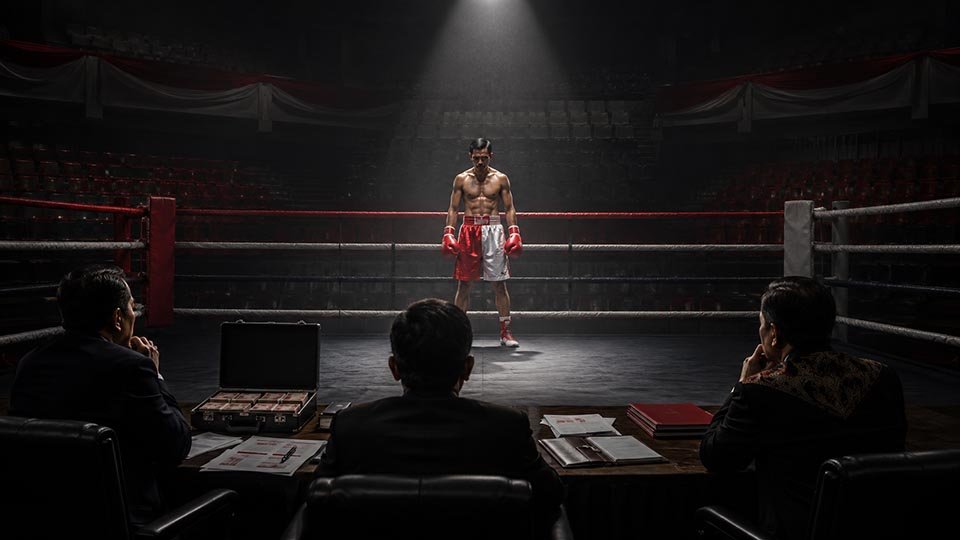
Indonesian boxing has repeatedly produced fighters worth watching. Financing the fights has been harder. For years, major cards often depended on individual promoters, personal capital and backers willing to absorb risks that the market itself could not reliably cover.

In March 2006, Indonesia had an IBF world champion who needed a fight.

Muhammad Rachman was supposed to defend his minimumweight title against Mexico’s Omar Soto. The opportunity existed. The sanctioning route was available.

The money was not.

Promoter Dondon Sugiarto said he could not finance the bout after another prospective backer withdrew from an arrangement worth Rp250 million. The fight eventually returned to the bidding process because the Indonesian promoters involved could not fund it.


Related Post

Chris John fights Simpiwe Vetyeka during their 2013 featherweight title bout in Perth.

After Chris John: Why Indonesia Failed to Build the Next Boxing Generation

July 12, 2026
Indonesian Boxing Champions: Pical, John and Yordan

Indonesian Boxing Champions: Pical, John and Yordan

July 10, 2026

Indonesian Boxing Television: How TV Built the Sport

July 9, 2026

What Replaced BOPI in Indonesian Professional Combat Sports?

July 8, 2026

It was a small episode compared with the careers of Ellyas Pical, Chris John or Daud Yordan.

But it exposed a problem that followed Indonesian professional boxing for years.

A fighter could earn a world title.

That did not mean the domestic market could finance the next defense.

The Promoter Was Often the Financial System

Professional boxing needs somebody willing to spend before revenue arrives.

The promoter books the venue, secures opponents, handles sanctioning requirements, sells sponsorship, negotiates broadcast arrangements and hopes ticket sales or commercial partnerships cover the bill.

In a mature market, those risks can be spread across recurring media rights, sponsorship contracts, ticket revenue and a stable event calendar.

Indonesia often relied more heavily on the person staging the card.

That distinction became visible even around Chris John.

In 2010, the Indonesian Boxing Commission said it was prepared to find both a promoter and financial backer for John’s next title defense. KTI chairman Anthon Sihombing explained why promoters were reluctant: without an option giving them rights to a future bout, one unsuccessful event could leave them with losses and no chance to recover the investment later.

The economics were not built around predictable returns.

They depended on whether someone was willing to take the risk.

Even Chris John Was Not Protected From Fragile Financing

John’s championship reign can make that period look commercially stronger than it was.

Behind the title defenses, financial arrangements could remain uncertain.

In August 2010, John’s wife, Anna Maria Megawati, publicly called for greater transparency around sponsorship and fight contracts. She said John had personally spent Rp1 billion on his January 2008 defense against Roinet Caballero and described uncertainty around the financial terms of another proposed bout.

The significance goes beyond one management dispute.

If Indonesia’s most valuable boxer could put substantial personal money into staging a championship fight, the business surrounding professional boxing was not automatically generating enough institutional capital to carry its leading athlete.

A world title increased visibility.

It did not remove financial risk.

Promoters Needed More Than One Night

The problem was partly structural.

A promoter investing in one fight has limited ways to recover a loss. Rights over future contests change that calculation because the athlete becomes a continuing commercial asset rather than a one-night expense.

Sihombing’s 2010 explanation of the option system made the logic explicit: a promoter might lose money on one card but recover it through a subsequent event if contractual rights remained in place. Without that possibility, financing a major bout became less attractive.

Indonesian boxing therefore faced more than a shortage of generous backers.

Its promoters needed business models capable of surviving an unsuccessful event.

That is harder than finding somebody willing to write a cheque.

Tickets and Sponsors Helped, but the Model Remained Event-Driven

There were attempts to build a broader commercial package.

For the April 2011 fight between Chris John and Daud Yordan, promoter Raja Sapta Oktohari’s team printed 3,440 tickets, with standard seats priced at Rp200,000 and premium table seating at Rp3 million per person. The promoter targeted a 90 to 95 percent sell-through after reporting similar attendance for John’s previous Jakarta appearance.

That card also had a confirmed sponsor while organizers sought additional commercial support shortly before the event.

This was closer to a diversified fight business: tickets, sponsorship and a recognizable main event working together.

Still, the economic unit remained the card.

Once one event ended, another had to be financed.

A sustainable industry needs revenue relationships that survive the final bell.

The Cost Was Eventually Passed Down to Fighters

Weak promotion economics did not stay inside the promoter’s office.

They reached the boxer.

In 2010, KTI chairman Anthon Sihombing said a fighter competing in a 12-round national championship could receive only Rp5 million, an amount he described as insufficient against the cost of preparation. He also said some athletes had competed on nationally televised cards without receiving a purse, with managers occasionally paying them simply to keep them active.

Those examples show why promoter finance matters to athlete development.

A boxer cannot build a professional career from training alone.

Rent continues between fights. Camp expenses arrive before the purse. Coaches, nutrition, travel and equipment have to be covered regardless of whether the next event is commercially successful.

When promotion is unstable, fighters absorb part of that instability.

Chris John Saw the Problem After Retirement

By 2015, John was describing Indonesian professional boxing as dormant because fighters had too few opportunities and promoters were disappearing.

He contrasted the situation with his own 15-year career, during which a promoter handled the commercial side while he concentrated on training and competing. John also pointed to Daud Yordan’s difficulty finding fights as evidence that having a capable boxer was not enough without somebody willing to package the event.

A year later, he tried to address the problem himself.

John announced plans to develop a promotion company capable of staging regular events and helping Indonesian fighters reach international competition. Funding remained central to the plan: he spoke about seeking corporate sponsorship and possible cooperation with state-owned enterprises.

The country’s most successful modern boxer had moved from fighting to solving the financial problem that surrounded fighters.

That transition says something about the structure he left behind.

Patronage Can Produce a Champion. It Cannot Guarantee a Generation.

Individual backers are not inherently bad for boxing.

Many important fights would never happen without people willing to take financial risks.

The weakness appears when personal backing becomes the system rather than one part of it.

A patron can support a promising boxer.

A promoter can finance a world-title opportunity.

A local government, company or wealthy supporter can make one major night possible.

None of those arrangements guarantees the next card, the next prospect or the next three years of development.

Indonesia’s boxing problem was not a lack of people willing to help.

It was the difficulty of turning that help into recurring commercial infrastructure.

The stronger model is less dependent on finding another benefactor. Promotions need calendars that sponsors can buy across multiple events, media products that keep fighters visible between bouts, contractual structures that reward long-term development and ticketing that contributes meaningful revenue instead of functioning as a secondary income stream.

That changes the question.

Instead of asking who will fund this fight, Indonesian boxing has to ask whether the business can finance the one after it.

That is the difference between patronage and an industry.
Related Posts

Chris John fights Simpiwe Vetyeka during their 2013 featherweight title bout in Perth.
Boxing

After Chris John: Why Indonesia Failed to Build the Next Boxing Generation

by Voice of Fighter
July 12, 2026
Indonesian Boxing Champions: Pical, John and Yordan
Boxing

Indonesian Boxing Champions: Pical, John and Yordan

by Voice of Fighter
July 10, 2026
Professional boxing match broadcast on Indonesian television during the sport's terrestrial TV era.
Business

Indonesian Boxing Television: How TV Built the Sport

by Voice of Fighter
July 9, 2026

Recommended

Professional fighter reviewing a bout agreement before signing a combat sports contract

Promotional Agreement vs. Bout Agreement: What Is a Fighter Actually Signing?

July 2, 2026
mi Lichtenfeld and the historical development of Krav Maga from Bratislava street defense to modern self-defense training.

The History of Krav Maga: From Bratislava Street Defense to a Global Self-Defense System

August 22, 2026
Young taekwondo athletes compete during a youth selection event in Jakarta ahead of the Onepride Future Champ Taekwondo Series 2026.

Onepride Future Champ Taekwondo Series Moves Toward September Event After Jakarta Selection

August 21, 2026
Two young fighters exchange punches inside a boxing ring during Born to Fight Vol. 2 at HAN Fighting Academy in Colomadu, Karanganyar.

HAN Academy Hosts Around 200 Fighters at Born to Fight Vol. 2

September 7, 2026
Two young fighters exchange punches inside a boxing ring during Born to Fight Vol. 2 at HAN Fighting Academy in Colomadu, Karanganyar.

HAN Academy Hosts Around 200 Fighters at Born to Fight Vol. 2

September 7, 2026
Boxing, kickboxing and MMA fighters representing the combat disciplines featured at Born to Fight Vol. 2 in Karanganyar.

Born to Fight Vol. 2 Highlights the People and Places Behind Every Fighter

August 29, 2026
Pencak silat athletes compete at the Indonesia Pencak Silat Banten Championship 2026 in Serang, Banten.

Banten Pushes Mandatory Pencak Silat in Schools to Expand Athlete Pipeline

August 29, 2026
Gregory Rodrigues throws a right hand against Anthony Hernandez during the UFC Sacramento middleweight main event.

Gregory Rodrigues Beats Anthony Hernandez at UFC Sacramento

August 23, 2026
Voice of Fighter

Voice of Fighter is an independent combat media platform covering combat sports, martial arts, and self-defense — from the fight itself to the people, systems, and culture behind it.

Recent Posts

  • HAN Academy Hosts Around 200 Fighters at Born to Fight Vol. 2
  • Born to Fight Vol. 2 Highlights the People and Places Behind Every Fighter
  • Banten Pushes Mandatory Pencak Silat in Schools to Expand Athlete Pipeline

Categories

  • Boxing
  • Business
  • Fighters
  • Grappling
  • Martial Arts
  • MMA
  • Muay Thai
  • Radar
  • Self-Defense
  • About
  • Editorial Standards
  • Corrections
  • Ownership
  • Privacy

© 2026 VOF - Independent Combat Media by Tabooo.

No Result
View All Result
  • Fight
  • Fighters
  • MMA
  • Boxing
  • Muay Thai
  • Martial Arts
  • Self-Defense

© 2026 VOF - Independent Combat Media by Tabooo.