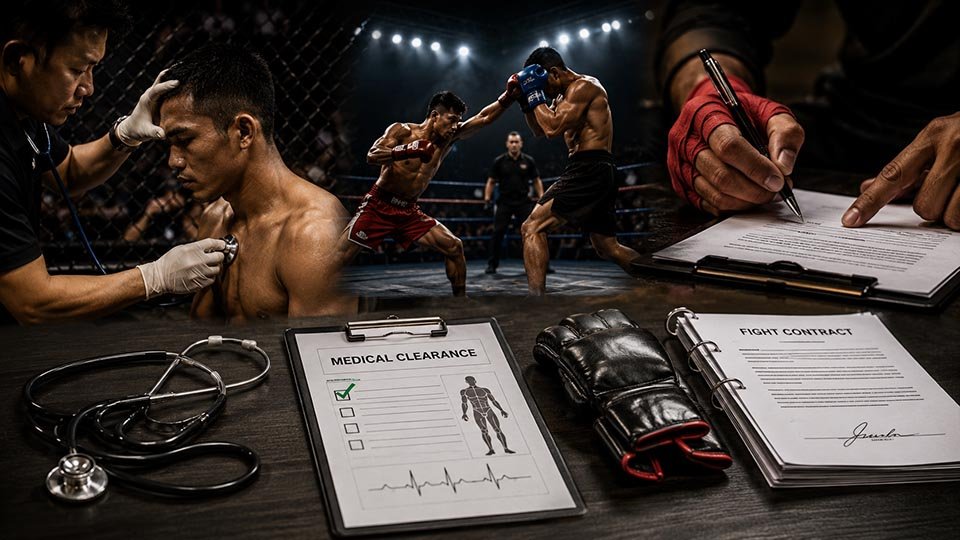
A fighter accepts the physical danger of competition, not avoidable failures around it. Medical clearance, fair matchmaking, written contracts, insurance and enforceable suspensions should protect athletes before the first strike lands—especially in a system where responsibility is divided across promoters, sanctioning bodies and public authorities.
A fighter accepts the physical risk of competition. That agreement should not extend to an undisclosed medical condition, an opponent selected without adequate scrutiny, an unclear purse, missing insurance or a suspension that disappears when the athlete moves to another commission. Fighter safety begins before either corner enters the ring.
On February 27, 2022, Indonesian lightweight Hero Tito fought James Mokoginta in Jakarta.
He was knocked out in the seventh round, hospitalized with brain swelling and died after spending five days in a coma. Hero Tito was 35.
His death does not, by itself, establish that one regulation, doctor or official failed. Combat sports carry inherent danger even when safeguards are followed.

It does establish the stakes.
The responsibility surrounding a fighter cannot begin when a referee says fight. It starts with determining whether the athlete should compete, whether the opponent represents a defensible matchup and whether the agreement explains what happens financially if something goes wrong.
Indonesia already recognizes several of those principles in law.
The harder question is whether they operate consistently across every ring, cage and sanctioning structure.
Medical Clearance Is More Than Passing a Physical
Indonesia’s Law No. 11 of 2022 on Sports states that someone becoming a professional athlete must satisfy both employment and medical requirements. Professional competitors also have the right to support from health personnel, alongside managers, coaches, psychologists, lawyers and other specialists where required.
The same statute places responsibility on organizers or sporting authorities to provide appropriate health personnel during training and competition.
Those provisions establish an obligation.
They do not answer every ringside question.
A meaningful combat-sports medical system needs to determine whether an athlete has recovered from previous damage, not simply whether blood pressure and pulse appear acceptable on fight week.
International standards illustrate the difference.
The World Boxing Association requires a boxer who suffers a knockout to serve a minimum 60-day suspension and undergo medical evaluation before returning. (WBA rules)
Amateur MMA follows the same underlying principle. IMMAF competition rules require pre-contest examinations, supervised weigh-ins and a medical assessment immediately after competition. (IMMAF medical requirements)
The critical information is therefore not only can this fighter compete tonight?
Officials also need to know what happened last month.
A Suspension Has to Follow the Fighter
Indonesia’s combat-sports structure makes record sharing particularly important.
Professional boxing operates through several commissions. MMA has separate amateur and professional institutional tracks. Hybrid cards may involve other sanctioning organizations.
That creates a simple safety problem.
A suspension issued by one body offers limited protection if the next organizer does not know it exists.
The Association of Boxing Commissions’ safety framework provides a useful international comparison. Its rules call for commissions to check professional records and medical certification, prevent fighters from competing while suspended after knockouts or injuries, and report results and suspensions into a shared registry.
That system is not Indonesian law.
Its logic is relevant here.
A fighter’s knockout history should not reset because a different commission sanctions the next contest. Neither should a concussion, failed medical examination or compulsory rest period disappear when an athlete changes promotion.
Without interoperable records, fragmentation becomes a medical issue.
Matchmaking Is Part of Fighter Safety
A doctor can clear two athletes individually while the pairing between them remains questionable.
That is why matchmaking belongs inside the safety conversation.
Records alone do not establish competitive equivalence. A responsible assessment also considers experience, quality of opposition, recent results, age, weight, periods of inactivity and previous stoppages.
A 10-2 fighter and another athlete with the same record may have faced entirely different levels of opposition.
Recent damage matters even more.
Someone returning from a knockout should not be evaluated as though the previous bout were merely another loss on a record sheet.
Indonesia’s Sports Law requires championship organizers to satisfy technical, health and safety requirements. Failure to meet those standards can carry criminal penalties under Article 103.
What the national framework does not provide publicly is one universal combat-sports matchmaking formula applied across every professional sanctioning organization.
That leaves considerable responsibility with commissions, matchmakers and promoters.
Commercial pressure complicates the decision.
A replacement opponent may be needed days before an event. Broadcast schedules are fixed. Tickets have been sold. Sponsors expect a card.
None of those facts changes the fighter’s physiology.
A short-notice replacement should still be a defensible opponent.
The Contract Should Explain the Risk Before the Fighter Accepts It
Physical protection is only one part of fighter safety in Indonesia.
Economic vulnerability matters because an athlete who lacks bargaining power may accept conditions that someone with stable income, management and legal representation would reject.
Indonesian law recognizes professional sport as paid work. Article 59 provides professional athletes with the right to appropriate support, including legal expertise, and states that they are entitled to reasonable income under standards determined by their professional sport.
The statute establishes the principle but does not publicly prescribe one detailed bout-contract template for every Indonesian combat discipline.
That makes the written agreement critical.
Before committing, a fighter should be able to identify the opponent, contracted weight, number of rounds, purse, payment timing, expenses, deductions, cancellation terms, medical responsibility, insurance coverage and any rights granted over future appearances or commercial use of the athlete’s identity.
Those are not theoretical concerns.
The ABC’s model professional boxing contract specifies the opponent, contest length, weight, purse and expenses while requiring deductions from the fighter’s payment to be disclosed.
Its Professional Boxers’ Bill of Rights goes further: fighters should receive written contracts, retain copies, understand deductions, know their opponent and purse before the bout, and receive information about medical insurance.
Again, those American provisions do not govern Indonesian contracts.
They show what transparency can look like.
A fighter should not discover the economics after taking the punches.
Insurance Cannot Be an Optional Detail
Indonesia’s own statute provides a stronger foundation here.
Article 100 of Law No. 11 of 2022 states that athletes and other sports participants are to receive social-security protection through the national social-security system.
Some Indonesian combat promotions have already put that principle into practice.
In 2023, athletes competing at Holywings Sport Show Series 3 were enrolled in BPJS Ketenagakerjaan protection. The arrangement covered competitors through the Jaminan Kecelakaan Kerja and Jaminan Kematian programs, with medical treatment for covered work-related injuries provided according to medical need. (HSS athlete protection)
BYON Combat also enrolled participating boxers in BPJS Ketenagakerjaan protection for its 2023 event. (BYON athlete coverage)
Those examples matter because insurance answers a question that becomes urgent only after an injury occurs:
Who pays?
Ambulance transport, surgery, hospitalization and rehabilitation cannot depend on a post-fight negotiation between an injured athlete and an organizer.
Coverage should be known before the contract is signed.
The Fighter Also Needs Protection From Conflicted Decisions
Combat sports contain an unusual power structure.
The athlete takes the physical damage, yet other parties often control the opponent, event date, purse, officials, promotional opportunity and future booking.
That imbalance becomes more sensitive when the organization enforcing sporting standards has a close commercial relationship with the promotion paying for the event.
It does not automatically prove misconduct.
It creates a reason for transparency.
Medical clearance should belong to qualified health personnel rather than commercial staff. Officials need authority to stop a contest regardless of the consequences for the broadcast. A sanctioning body must be capable of rejecting an unsafe pairing even when the promoter wants it.
Contract disputes also require somewhere to go.
Indonesia’s Sports Law provides a sequence for sporting disputes beginning with deliberation, followed where necessary by mediation, conciliation or arbitration.
A fighter should know that mechanism before a disagreement over payment or contractual rights occurs.
Protection Means Being Able to Say No
Combat sports cannot be made risk-free.
Punches to the head remain punches to the head. MMA still permits strikes, takedowns and submissions designed to force an opponent to stop. No medical examination can eliminate every possibility of catastrophic injury.
Regulation has a different job.
It should stop preventable risk from being added to unavoidable danger.
That means refusing a fighter who has not medically recovered. It means checking the opponent rather than filling an empty slot on the card. It requires documenting the purse instead of settling payment through verbal promises. Medical coverage must exist before the ambulance is needed, while suspensions should follow the athlete across organizational boundaries.
Most importantly, a fighter needs enough information and institutional protection to decline a contest without placing an entire career at risk.
The athlete accepts the fight.
The system should make sure that is the only risk being accepted.