Indonesia has produced world champions, sent a fighter to the UFC and built combat events capable of attracting a mass digital audience. The harder question is whether matchmaking, athlete development, management, regulation, media and capital are connected well enough to turn those achievements into an industry.
Indonesia does not have a shortage of fighters.
The country has produced boxing champions, developed athletes through Pencak Silat, Wushu and other martial arts, built a recurring domestic MMA circuit and sent Jeka Saragih to the UFC. Digital-first promotions have also demonstrated that an Indonesian combat event can sell attention beyond the traditional fight audience.
Those are significant assets.
They are not the same thing as an industry.


A fight industry exists when talent can enter a system and move through it: from the regional gym to appropriate competition, from competition to professional management, from management to better matchmaking, from domestic success to international opportunity, while promoters, broadcasters and sponsors have enough commercial certainty to keep financing the process.
Indonesia has parts of that chain.
The problem is that those parts still operate with different levels of maturity and often under different incentives.
A fighter can win domestically without having the training environment required internationally. A promoter can build a commercially successful event without developing the athletes beneath it. A company can spend billions of rupiah on sport without that money entering professional combat. A gym can produce talent without controlling where that talent competes next.
The result is a market capable of producing breakthroughs but still struggling to reproduce them.
Boxing Proved That Champions Are Not an Industry
Professional boxing provides the clearest historical warning.
Source validation — World Boxing Association:
His career demonstrated that an Indonesian boxer could remain at world level over an extended period.
But Indonesian boxing’s problems were visible even when national television still carried the sport regularly.
A 2007 report by Inside Indonesia documented an environment in which RCTI and Indosiar were broadcasting live fight cards weekly, while professional boxing governance had already splintered across organizations including KTI, ATI and KTPI. The same report examined safety failures and mismatches inside the domestic market.
That history matters because it separates popularity from infrastructure.
A sport can have television.
It can have recognizable champions.
It can have promoters.
It can have an audience.
And the underlying system can still be fragile.
Chris John’s longevity was an achievement by the fighter and the people around him. What Indonesia did not establish at the same scale was an institutional machine capable of repeatedly moving prospects from domestic boxing into durable world-level careers.
That is the distinction between producing a champion and producing continuity.
A mature industry does not depend on waiting for another exceptional athlete to appear.
It increases the probability that one will.
MMA Created a More Regular Domestic Route
Mixed martial arts later supplied another professional pathway.
One Pride MMA began national television distribution on tvOne in August 2016. After six years, the program moved to ANTV in September 2022. That continuity gave Indonesian MMA fighters something structurally important: a recurring domestic competitive platform rather than isolated opportunities.
Regular competition solves one problem.
It does not solve the entire development pathway.
Indonesia already has athletes emerging from Pencak Silat, Wushu, Taekwondo, Judo, boxing and other disciplines. Those systems can produce timing, conditioning, movement, competitive experience and discipline-specific technical ability.
MMA requires those skills to operate inside a different technical environment.
A striker must defend takedowns.
A judoka has to work without relying on gi grips.
A Wushu or Silat athlete has to understand how striking changes when an opponent can convert an exchange into wrestling.
A fighter must move between striking, clinch work, takedown defense, positional control and submissions without treating them as separate sports.
That demands an integrated training environment.
Indonesia has such environments.
Access is another question.
High-Level Training Exists. Access Is Uneven.
Bali MMA illustrates both sides of the problem.
The gym says it was founded in 2014 and built around MMA, wrestling, Brazilian Jiu-Jitsu, Muay Thai and related training. Its founders include former NCAA Division I wrestler Don Carlo-Clauss, Andrew Leone and Steve Suryadinata.
For an Indonesian athlete, a facility like that means high-level coaching can be accessed without leaving the country.
But location is not the same as affordability.
Those figures do not include accommodation, food, transport, equipment, medical expenses or the income an athlete may sacrifice by training full time.
For an established fighter with sponsorship, those costs may be manageable.
For a prospect from outside Bali without a commercial backer, they can become part of the selection mechanism.
Talent determines only part of who reaches the better room.
Money determines access to it.
That creates a different development question: not whether Indonesia possesses advanced coaching, but whether promising athletes can reach it early enough and remain there long enough for it to matter.
Jeka Saragih Shows What Happens When the Resources Align
During his Road to UFC campaign, Mola financed an intensive training period in San Diego. ANTARA reported in August 2022 that Saragih would work with wrestling coach Marc Fiore, assisted by Brazilian Jiu-Jitsu black belt Jacob Buracker.
The intervention mattered because Saragih was moving from domestic MMA into a tournament designed to identify UFC-level Asian talent.
He defeated Pawan Maan Singh and Ki Won Bin to reach the inaugural Road to UFC lightweight final.
Anshul Jubli stopped him by strikes at 3:44 of the second round.
Saragih still received a UFC contract.
UFC later described him as the first Indonesian fighter to earn a place on its roster.
His first UFC victory followed in November 2023. Saragih knocked out Lucas Alexander with a right hand at 1:31 of the first round, becoming the first Indonesian to win inside the promotion.
The next two fights showed how unforgiving that level can be.
Westin Wilson submitted Saragih by armbar at 1:49 of the first round in June 2024.
At UFC 316 on June 7, 2025, JooSang Yoo knocked him out with a left hook after 28 seconds.
Saragih’s career should not be reduced to whether he succeeded or failed in the UFC.
It reveals something more useful.
When an Indonesian fighter received international coaching, financial support, professional management and access to the right competition, he reached the UFC.
That establishes possibility.
It does not establish scalability.
The industry question is how many Indonesian prospects can receive comparable preparation before an international opportunity forces the issue.
A functioning pipeline should not discover a fighter’s technical and financial requirements only after he becomes nationally valuable.
It should identify them while he is still developing.
Regulation Changed, but the Architecture Is Still Divided
Professional combat also requires something fighters cannot build themselves: credible governance.
The significance for combat sports is structural.
Indonesia no longer has BOPI functioning as the dedicated non-structural professional-sport body that previously sat inside that landscape.
MMA has subsequently developed a clearer amateur-professional division of its own.
That provides one useful separation: amateur development does not have to be identical to professional promotion.
But it does not create a single regulatory architecture for every form of professional combat operating in Indonesia.
Boxing, MMA, kickboxing and crossover cards can sit within different organizational and sanctioning arrangements.
That makes the next issue less about the name of any one institution and more about standards.
For an industry to mature, fighters and promoters need predictable answers on medical requirements, licensing, contractual disputes, matchmaking responsibility and event safety.
The existing public-source record establishes fragmentation of functions.
It does not, by itself, prove that every Indonesian promotion applies inadequate standards. That would require promotion-by-promotion examination.
The distinction matters.
Fragmentation is a structural fact.
Poor practice must still be demonstrated case by case.
Digital Promotions Solved a Problem Traditional Combat Often Struggled With: Attention
While institutional development moved unevenly, Indonesian fight promotion changed quickly.
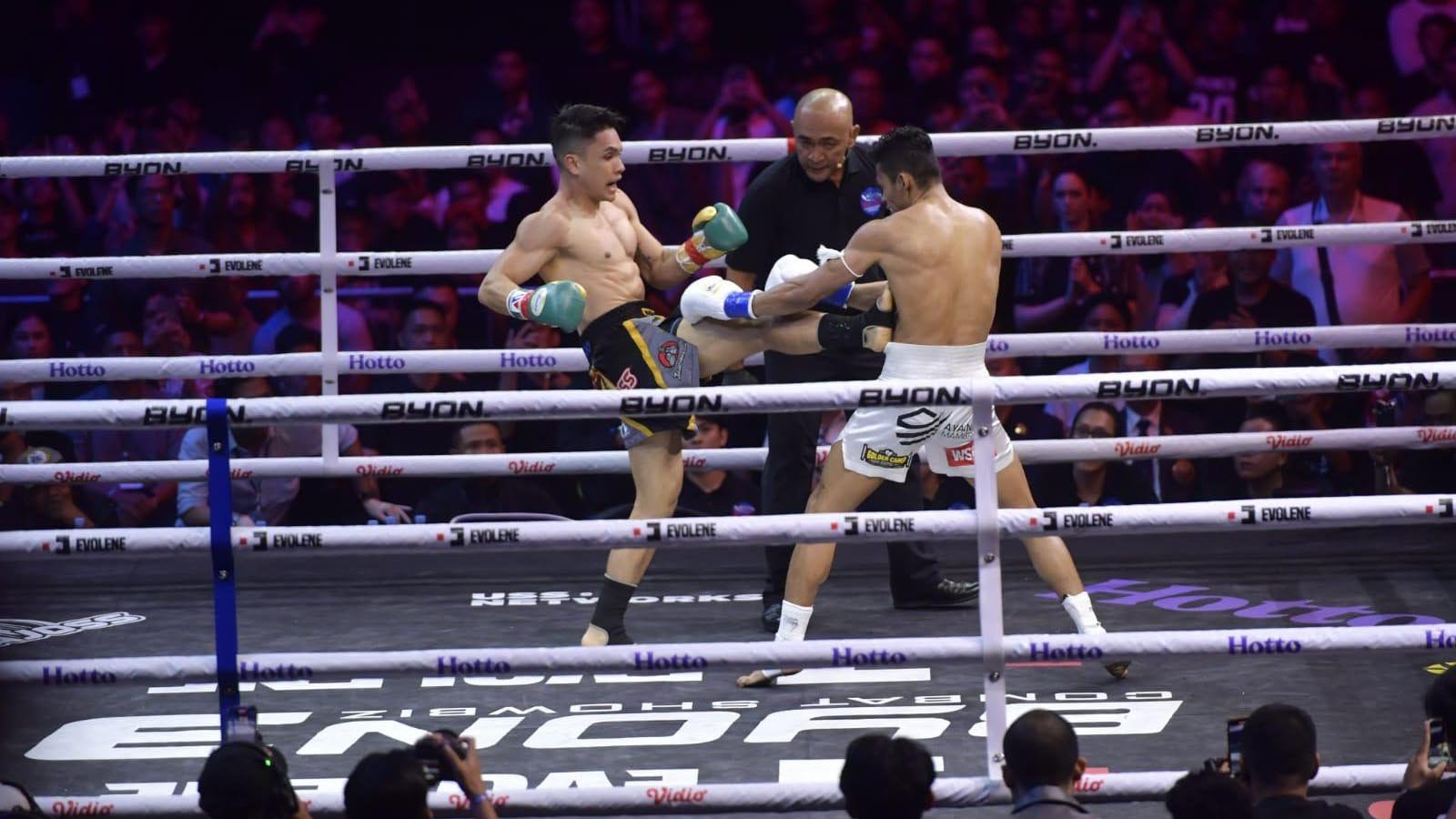
BYON built its model around digital distribution, crossover personalities, professional fighters, national rivalry and pay-per-view.
The numbers require careful attribution because much of the audience data comes from the promoter itself.
Those are BYON’s figures, not independently audited VOF measurements.
There is, however, external confirmation that the format has generated substantial transactional demand.
This matters because BYON has addressed a commercial problem that sporting legitimacy alone cannot solve.
A technically excellent fight has limited commercial value if few people know it is happening.
Digital promotions begin somewhere else.
They build the narrative first.
A creator or recognizable personality supplies an existing audience. National rivalry or interpersonal tension creates a reason to follow the buildup. Short-form content distributes the story. PPV converts a portion of that attention into revenue.
The commercial sequence is different from the traditional assumption that sporting achievement will automatically create mass interest.
For professional fighters, the tension is obvious.
A creator can arrive at a fight with an audience already attached.
A career fighter often has to build technical credibility and public visibility at the same time.
But dismissing crossover combat would ignore what the model has demonstrated.
Indonesia has people willing to pay specifically to watch locally produced combat entertainment.
That is commercially important.
The deeper question is where the money goes next.
Entertainment Can Finance Sport — If the Card Is Designed That Way
Crossover fights do not automatically weaken professional combat.
A popular headliner can subsidize the rest of a card.
If a creator-driven matchup generates the ticket sales, sponsorship inventory and PPV purchases, that revenue can help pay professional athletes who would struggle to generate the same commercial demand independently.
That model already appears in mixed cards where recognized personalities and trained competitive athletes occupy the same event.
The distinction VOF should make is between using entertainment to finance sport and allowing entertainment to replace the sporting pipeline.
The first can expand the market.
The second produces events without solving development.
Indonesia does not need every fight to satisfy the same purpose.
A commercial show can be a commercial show.
A professional championship can be a professional championship.
Problems begin when the industry lacks clear pathways between entertainment exposure, legitimate matchmaking and long-term athlete progression.
Indonesia Has Sports Capital. That Does Not Mean Fighters Can Access It.
The corporate-capital question is equally important.
Indonesia clearly has companies willing to spend significant money on sport.
The 2024 event included Pencak Silat and Taekwondo alongside football.
Those figures do not show that Bayan should finance professional fighting.
They show something more basic.
Substantial Indonesian corporate sports capital exists.
The fight industry still has to construct credible products capable of competing for it.
That requires more than selling a logo placement for one evening.
A promotion seeking recurring sponsorship must be able to package measurable assets:
Broadcast exposure;
Digital distribution;
Verified audience numbers;
Venue attendance;
Fighter content;
Walkout inventory;
Canvas branding;
Hospitality;
Fan activation;
Social distribution;
and continuing stories between events.
The commercial difference is significant.
Single-event sponsorship finances an event.
Recurring partnerships can finance an organization.
Only the second model gives a promoter greater capacity to invest between fight nights.
The Missing Layer Is Often Between the Fighter and the Promoter
One part of the Indonesian ecosystem receives less public attention than the fighter, gym or event: management.
A professional fighter’s career requires decisions that should not be made solely on the basis of who offers the next bout.
Someone has to evaluate the opponent.
Someone has to negotiate compensation.
Someone has to read exclusivity clauses.
Someone has to assess whether the athlete should change division, change camps, reject a short-notice matchup or pursue an international route.
Someone has to build sponsor value before the athlete becomes famous enough for brands to approach without persuasion.
Someone has to think beyond the next Saturday.
That program is important precisely because it connected functions that are often discussed separately: talent identification, funding, coaching, management and international competition.
The strategic problem is scale.
A national industry cannot depend exclusively on exceptional programs appearing around a small group of selected athletes.
Those connections have to become easier to reproduce.
Thailand Shows What Happens When Combat Becomes an Economic Asset
Indonesia does not need to copy Thailand.
The comparison is still useful.
Commercial infrastructure sits beside that policy.
The important lesson is not that Thailand has solved every problem in combat sports.
It is that Muay Thai exists simultaneously as competition, employment, tourism, cultural identity, training business and media product.
The economic functions reinforce each other.
Singapore Shows Another Model
Singapore operates from almost the opposite starting point.
Its domestic fighter population is far smaller than Indonesia’s, but it has provided corporate infrastructure for a major Asian combat property.
ONE Championship continues to list its corporate address at DUO Tower in Singapore.
The comparison exposes Indonesia’s unusual position.
Indonesia has more domestic fighter supply than Singapore.
It has a martial tradition that can be commercially differentiated from neighboring countries.
It has major population centers, tourism markets and a digitally active fight audience.
It already possesses training facilities capable of serving international athletes.
And its promoters have demonstrated that Indonesians will purchase locally produced combat through PPV.
The assets are present.
The system connecting them remains the larger project.
A Fight Industry Is a Chain
The relevant structure is not complicated to describe.
It is difficult to build.
Grassroots
→ Gym
→ Coaching
→ Amateur Competition
→ Professional Transition
→ Matchmaking
→ Management
→ Promotion
→ Media
→ Sponsorship
→ International Opportunity
→ Career Sustainability
Every link changes the one after it.
Weak coaching produces technical limits.
Weak matchmaking produces bad records or unsafe jumps in opposition.
Weak management transfers negotiating power away from the athlete.
Weak media makes sponsorship harder to sell.
Weak sponsorship limits purses and event frequency.
Infrequent events make professional development difficult.
Limited development reduces international competitiveness.
And when international success finally arrives, the industry can become dependent on the successful fighter rather than the system that produced him.
That is the cycle Indonesia has to break.
The Test Is Not Whether Indonesia Can Produce Another Jeka Saragih
It probably can.
That is not a sufficient measure of progress.
The harder questions concern the fighter who has not yet become valuable enough for the industry to notice.
Can a 19-year-old prospect outside Jakarta or Bali access specialist wrestling and grappling coaching?
Can a domestic champion afford a serious training camp without unrelated employment?
Does someone independent of the promoter evaluate whether the next matchup makes career sense?
Can a manager build commercial value around an athlete before international success?
Can a promotion demonstrate verified audience data to a sponsor?
Can that sponsor commit beyond one event?
Can an athlete move from amateur competition into professional MMA without discovering technical gaps only after reaching international opposition?
Can a fighter lose without losing the financial ability to continue?
Can the industry provide a career after competition ends?
Those questions measure infrastructure.
Belts do not.
Indonesia Already Has Most of the Pieces
The country does not need to invent a combat ecosystem from zero.
Boxing established that Indonesian athletes can sustain world-level success.
One Pride established recurring domestic MMA competition.
Bali MMA demonstrated that international-standard training can operate inside Indonesia.
Jeka Saragih proved that an Indonesian-developed fighter, when connected to international coaching and management, could reach the UFC and win there.
BYON demonstrated that locally produced combat can generate meaningful PPV demand.
Corporate sports programs demonstrate that substantial private capital can enter athletic development.
Pencak Silat and Indonesia’s wider martial arts base provide a talent reservoir few markets can replicate.
These are not minor ingredients.
But ingredients are not infrastructure.
An industry begins when the connection between them becomes predictable.
When a promising fighter does not need an exceptional patron to find advanced coaching.
When a gym understands the pathway beyond domestic competition.
When professional management appears before crisis.
When promoters can plan seasons instead of only cards.
When sponsors buy measurable long-term properties instead of isolated visibility.
When regulation gives participants clear expectations.
When commercial spectacle helps finance competitive development rather than merely borrowing the image of combat.
Indonesia has already answered one question.
It can produce fighters.
The unresolved question is whether it can build a system strong enough that the next breakthrough looks less like an exception.