The public sees the announcement, press conference, scale and walkout. Between those moments, a professional bout has to survive contracts, licensing, medical clearance, anti-doping obligations, weight management and final inspection before a referee can call two fighters forward.
A fight announcement confirms an intention. It does not guarantee that two athletes will eventually meet in the ring or cage.
Between the first promotional graphic and the opening bell, a professional contest moves through several systems at once. Contractual terms establish who competes, under what conditions and for how much. Regulators determine whether each athlete is licensed and medically eligible. Anti-doping rules can remain active throughout training camp. Fight Week adds media duties, administrative checks and the official weigh-in. Hours before competition, inspectors still have to approve hand wraps, gloves and other equipment.
Any one of those stages can derail the matchup.
There is also no universal pre-fight procedure. Requirements change between jurisdictions, disciplines and promotions. Nevada operates under its own athletic commission rules. California has another regulatory framework. The UFC maintains a separate anti-doping program for contracted athletes. ONE Championship uses hydration testing alongside the scale.


The sequence is recognizable across professional combat sports, but the authority behind each checkpoint matters.
So, what happens before a professional fight?
The answer begins long before Fight Week.
The Matchup Has to Exist on Paper
A public announcement usually comes after promoters, managers and fighters have agreed on the core terms of a contest, although contracts can differ considerably between organizations.
At minimum, the parties need to establish the opponent, date, weight division, compensation and other obligations surrounding the appearance.
A fighter may also be tied to a longer promotional relationship that reaches beyond a single card.
A professional MMA agreement filed with the U.S. Securities and Exchange Commission provides a concrete example. The contract between Cage Fury Fighting Championships and fighter Jared Gordon covered multiple bouts, granted the promotion exclusivity during the term and specified separate payments for appearing and winning. For the first contest listed, Gordon was contracted to receive $1,600 to show and another $1,600 if he won. The document also addressed outside competition and circumstances under which the athlete could be released. The full fighter agreement is available through the SEC archive.
That filing should not be mistaken for a universal compensation model. Fighter contracts vary by promotion, market, bargaining power and jurisdiction.
What it demonstrates is the machinery beneath a matchup.
The purse is not simply a number announced after negotiations. It can sit beside exclusivity provisions, ticket obligations, medical requirements, promotional rights and conditions governing future appearances.
Before two athletes can fight each other, the business relationship has to survive its first test: both sides must still be capable of delivering the contest they agreed to stage.
A Contract Does Not Make a Fighter Eligible
Signing is only one layer.
In regulated markets, professional contestants must also satisfy the authority responsible for licensing and supervising the event.
Nevada shows how extensive that process can become. The Nevada Athletic Commission’s current professional contestant requirements call for a physical examination and laboratory reports covering HIV, Hepatitis B surface antigen, Hepatitis C antibody and a complete blood count. The commission states that the HIV and hepatitis testing must fall within its prescribed licensing window.
Additional requirements can apply depending on a contestant’s age, experience, inactivity or licensing history. Nevada separately identifies circumstances in which applicants may face comprehensive medical review, while athletes moving from amateur to professional competition are required to provide items including a dilated ophthalmological examination and brain imaging. The state’s amateur-to-professional licensing page sets out those requirements.
The important distinction is between being prepared to compete and being cleared to do so.
A fighter can finish camp, book travel and appear on promotional material while still carrying an unresolved medical or licensing issue.
The regulator does not have to accept the athlete’s own assessment that they feel healthy.
Medical Clearance Looks for Problems Training Cannot Reveal
Combat sports place the head, eyes, cardiovascular system and other parts of the body under stresses that ordinary athletic participation may not reproduce.
That is why regulatory examinations can extend beyond a standard pre-participation physical.
Brain imaging may be required in specified circumstances. Ophthalmological examinations can look for conditions that make repeated impact particularly dangerous. Blood testing addresses transmissible infections. Cardiovascular screening can become more extensive for older contestants or athletes with particular risk factors.
The exact package depends on the jurisdiction.
This difference matters because phrases such as “medically cleared” can make the process sound uniform when it is not.
A fighter approved in one jurisdiction has not automatically satisfied every commission elsewhere.
The regulator holding authority over the upcoming event determines what documentation it accepts, how recent those examinations must be and whether further testing is needed.
Medical eligibility can therefore change a card without any injury occurring during training.
A scan, laboratory result or physical examination may uncover a problem before the athlete experiences obvious symptoms.
When that happens, cancelling a bout is not an interruption of the regulatory process.
It is the process doing what it was designed to do.
Anti-Doping Can Follow the Fighter Long Before the Event
For UFC athletes, another system operates independently of the immediate fight schedule.
The promotion ended its previous arrangement with USADA after 2023 and introduced a program independently administered by Combat Sports Anti-Doping, or CSAD. Drug Free Sport International handles sample collection, while samples are analyzed at the WADA-accredited Sports Medicine Research and Testing Laboratory in Salt Lake City. The UFC describes the structure on its Athlete Health and Performance platform.
When the new framework was announced, UFC said fighters would be subject to no-notice collection by DFSI, which maintains thousands of collection personnel around the world. The program announcement also established that testing would not be confined to the few days surrounding an event.
That distinction changes what “pre-fight” means.
For an athlete covered by a year-round regime, anti-doping compliance does not begin when a bout agreement is signed. Testing obligations can exist during camp, between appearances and during periods without a scheduled contest.
Whereabouts rules make location information part of that responsibility.
They are not theoretical. In October 2025, Conor McGregor accepted an 18-month period of ineligibility after three whereabouts failures during a 12-month period under the UFC Anti-Doping Policy. The UFC published the sanction and circumstances of the case.
A fighter can therefore lose eligibility without ever reaching the scale.
Fight Week Brings Separate Systems Into the Same Building
Months of training narrow into a few heavily managed days once athletes arrive in the host city.
The itinerary depends on the event, but a major card can involve commission administration, remaining medical checks, production meetings, interviews, promotional shoots, press activity, weight management and logistical coordination with the fighter’s corner.
From the audience’s perspective, Fight Week often looks like a sequence of media appearances.
For the athlete, those appearances sit around the work required to remain eligible for the contest.
Recent UFC schedules show how distinct those public stages are. The promotion’s UFC 330 Fight Week guide, for example, separates Fight Week activities from the ceremonial weigh-in and Saturday competition. Other UFC cards have likewise listed official weighing separately from the later public presentation.
That separation matters most on the day of the scale.
What fans watch later is not necessarily the moment that determines whether the athlete made weight.
There Are Two Very Different Versions of the Weigh-In
At many major MMA events, fighters appear on scales twice.
Only one measurement matters for regulatory weight compliance.
The official weigh-in occurs under the rules governing the contest. The result is recorded, and any failure to meet the required limit has immediate consequences.
The ceremonial version comes later.
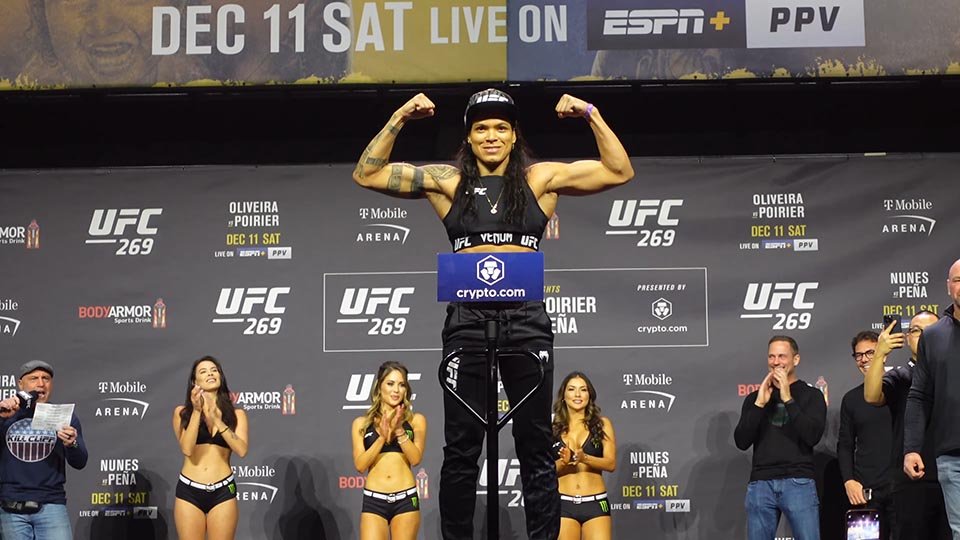
That is the one built for cameras: music, stage lighting, face-offs, staredowns and photographs.
UFC event schedules explicitly distinguish the Official Weigh-Ins from the Ceremonial Weigh-Ins. The UFC 327 Fight Week guide is one clear example, listing the regulatory scale before the separate public ceremony.
By the time an athlete walks onto the ceremonial stage, recovery from the earlier cut may already have started.
That is why the same person can look gaunt in footage from the official scale and noticeably fuller when facing an opponent later that day.
The first appearance determines weight compliance.
The second presents the matchup to the audience.
Confusing those functions obscures one of the most demanding parts of the entire pre-fight cycle.
Making Weight Is a Physiological Process, Not Just a Number
Combat athletes frequently compete below their normal training weight.
To reach the contracted limit, some reduce body mass progressively during camp before accelerating the process as the weigh-in approaches.
Research involving professional MMA fighters has documented methods that include food restriction, fluid restriction, increased exercise, sauna use and other rapid weight-loss strategies. A study of self-reported weight-cutting methods among professional MMA athletes found widespread use of rapid weight reduction before competition.
Another analysis of UFC competitors found average losses approaching 7 percent of body mass within the 72 hours preceding the official scale, followed by substantial regain before competition. The study on UFC weight loss and competition weight illustrates the size of the swing that can occur within a short period.
The final stage is often less about losing fat than temporarily reducing water, intestinal contents and other components of body mass.
Once the official number has been accepted, the objective reverses.
Now the athlete needs fluid.
Electrolytes matter.
Carbohydrate availability matters.
Food tolerance matters.
Sleep matters.
Time matters.
Research measuring dehydration and acute weight gain in MMA fighters found substantial post-weigh-in increases while also identifying dehydration around competition, demonstrating why stepping off the scale does not mean the physiological problem is finished.
The athlete has made weight.
The next task is to become functional again.
Missing Weight Changes More Than the Official Result on the Scale
A failed weigh-in creates several questions at once.
Can the athlete attempt to lose more?
Is another attempt medically acceptable?
Will the opponent agree to continue?
Does the contest move to catchweight?
What happens to the purse?
Does championship eligibility disappear?
There is no single global answer.
Those outcomes depend on the contract, commission and promotion involved.
The Association of Boxing Commissions’ regulatory guidelines provide one framework for professional boxing, including procedures around contracted weight and circumstances in which terms may need to be renegotiated.
MMA also commonly operates with rules distinguishing championship limits from allowances permitted in certain non-title contests, but those provisions must be read through the regulations governing the specific event rather than assumed to apply everywhere.
A fighter who arrives heavy has not merely failed an individual target.
The miss can alter competitive conditions for the opponent, financial terms for both camps and the sanctioned status of the matchup.
The contest has already changed before anyone enters the cage.
ONE Championship Chose a Different Weight-Control Model
Not every organization accepts the conventional cycle of acute dehydration followed by rapid regain.
ONE Championship combines its weigh-in process with hydration testing.
Under the promotion’s published weight and hydration rules, athletes submit a urine sample under medical supervision. ONE uses a refractometer to measure urine specific gravity and identifies a reading of 1.025 or lower as its hydration threshold. Athletes participate in combined hydration testing and weighing before competition.
Official event footage shows the procedure being applied in practice. ONE’s WARRIOR’S CODE weigh-ins and hydration tests in Jakarta showed athletes undergoing the urine test before stepping onto the scale.
The contrast reveals why weight regulation cannot be explained as though every promotion follows the same model.
A UFC athlete competing under an athletic commission’s conventional scale framework faces one set of incentives and procedures.
A ONE athlete has to satisfy an additional hydration requirement.
Both systems are attempting to establish eligibility.
They approach the problem differently.
Fight Night Still Has Its Own Inspection Process
Making weight does not end regulatory oversight.
Hours before the bout, preparation moves into the dressing room, where officials can monitor equipment and hand wrapping.
This is not a cosmetic detail.
What goes underneath a glove directly affects the striking surface.
The Association of Boxing Commissions’ Unified Rules of MMA specify permitted amounts of gauze and tape and require wrapping to take place in the dressing room in the presence of an inspector. ABC guidance also provides for an opponent’s manager or chief second to observe when warranted.
Boxing regulations can impose their own specifications.
California has historically regulated hand-wrap materials and application through Rule 323. Commission material states that wraps are applied under official observation, with protections allowing representatives of the opposing side to watch the process. The California State Athletic Commission’s Rule 323 material sets out that regulatory approach.
Once the wrapping is approved, gloves are fitted and secured under supervision.
Inspection replaces trust.
That distinction became impossible to ignore in one of boxing’s most consequential modern hand-wrap cases.
The Margarito Case Shows Why the Dressing Room Matters
On January 24, 2009, Antonio Margarito was preparing to face Shane Mosley in Los Angeles.
Margarito’s trainer, Javier Capetillo, wrapped his hands while California State Athletic Commission inspectors and members of Mosley’s team observed.
Mosley’s trainer raised concerns about a pre-made knuckle pad.
Inspectors examined it.
They found that the material felt unusually hard.
A similar insert was then discovered after Margarito’s already-wrapped hand was opened.
The pads were confiscated, and the hands were wrapped again with approved material.
The subsequent legal record became far more important than the immediate dressing-room dispute.
In Margarito v. State Athletic Commission, the California Court of Appeal recounted that the commission found the confiscated pads had been adulterated with a white, plaster-like substance. Margarito argued that he had not known what his trainer placed inside the wraps. The commission nevertheless revoked his license, and the court upheld the decision. The published appellate opinion details the inspection, administrative proceedings and reasoning behind the ruling.
The case demonstrates why the opposing corner is allowed to look, why inspectors physically examine wrapping materials and why responsibility does not simply disappear because preparation was delegated to a trainer.
A hand wrap is part of the regulated equipment used to strike another person.
What sits underneath the glove matters.
The Fighter Can Still Be Stopped Before the Walkout
By the final hours, most major conditions have already been satisfied.
The bout exists contractually.
The athlete holds the necessary approval.
Medical documentation has been accepted.
Weight has been addressed.
Any applicable anti-doping obligations remain in order.
Hand wraps and gloves pass inspection.
The referee delivers final instructions.
Yet participation is still not unconditional.
Commission doctors and event physicians retain responsibilities close to competition. A fighter whose physical condition deteriorates after an earlier examination can require reassessment. A new injury, illness or other medical concern may prevent the athlete from proceeding even after every commercial reason to preserve the bout has intensified.
That authority matters because combat sports create an obvious conflict of incentives.
The fighter trained to compete.
The coach wants the camp completed.
The promoter needs the event.
The broadcaster has a schedule.
Ticket buyers expect the matchup.
Medical clearance has to remain capable of overriding all of them.
Otherwise, it is not medical clearance.
The Walkout Means the Fight Survived Everything Before It
The arena lights narrow the story to two people.
The preceding weeks were anything but simple.
A professional bout reaches Fight Night only after separate interests converge: the promoter needs a viable event, athletes must meet contractual obligations, regulators have to accept their eligibility, doctors must consider them fit, weight requirements need to be resolved and technical inspectors must approve the equipment entering competition.
The UFC’s anti-doping structure adds another year-round layer for its roster. Nevada’s medical licensing framework demonstrates how health requirements can extend far beyond a routine physical. ONE Championship’s hydration system shows that even the meaning of “making weight” depends on the organization involved. California’s hand-wrap rules illustrate how regulation continues until minutes before the athlete leaves the dressing room.
The audience experiences that machinery only when something fails.
A bout disappears because of a medical result.
An athlete misses weight.
A drug-testing violation removes someone from competition.
A doctor refuses clearance.
An inspector finds something inside a wrap.
When everything works, almost none of it becomes part of the broadcast.
The fighter simply walks.
That walk is the final result of the pre-fight process.
The opening bell does not begin the machinery surrounding a professional contest.
It means the contest has finally survived it.